
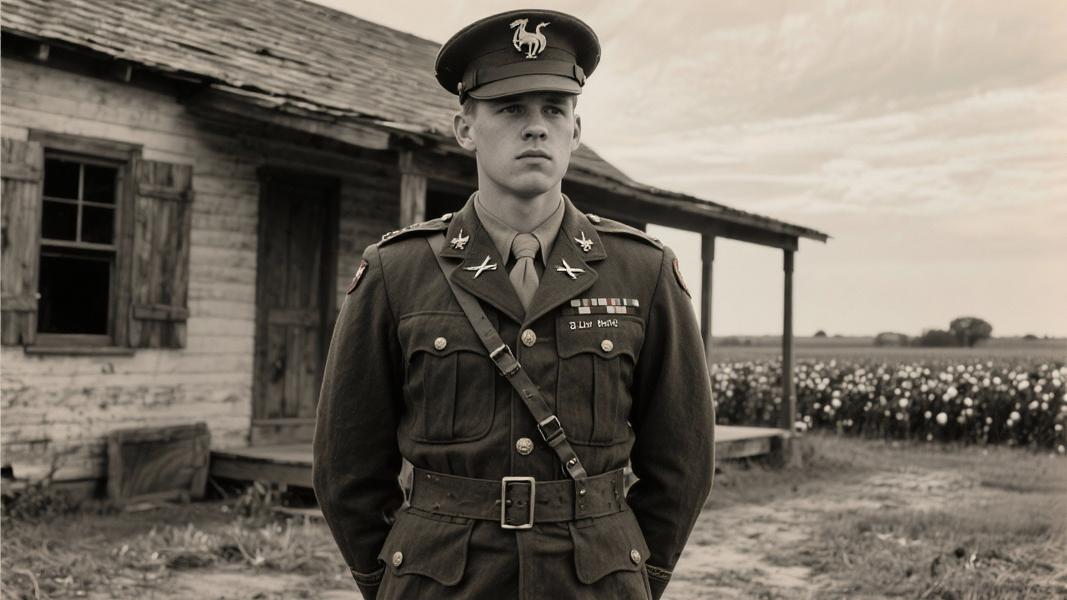
When Ben Fuelberg joined the National Guard in 1934, he couldn’t have predicted that decision would lead him to the jungles of Burma fighting Japanese forces during World War II.
“The National Guard paid for meetings and we had four paid meetings a month, and a summer camp of 15 days, and of course the pay wasn’t very high, but a dollar was worth a lot more in 1934 than it is now,” Fuelberg recalled of his early service days.
From Texas to War
Born in December 1916 in Washington County, Texas, Fuelberg joined Troop E, 124th Cavalry in Brenham, Texas. His unit was called into active duty in November 1940 — more than a year before the Pearl Harbor attack would change everything. “Of course we were called to active duty for one year, which the Congress had extended the call for six months and then Pearl Harbor happened and of course it was obvious we wasn’t gonna get out of the service for some time,” he explained.
Fuelberg, who would eventually rise to the rank of Lieutenant Colonel in the U.S. Army before his death in 2010, was stationed with his unit at Fort Bliss in El Paso when news of Pearl Harbor broke across the nation. The immediate impact was palpable.
“We didn’t have television at that time, the news went out over the radio for all servicemen to return to their post, and the announcement of course was that the Japanese had attacked Pearl Harbor, and of course things changed a whole lot,” Fuelberg remembered. “Everybody that was in the service I’m sure returned to their post. I know I did.”
Gone were the days of casual regulations. Servicemen were no longer permitted to wear civilian clothes, and military discipline tightened immediately as America prepared for war.
Border Duty
Where did Fuelberg find himself in those early days of American involvement? His cavalry unit was deployed to various posts along the Texas-Mexico border.
“My unit had been called to active duty. We were stationed first at Fort Bliss in El Paso and from there we were sent to various posts along the border. My unit, second squadron 124th was stationed at Fort Ringoll, which is an old post up the river from Fort Brown where they camped at Brownsville,” he stated.
The border assignment wouldn’t last. As the war expanded across the Pacific, Fuelberg’s destiny would take him far from the Texas heat to the steamy jungles of northern Burma (now Myanmar).
The Burma Mission
Fuelberg became part of what was known as the Morris Taskforce, a specialized unit with a critical mission in the China-Burma-India Theater. Their objective? To drive Japanese forces away from an airstrip they had occupied and were using to threaten American supply planes flying the perilous route into China.
“I don’t remember exactly when we realized what our mission would be, but it was known that we were gonna be what was called a Morris Taskforce and we were going to go into northern Burma to drive the Japanese away from an airstrip that they had taken over up there,” Fuelberg detailed. “They had brought in some of their zero fighters and they were shooting at our planes, our transport planes that was carrying supplies into China.”
The stakes couldn’t have been higher. The aerial supply route known as “The Hump” — flying over the Himalayan mountains — was the only way to get crucial materials to Chinese forces fighting the Japanese. Without securing this corridor, the entire Allied strategy in Asia could collapse.
“Our mission really was to drive those Japanese, take over that airstrip, and drive the Japanese south so they wouldn’t endanger our air supply system,” he emphasized.
Fuelberg’s journey from the Texas National Guard to the jungles of Burma represents one of countless American stories of adaptation and service during World War II — ordinary citizens thrust into extraordinary circumstances across the globe, fighting in places they’d never imagined visiting before Pearl Harbor changed everything.
