
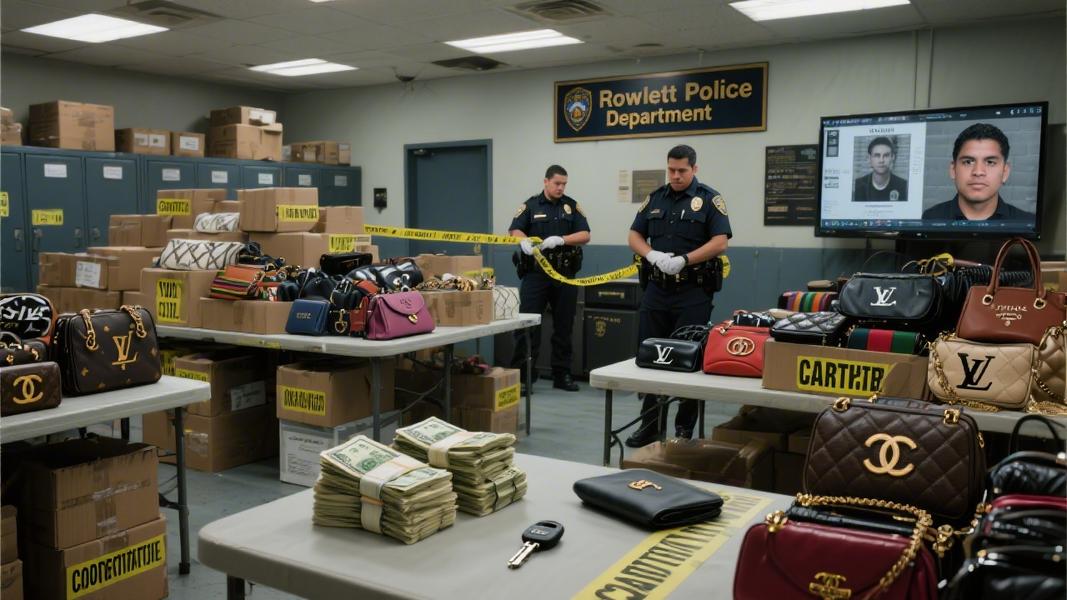
A tip about a Facebook Live sale led Texas police to one of the largest counterfeit luxury goods busts in recent memory — and the numbers are staggering.
The Rowlett Police Department seized more than 62,000 counterfeit luxury items with an estimated authentic retail value of $101 million, following a tip that sellers were hawking the fake goods in real time over Facebook Live. The sheer scale of the operation raises an obvious question: how does a counterfeit ring that size operate in plain sight, broadcasting sales on social media?
A Tip That Paid Off
It started with a tip. Someone flagged the Facebook Live stream to authorities, and Rowlett police moved on it. What they found wasn’t a small-time reseller moving knockoff handbags out of a garage — this was an operation producing or stockpiling tens of thousands of items, all bearing the trademarks of high-end luxury brands. Police have reported the haul as one of the most significant seizures of its kind in the region.
Sixty-two thousand items. That’s not a side hustle. That’s a supply chain.
The $101 Million Question
The $101 million figure refers to what those goods would cost if they were the real thing — authentic designer pieces from brands whose price tags can run from a few hundred to several thousand dollars per item. Counterfeit goods, of course, sell for a fraction of that. But the economic damage to luxury brands — and to consumers who may not always know what they’re buying — is very real. The counterfeit industry costs the global economy hundreds of billions of dollars annually, and law enforcement agencies have increasingly flagged social media platforms as a growing marketplace for fake goods.
Still, it’s one thing to know counterfeit sales happen online. It’s another to watch them unfold live, in real time, on one of the world’s most-used platforms — and that’s exactly what appears to have happened here. Audacy noted the operation’s unusual visibility, underscoring just how brazen these sellers had become.
Social Media’s Counterfeit Problem
Facebook Live, Instagram storefronts, TikTok shops — these platforms have transformed how counterfeit goods reach buyers. It’s fast, it’s visual, and it creates a sense of urgency that mirrors legitimate flash sales. Sellers can move product quickly, collect payment through third-party apps, and disappear before anyone thinks to report them. That someone did report this one is, frankly, the reason this bust happened at all.
That’s the uncomfortable truth buried in this story. A $101 million counterfeit operation didn’t get caught because of sophisticated surveillance or a long-running federal investigation. It got caught because somebody picked up the phone.
What Comes Next
Details on arrests, charges, and the identities of those involved had not been fully disclosed at the time of reporting. Investigations of this scale typically involve coordination with federal agencies and the brand owners themselves, whose legal teams are often aggressive in pursuing counterfeit cases. Luxury houses like Louis Vuitton, Gucci, and Chanel — frequent targets of counterfeiters — have dedicated anti-counterfeiting units and work closely with law enforcement when seizures occur.
For Rowlett, a mid-sized city in the Dallas-Fort Worth metro, the bust is an extraordinary one. It’s a reminder that major criminal operations don’t always unfold in the places you’d expect — and that sometimes, the biggest leads come from the smallest tips.
Sixty-two thousand fake luxury items, $101 million in phantom value, and a Facebook Live stream that someone decided to report. In the end, that’s all it took.
