
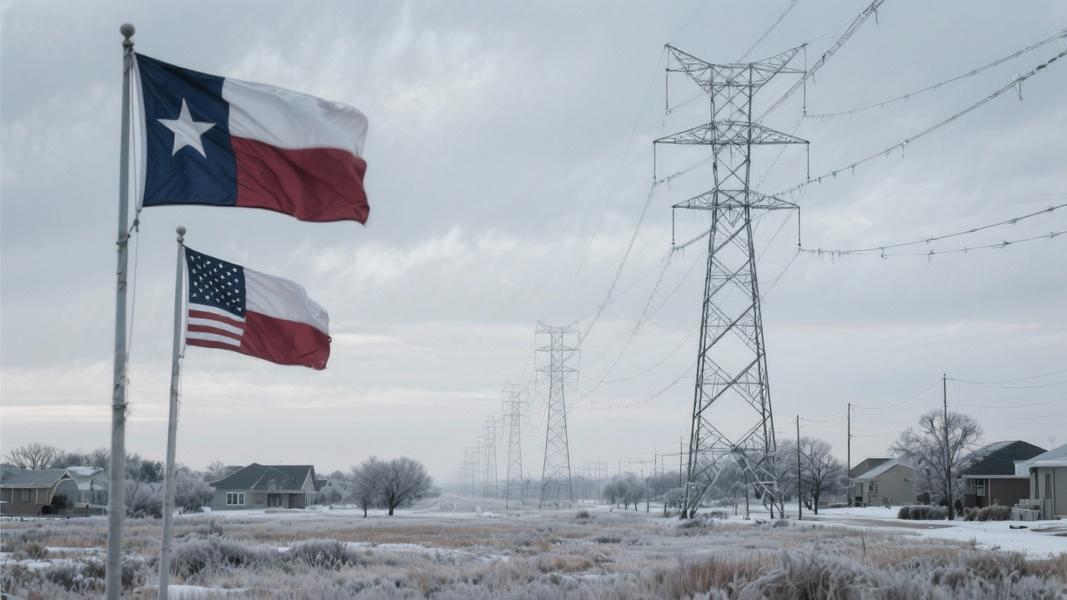
Texas’s power grid is getting a failing grade when it comes to planning for the future, according to a scathing new assessment that places the Lone Star State among the worst in the nation for transmission readiness.
The Electric Reliability Council of Texas (ERCOT) received a dismal D- grade for its transmission planning in 2025, according to a comprehensive evaluation from Grid Strategies and the Americans for a Clean Energy Grid (ACEG). The poor rating comes at a critical time when Texas faces unprecedented power demand growth that’s testing the limits of its isolated grid system.
“Accelerating demand growth is compressing planning timelines and raising the stakes for regions that continue to rely on reactive approaches,” the report states, highlighting a fundamental weakness in how Texas is preparing for its energy future.
An Island of Electricity
ERCOT isn’t just any grid operator — it manages power for roughly 90% of Texas’s electric load through a system that intentionally stands apart from the rest of the country. This isolation, once a point of pride, now appears to be a liability as the grid operator struggles to keep pace with surging demand.
With over 54,000 miles of transmission lines and more than 1,200 generation units under its management, ERCOT faces unique challenges. Unlike other regions that can lean on neighboring systems during crises, Texas largely stands alone, a fact that became painfully apparent during the 2021 winter storm that left millions without power.
The organization’s approach to interregional planning is particularly problematic, according to experts. “Across most regions, interregional coordination relies on reliability-focused studies rather than proactive, scenario-based planning with durable selection and cost-allocation frameworks,” notes the assessment. “As a result, interregional transmission remains one of the weakest elements of the national planning landscape, with planned capacity generally falling short of estimated need.”
Playing Catch-Up
How bad is the situation? ERCOT’s transmission planning appears to be woefully behind the curve of actual demand growth. The grid operator’s Regional Transmission Plan (RTP), which addresses reliability and economic needs for the next six years, is based on forecasts that may already be outdated.
According to documents reviewed for this story, ERCOT’s current transmission plan relies on a 2022 study that projected just 4 gigawatts of load growth from oil and gas operations between 2025 and 2030. In response, the Public Utility Commission of Texas approved a $10 billion plan to construct approximately 1,250 miles of new transmission lines — a significant investment, but potentially insufficient given recent trends.
ERCOT’s own report on existing and potential system constraints, released in December 2025, details the Regional Transmission Plan but doesn’t fully address the accelerating pace of demand growth that has industry observers concerned.
A Framework Without Flexibility
The planning process itself follows guidelines established in ERCOT’s Planning Guide, which outlines major transmission planning activities including the Long-Term System Assessment, Regional Transmission Plan, and Regional Planning Group project reviews. These procedures, while comprehensive on paper, appear to lack the agility needed in today’s rapidly evolving energy landscape.
Critics suggest that ERCOT’s approach remains too reactive rather than proactive. While the organization regularly publishes planning information, including the 2025 constraints report posted last December, the D- grade suggests these efforts fall well short of what’s needed.
That’s particularly concerning given Texas’s booming economy and the explosive growth in power-hungry industries like data centers and cryptocurrency mining operations, which weren’t fully factored into earlier projections.
The Road Ahead
The stakes couldn’t be higher for Texas. Without adequate transmission planning and development, the state faces the prospect of more frequent energy emergencies, higher electricity costs, and potential barriers to economic growth. For a state that prides itself on independence and business-friendly policies, the irony isn’t lost on energy experts.
While the $10 billion transmission expansion represents a step in the right direction, the critical question remains whether it will be enough — and whether it will be completed in time to meet the state’s rapidly growing needs.
As Texas continues to attract new residents and businesses at a breakneck pace, ERCOT’s planning deficiencies could soon move from theoretical concerns to practical problems affecting millions. The D- grade isn’t just an academic assessment — it’s a warning signal that the Lone Star State’s energy independence may come at an increasingly high price.
