
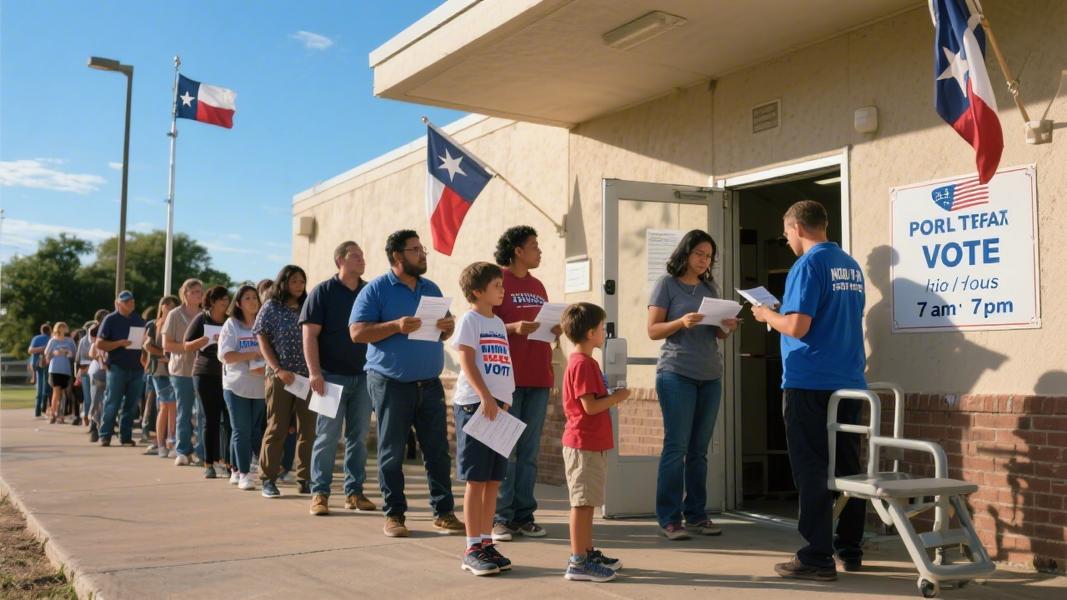
Millions of Texas voters head to the polls on Tuesday, March 3, 2026 — and for many, the primary is where the real decisions get made.
The 2026 Texas Primary Election isn’t just a warm-up act. It’s the contest that shapes who lands on the November ballot for more than a dozen statewide offices, seats in Congress, state legislative chambers, judgeships, and county posts across the state. As FOX 4 noted, “The Texas Primary on Tuesday gives Democrats and Republicans across the state a chance to decide which candidates they want on the November general election ballot.” Polls open statewide at 7 a.m. CT and close at 7 p.m. CT — though if you’re in line before the doors close, you vote. No exceptions.
What’s on the Ballot — and Why It Matters This Cycle
This isn’t a quiet, off-year primary. Newly redrawn congressional district maps mean some voters may find themselves in an entirely different district than they expected — which could shift their polling location and their choices on the ballot. CBS confirmed that voting remains precinct-based in many counties, so checking your specific assignment before Tuesday isn’t optional. It’s essential.
“More than a dozen statewide offices will be decided, along with members of Congress, state lawmakers, judges and county officials,” FOX 4 reported. The breadth of what’s at stake here is easy to underestimate. From the U.S. Senate race to local judgeships that rarely make front pages, this ballot runs deep.
Early voting ran from February 17 through February 27 in participating counties. If you missed it, Tuesday is your shot. Results will be shared by FOX 4 and other outlets after 7 p.m. CT once polls close.
Texas Has Open Primaries — Here’s What That Actually Means
Texas is one of just 15 states with open primaries, which means any registered voter — regardless of party affiliation — can walk in and choose which party’s ballot they want to cast. You don’t register as a Democrat or Republican in Texas. You just pick a lane when you show up. That said, there’s a catch: if no candidate clears 50 percent in their race, the top two advance to a runoff scheduled for May 26, 2026. And if you vote in a runoff, you’re limited to the same party’s ballot you chose in March — or you must not have voted in either party’s primary at all. It’s a nuance that trips people up every cycle.
For comparison, 10 states run closed primaries, locking out voters who aren’t registered with a party. Texas’s system is more permissive — but it still has rules.
Finding Your Polling Place
So where exactly do you vote? That depends on your county — and sometimes, your specific precinct. The Texas Secretary of State’s “Am I Registered?” portal lets voters search by name, birthdate, or address to locate their assigned polling site and pull up a sample ballot. The portal is typically populated two days before Election Day, so don’t panic if it’s blank when you check early in the week. The state’s broader voter resource hub at votetexas.gov also hosts a “My Voter Portal” with the same lookup functionality.
“In most counties, where you vote depends on where you live,” FOX 4 explained. “Visit your county’s election page and search using your name, birthdate, or address to find your specific polling location, along with sample ballots.” Voter registration cards also list your assigned location — if yours is handy, that’s still a reliable starting point, though locations do occasionally change between elections.
Not all counties play by the same rules, though. Some participate in the Countywide Polling Place Program (CWPP) — commonly called “Vote Centers” — which lets residents vote at any polling location in their county on Election Day. Others stick to strict precinct assignments. Here’s how the major North Texas counties break down:
| County | Early Voting | Election Day |
|---|---|---|
| Collin | Any countywide location | Any countywide location |
| Dallas | Any early voting location | Assigned polling place only |
| Denton | Any location countywide | Assigned precinct only |
| Tarrant | Any countywide location | Any countywide location |
Tarrant County voters also have access to a real-time wait-time tool on Election Day — a genuinely useful feature that lets you avoid a long line by checking which vote centers are busy before you leave the house.
FOX 4 compiled direct links for 27 North Texas counties, including Anderson, Bosque, Collin, Cooke, Dallas, Delta, Denton, Ellis, Erath, Fannin, Freestone, Henderson, Hill, Hood, Hopkins, Hunt, Jack, Johnson, Kaufman, Lamar, Navarro, Palo Pinto, Parker, Rains, Red River, Rockwall, Somervell, Tarrant, Van Zandt, and Wise. Collin County voters can find information at collincountytx.gov; Tarrant County residents can visit tarrantcounty.com. For North Richland Hills specifically, example vote centers include City Hall and the local library branch.
Voter ID: What You Need to Bring
Texas has a strict photo ID requirement for in-person voting. There are seven acceptable forms of photo identification, and it’s worth knowing this list cold before you walk in the door. According to state guidelines, those are:
- Texas Driver License issued by the Texas Department of Public Safety (DPS)
- Texas Election Identification Certificate issued by DPS
- Texas Personal Identification Card issued by DPS
- Texas Handgun License issued by DPS
- United States Military Identification Card containing the person’s photograph
- United States Citizenship Certificate containing the person’s photograph
- United States Passport (book or card)
Here’s the age distinction that often gets overlooked: voters between 18 and 69 must present an ID that is either current or expired within the last four years. Voters 70 and older can use an ID of any expiration date. That’s a meaningful carve-out for older Texans.
No photo ID? You’re not automatically turned away. Supporting documents — including a voter registration certificate, utility bill, bank statement, government check, paycheck, birth certificate, or foreign birth document — can be presented alongside a signed declaration. The full FAQ lives at votetexas.gov and is worth bookmarking.
What You Can — and Can’t — Bring Inside
The rules inside a polling place are stricter than some voters realize. No phones, cameras, or recording devices are permitted inside the voting room or within 100 feet of a voting station. You can use your phone outside, but once you’re in that zone, it goes in your pocket — and it stays there.
Political clothing is also off-limits. “No one is allowed to wear clothing or any similar items related to a candidate, measure, or political party, even if they are not on the ballot,” according to state rules. “This is enforceable within 100 feet of a polling station.” That means the campaign T-shirt you wore without thinking, the button on your jacket, the yard sign you accidentally left in your car window — all of it. Cover it or remove it before you cross that line.
Firearms are prohibited at polling places, with one exception: licensed peace officers on duty. Sample ballots and personal notes, however, are welcome — just print them out ahead of time, since you won’t be pulling them up on your phone once you’re inside.
One provision that tends to surprise new voters: children under 18 are explicitly permitted to accompany a parent who is voting. “According to the Texas Election Code, a child under 18 years old can accompany a parent who is voting,” FOX 4 stated. So you don’t need a babysitter to cast your ballot.
If something goes wrong at your polling place — intimidation, equipment failure, a poll worker who won’t follow the rules — report it. The state’s voter assistance hotline is 1-800-252-VOTE (8683). You can also reach the Secretary of State’s office at [email protected] or file a formal complaint at sos.texas.gov.
Runoffs, Mail Ballots, and What Comes Next
If any race fails to produce a candidate with a majority — more than 50 percent of the vote — the top two finishers advance to a runoff on May 26, 2026. In competitive primaries with crowded fields, that’s not an unusual outcome. Watch the returns closely on Tuesday night.
Voters who prefer not to vote in person can request a mail ballot through their county elections office. Eligibility rules apply, and deadlines vary by county, so check early rather than late.
FOX 4 is also tracking key statewide races — including the U.S. Senate contests on both sides, along with updated congressional maps reflecting newly drawn district lines. Those resources are available at fox4news.com for voters who want to dig into the specifics before Tuesday.
Oh, and the sticker selfie after you vote? Fully encouraged. That part, at least, has no rules.
Democracy in Texas runs on the choices made in primaries like this one — and in a state this large, with this many offices on the line, the voters who show up on March 3 will have an outsized say in what November looks like. The polls close at 7 p.m. But the decisions made inside those booths will echo a lot longer than that.
