
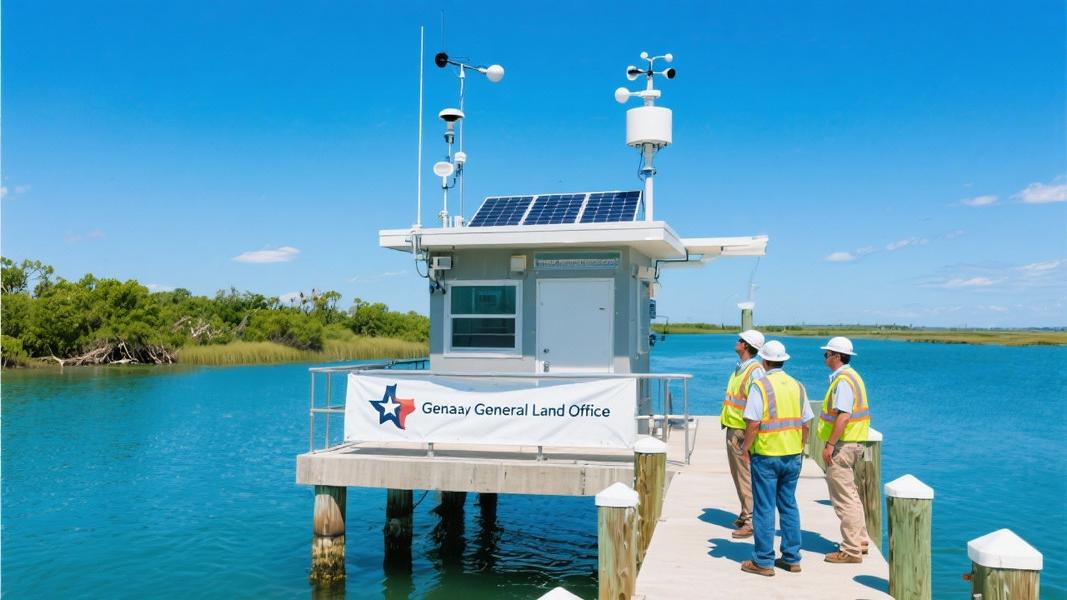
Critical coastal monitoring equipment damaged by Hurricane Harvey has been restored along the Texas coast, marking a significant step in the state’s ongoing efforts to protect its shorelines and maritime industries.
Texas Land Commissioner Dawn Buckingham announced this week that TCOON Station #8774513 in Copano Bay has been successfully rebuilt after suffering extensive damage during Hurricane Harvey in 2017. The station, part of the Texas Coastal Ocean Observation Network (TCOON), provides real-time data on water levels, currents, and other environmental factors crucial for emergency management and coastal planning.
Rebuilding After the Storm
“I am proud of the work that has been done to get this crucial TCOON system back up and running in Copano Bay following the damage caused by Hurricane Harvey,” said Commissioner Buckingham in a statement from her office. The rebuilding effort represents a significant investment by the Texas General Land Office (GLO) in maintaining the state’s coastal monitoring capabilities.
The Copano Bay station, originally established in January 2004, is one of 28 monitoring stations operated by TCOON along the Texas Gulf Coast. These stations collect data on everything from water levels and currents to salinity, temperature, and wind conditions — information that’s vital during emergencies and for long-term coastal management.
Why does this matter to everyday Texans? During storms and other coastal emergencies, these stations provide the real-time information that emergency managers need to make life-saving decisions about evacuations, flood warnings, and resource deployment.
A Network Built on Partnerships
TCOON isn’t exactly a household name, but it’s been silently watching over Texas coasts since 1989. The network was formally recognized by the Texas Legislature in 1991, establishing it as an official entity “to facilitate the collection of environmental data for the purposes of studying, planning for, and managing human uses of the Texas Coast.”
The system operates through a partnership among several agencies, including the Texas General Land Office, NOAA, the U.S. Army Corps of Engineers, Texas Water Development Board, and the Conrad Blucher Institute at Texas A&M University–Corpus Christi.
“The importance of the TCOON system cannot be overstated as it provides coastal data for the Texas coast, allowing us to see real-time data on various environmental parameters, including during emergencies when quick responses can save lives,” the GLO emphasized in their announcement.
The network’s data supports a wide range of users beyond emergency management — maritime industries rely on it for navigation, researchers use it to study coastal changes, and port authorities depend on it for operational decisions.
Making History at the Land Office
The station’s rebuild comes under the watch of Dr. Dawn Buckingham, who made Texas history in 2022 by becoming the state’s first female Land Commissioner. Since taking office, Buckingham has focused on several priorities including disaster aid, energy support, education, veteran services, and border security.
The Copano Bay station can be found on nautical charts as Station #8774513, and its restoration represents just one piece of the GLO’s broader commitment to coastal protection. TCOON stations continuously monitor water levels, providing data that helps establish tidal datums and track long-term sea level changes — increasingly important as coastal communities face rising seas and more frequent storms.
For coastal residents and businesses who’ve weathered hurricanes like Harvey, Ike, and others, the restoration of this monitoring infrastructure may seem like a small step. But in the complex world of coastal management and disaster response, these silent sentinels provide the data backbone that supports virtually every decision made when storms threaten Texas shores.
As climate change continues to influence coastal weather patterns and sea levels, the information gathered by stations like the one in Copano Bay will only grow more vital to Texas’ future — a future that depends on knowing exactly what’s happening along its 367 miles of coastline, minute by minute, day by day.
