
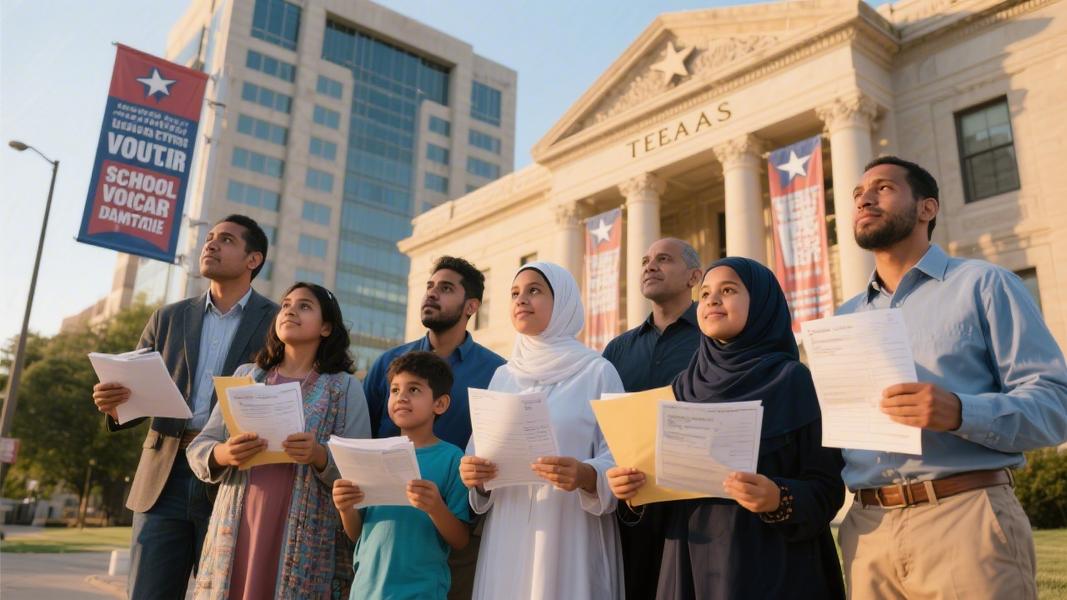
A Texas school voucher program already drawing record interest just got a little more complicated — and a federal court is now involved.
A federal judge has extended the application deadline for Texas’s Taxpayer-Funded Education Allowance (TEFA) program to March 31, following a pair of lawsuits challenging the state’s exclusion of Islamic schools from the program. The legal fight has thrust one of the country’s largest new school choice initiatives into a heated constitutional debate over religious discrimination — one that could reshape who benefits from the billions of dollars Texas is preparing to hand out in private school subsidies.
What Is TEFA, and Why Does It Matter?
Launched under Governor Greg Abbott and backed by the Texas Legislature, TEFA is one of the most ambitious school voucher programs in American history. The program allows families to use public funds — up to several thousand dollars per child — to pay for private school tuition and related educational expenses. By early March 2026, more than 160,000 applicants had already submitted materials, signaling enormous demand from Texas families eager to explore alternatives to traditional public schools.
The sheer scale of interest is hard to overstate. Texas is a big state with a lot of families, and a lot of frustration with the public school system — so the numbers aren’t surprising. What is surprising, to some, is how quickly the program ran into legal trouble.
The Lawsuit at the Center of It All
At issue is whether Islamic schools were unlawfully excluded from TEFA’s list of eligible private institutions. Plaintiffs argue the exclusion amounts to religious discrimination — a violation of the First and Fourteenth Amendments. The lawsuits, backed in part by the Council on American-Islamic Relations (CAIR), contend that the state applied a different and more burdensome standard to Muslim-affiliated schools than to schools affiliated with Christianity, Judaism, or other faiths.
That’s a serious allegation. And a federal judge apparently found it serious enough to intervene — ordering the deadline extended to give the court time to assess the merits of the challenge before the program’s application window closes for good.
Texas Attorney General Ken Paxton has pushed back hard. His office has argued that certain Islamic schools were excluded not because of their religious identity, but because of alleged ties to organizations that have been designated — or considered for designation — as terrorist groups by the federal government. It’s a legally and politically charged framing, and one that CAIR has forcefully rejected, calling the characterization both inaccurate and discriminatory.
A Constitutional Fault Line
Here’s where it gets genuinely complicated. The U.S. Supreme Court has, in recent years, moved steadily toward requiring that religious institutions be treated equally when states offer public benefits — see Espinoza v. Montana Department of Revenue (2020) and Carson v. Makin (2022). Under that legal framework, excluding religious schools from a generally available program is increasingly difficult to justify on constitutional grounds.
Still, Paxton’s office is betting that a national security rationale — rather than a purely religious one — gives the state enough legal cover to defend the exclusions. Whether that argument holds up in federal court is another question entirely. Legal observers note that courts tend to scrutinize such justifications closely when they fall along religious or ethnic lines, particularly when the targeted group is a religious minority.
CAIR, for its part, has been unequivocal. In public statements, the organization has framed the exclusion as Islamophobia dressed up in bureaucratic language — and argued that Muslim families in Texas deserve the same access to voucher dollars as everyone else.
The Deadline Extension and What Comes Next
The court’s decision to push the deadline to March 31 is, at minimum, a signal that the judge didn’t see the lawsuits as frivolous. It buys time — for the plaintiffs, for the court, and potentially for thousands of Muslim families in Texas who applied to TEFA hoping to send their children to Islamic schools, only to find those schools weren’t on the approved list.
What happens after March 31 is harder to predict. If the court sides with the plaintiffs, Texas could be forced to expand its list of eligible institutions — potentially mid-program, which would create significant administrative headaches for the state agency overseeing TEFA. If the state prevails, the exclusions stand, and Muslim families are left with fewer options than their neighbors.
Either way, this case is almost certainly headed somewhere higher than a federal district court. Both sides have too much at stake — politically, legally, and financially — to let it rest at the trial level.
A Bigger Story About School Choice
Zoom out a little, and this lawsuit tells you something important about where the school voucher movement is right now in America. Voucher programs have long been championed as tools of parental freedom and educational equity — ways to give low-income and working-class families the same choices that wealthier families have always had. But when those programs are designed in ways that exclude specific religious communities, the equity argument starts to buckle.
Texas’s TEFA program drew more than 160,000 applicants in its first weeks. That’s a lot of families who believe in what the program is supposed to offer. The question now is whether the state built that program in a way that actually delivers on its promises — for all Texas families, not just some of them.
As one legal scholar might put it: you can’t build a program on the promise of religious freedom and then quietly decide which religions qualify.
