
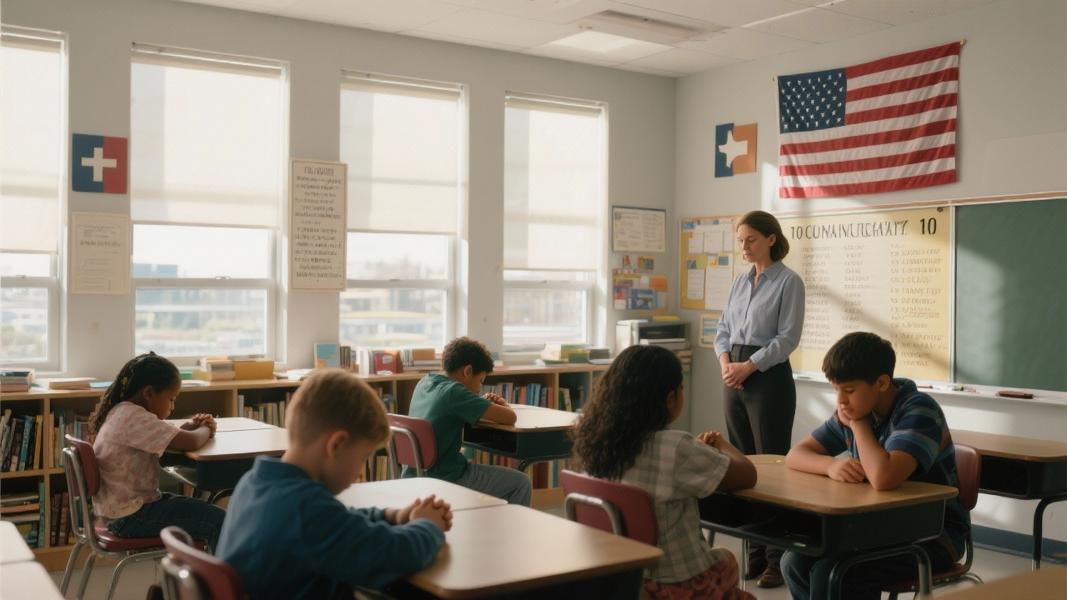
Texas Attorney General Ken Paxton is urging schools across the state to implement dedicated prayer time and scripture reading following a controversial new law set to take effect next fall, putting the Lone Star State at the center of an intensifying national debate over religion in public education.
In a statement that left little doubt about his vision for Texas classrooms, Paxton declared: “In Texas classrooms, we want the Word of God opened, the Ten Commandments displayed, and prayers lifted up.” He specifically recommended the Lord’s Prayer for students, while lambasting what he called “twisted, radical liberals” attempting to “erode the moral fabric of our society.”
Senate Bill 11: What It Does
The new measure, Senate Bill 11, will officially take effect September 1, 2025. It allows — but doesn’t mandate — public schools to establish time for voluntary prayer and religious text reading during the school day. Lt. Governor Dan Patrick celebrated the bill’s bipartisan passage, emphasizing that it “requires consent of students and educators to participate” and prohibits prayer time from interfering with instructional time.
Within six months of the law going into effect, every school district in Texas must hold a vote on whether to adopt such a policy. Even if a district votes against it, individual students with parental consent can still participate in prayer or scripture study. The Texas Tribune noted that the legislation specifically prohibits “any prayer or religious reading over a loudspeaker, or in the presence of any student who does not have a consent form signed.”
Schools implementing the policy must obtain signed consent forms from students, employees, or their guardians to participate. According to policy analysts, these forms include waivers of legal claims against such policies — a detail that has raised eyebrows among civil liberties advocates.
Pushback and Constitutional Questions
Is this all perfectly legal? That’s the question many are asking. The ACLU of Texas has come out strongly against the legislation, arguing it violates the First Amendment’s Establishment Clause. In a sharply worded statement, the organization warned SB 11 “could lead to religious coercion or exclusion by pressuring students to participate in religious activities they may not believe in, just to avoid being left out or bullied.”
“Promoting religious practice in public schools is a blatant violation of the First Amendment and an abuse of government power,” the ACLU declared, adding that “Texas public schools should be places where all students — regardless of faith or background — can learn, grow, and thrive.”
The measure arrives amid broader national tensions over the role of religion in public life, with several Supreme Court decisions in recent years expanding religious expression in public settings.
Mixed Community Reactions
On the ground, Texans appear divided. “When it comes to religion and government, when it comes to religion and laws, there should not be any. Religion should not be a part of how we are governed,” Willie Brown told local media outlets in El Paso.
But others see value in the measure. “So if the student gets busy on the school to learn something like the Bible or any other things under the school, it’s good. It’s good for them,” countered Juana Delgado, also speaking to reporters.
State Representative Vince Perez of El Paso offered perhaps the most pointed criticism: “My big problem with this is again, we’re seeing government just being very intrusive in the everyday private lives of citizens. Whether that becomes to our religious liberties and individual freedoms when it comes to our freedom of religion or whether that becomes to individual healthcare decisions for women. This is the biggest that we’ve ever seen government get here in Texas.”
School districts now face a six-month window after the law takes effect to hold formal votes on prayer period policies. Meanwhile, both supporters and critics are watching closely to see how implementation unfolds in a state where the intersection of religion, education, and government has rarely been more contentious — or consequential.
