
The stories veterans carry home from war don’t always make it into history books. Texas is trying to change that — and now, those stories have a bigger stage.
Texas Land Commissioner and Veterans Land Board Chairwoman Dawn Buckingham announced this week that the VLB Voices of Veterans Oral History Program has been formally integrated into the Texas Oral History Locator Database (TOLD) at Baylor University, a statewide archive established in 2022. The move broadens access to one of the most quietly significant preservation efforts in the state — a program that has, over its lifetime, captured more than 500 firsthand accounts from Texas veterans.
A First of Its Kind
What makes the Voices of Veterans program notable isn’t just its scope. It’s what it represents structurally. The program is recognized as the first time a state agency has ventured into the field of veterans’ oral histories — a distinction that carries real weight in preservation circles. Oral histories are fragile things. They exist only as long as the people who hold them do, and the window to capture them narrows every year.
The program records those histories and archives the transcripts in the Office of Veterans Records at the General Land Office, where they sit alongside documents belonging to some of the most storied names in Texas history — Sam Houston, Davy Crockett, Jim Bowie, and William Barret Travis. That’s not a small thing. These veterans’ accounts are being preserved in the same institutional breath as the founders of the state itself.
“Preserving the stories of our courageous Veterans is a responsibility I take seriously as VLB Chairwoman,” Buckingham said, “and it is an immense honor for our Voices of Veterans Oral History program to be included in the Texas Oral History Locator Database.”
One Soldier’s Story
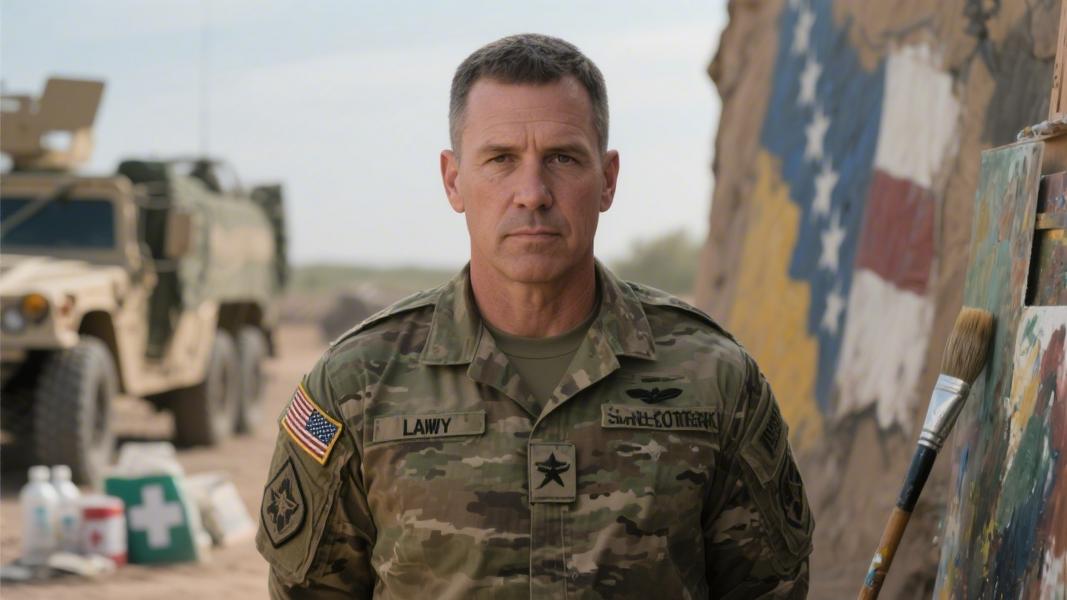
To understand what the program actually captures, consider the story of SFC Larry Scott Teakell. Born in Texas City in 1969, he attended Waco High School and earned a degree in Commercial Art and Advertising — not exactly the profile of someone destined for combat medicine. But life, as it tends to do, had other plans.
“I had a daughter and an ex-wife already in 1994,” Teakell recalled. “I was struggling to pay bills and thought I would join the military for four years… get out at four years and go back to college and get my bachelor’s degree and whatever. So, I joined the Army as a medic.” Simple enough calculus. It rarely stays that way.
He entered the Army in January 1995, reporting to basic training at Fort Leonard Wood, Missouri. And here’s a detail that’s easy to love: because Teakell had earned the Arrow of Light as a Boy Scout — the highest achievement in Cub Scouts — he was elevated to Private First Class immediately, jumping three ranks before he’d fired a single round in uniform.
After eight weeks at Fort Leonard Wood, he was sent to Fort Sam Houston, where he earned his EMT certification and learned, in his words, “about combat trauma and combat medicine.” His first duty station was in Germany. His first real test came in Bosnia, in 1997.
“We were on an Observation Point between the Muslim sector and the Serbian villages to keep the peace,” Teakell said, describing the moment a wounded Muslim man came running toward his position to escape Serbian forces. “He runs up to us, he’s bleeding… he had a corner piece of brick stuck in the back of his skull and his face was all cut up and his neck was all cut up.” Teakell treated him. That was his first medical trauma induction — not a simulation, not a drill.
From Germany to Iraq
After eight months in Bosnia, Teakell returned to Germany for three more years, pursued his LPN license, and was eventually assigned to Fort Lewis, Washington, where he joined the 123rd Infantry Tomahawks. The destination that followed needs no dramatic buildup.
“We trained and trained and trained and then Iraq happened,” he said. Deployed in 2003 with the Stryker Brigade, the unit hit the ground and, almost immediately, lost three soldiers. Just like that. The clinical distance of oral history can’t fully absorb what that sentence means, but it tries.
Still, Teakell’s driving motivation throughout his career remained the same. “I wanted to treat the trauma, stabilize the patient in combat and they live because you saved their lives.” That’s the whole job, distilled.
How to Participate
The program’s archive now holds over 500 stories, accessible to researchers, historians, genealogists, and anyone curious enough to look. The integration into Baylor’s TOLD database means those accounts are now woven into a broader statewide oral history infrastructure — harder to lose, easier to find.
Texas veterans who want to add their own story to the record can reach the program directly by email at [email protected]. The one requirement: veterans must be a resident of Texas at the time of their interview. That’s it. The bar to entry is low. The permanence of what gets recorded is not.
There are more than 1.5 million veterans living in Texas today. Five hundred stories is a start — but it’s also a reminder of just how much is still waiting to be told before it isn’t.
