
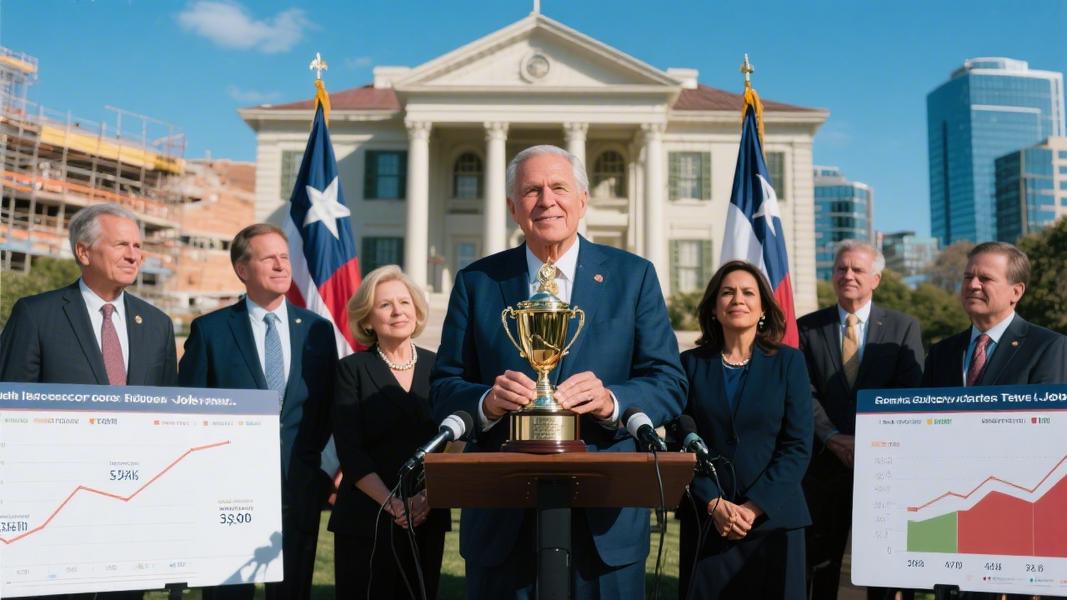
Texas doesn’t do modesty well. Then again, when you’ve just lapped the entire country in corporate investment for the 14th consecutive year, maybe you’ve earned the right to brag.
Gov. Greg Abbott announced this week that Texas has once again claimed Site Selection magazine’s Governor’s Cup, the annual award recognizing the state with the highest number of major corporate relocation and expansion projects in the United States. It’s the latest chapter in what is becoming one of the more lopsided streaks in American economic history — and the numbers behind this year’s win are, by any measure, staggering.
A Record That Rewrote the Record Book
Texas logged more than 1,400 qualifying projects in 2025 — nearly double the 680 posted by second-place Illinois. Those projects represent over $75 billion in capital investment and more than 42,000 new jobs, accounting for roughly 18 percent of all qualifying projects across the entire country. Abbott, never one to undersell a moment, put it simply: “There is no state that is better-designed or better-positioned economically now and going forward.”
Site Selection Executive Vice President Ron Starner went further. “It is time to start talking about the State of Texas as a dynasty in economic development,” he declared. Abbott echoed the sentiment with a line that could double as a campaign slogan: “Texas did not just win the Governor’s Cup this time, it obliterated the record book.”
Texas has now won the Governor’s Cup 22 times overall since the award’s inception, with the current streak dating back to 2012. Fourteen years. That’s longer than most professional sports dynasties last, and considerably more profitable.
What the Award Actually Measures
That’s the catch, though. The Governor’s Cup counts project volume — not per-capita investment, not average wages, not long-term economic outcomes. To qualify, a project needs to clear at least one of three relatively modest thresholds: $1 million in investment, 20 new jobs, or 20,000 square feet of new space. It’s a broad net, and Texas — with its sheer geographic and demographic mass — is built to fill it.
When adjusted for population, the picture shifts. Texas actually ranked fourth nationally in per-capita project counts, trailing North Dakota, Illinois, and Kansas. Smaller states, it turns out, can punch above their weight when the denominator is a fraction of Texas’s 30-million-plus residents. Still, raw volume has its own logic — and for businesses, suppliers, and infrastructure planners, concentrated activity in a single market matters enormously.
Jobs Numbers Add Another Layer
Beyond the Governor’s Cup, Texas added 132,500 nonfarm jobs in 2025 — the most of any state in the nation — while its labor force hit a record 15,283,600 workers, outpacing national employment growth by a significant margin. Those aren’t just talking points. They reflect a labor market that, whatever its critics say, keeps pulling people and companies in from across the country and around the world.
But it’s not that simple. Texas’s model — low taxes, light regulation, abundant land — attracts volume. Whether those 42,000 new jobs are high-wage, whether the communities hosting those 1,400-plus projects see broadly shared prosperity, whether the infrastructure can keep pace: those are questions the Governor’s Cup doesn’t answer.
A Dynasty, For Now
Dynasties, of course, have a way of eventually ending. The conditions that built Texas’s streak — a booming Sun Belt migration, favorable tax policy, and years of pent-up corporate mobility accelerated by the pandemic — aren’t guaranteed to hold forever. Competing states are watching, adapting, and spending.
For now, though, the trophy goes back to Austin for the 14th straight time. And if Ron Starner’s instinct is right — that this is a dynasty, not just a hot streak — then the rest of the country may be waiting a good while longer before it changes hands.
