
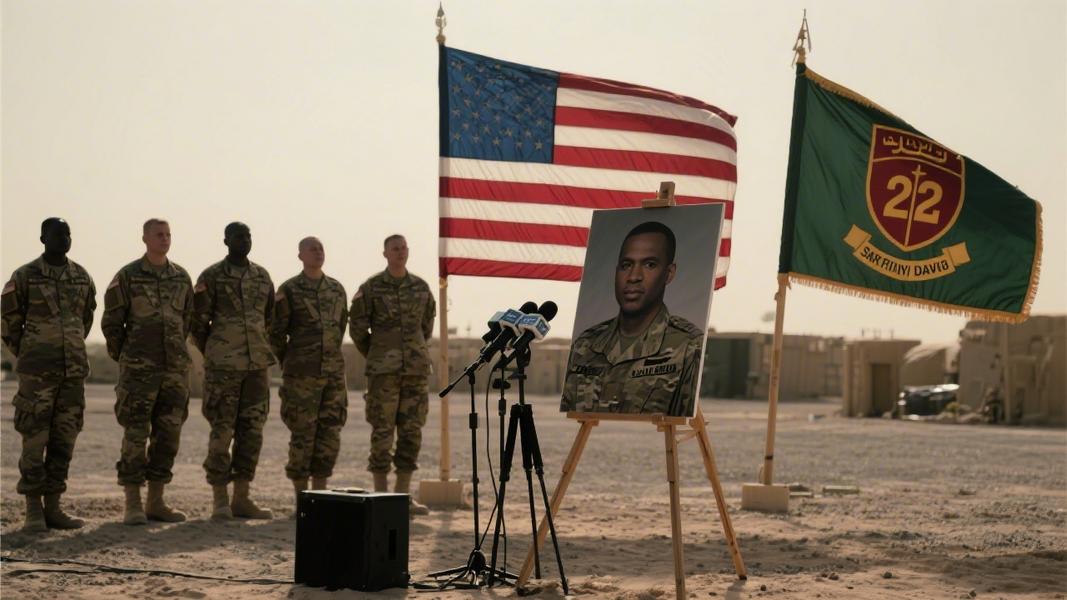
They don’t always die from enemy fire. Sometimes it’s an IED on a dusty Iraqi road, a gunshot in a border town, or something quieter — something still under investigation in a Kuwaiti military camp. The cost of service, it turns out, doesn’t always look the way we expect it to.
The U.S. military and National Guard units across the country continue to absorb losses both in active combat zones and in domestic and support operations — deaths that, taken together, sketch a portrait of modern military service that’s far more complicated than any recruitment poster suggests. From the deserts of the Middle East to the banks of the Rio Grande, American soldiers are dying. And the circumstances aren’t always clean.
A Soldier Lost in Kuwait
The Department of Defense identified Maj. Sorffly Davius, 46, of Cambria Heights, Queens, New York, as having died on March 6, 2026, at Camp Buehring, Kuwait. The cause was listed as a non-combat related incident while supporting Operation Spartan Shield — the long-running U.S. force presence mission in Kuwait. He was assigned to the Headquarters, Headquarters Battalion, 42nd Infantry Division out of Troy, New York. The incident remains under investigation.
That phrase — “non-combat related” — tends to swallow a lot. It can mean an accident, a medical emergency, or something harder to talk about. The Army hasn’t said more, and for now, a family in Queens is left waiting for answers that investigations take weeks, sometimes months, to provide.
The Border’s Quiet Toll
How bad does it have to get before someone calls it a crisis? In October 2022, the Texas National Guard lost a service member during Operation Lone Star — Governor Abbott’s controversial border security mission — to a self-inflicted gunshot wound in Eagle Pass. It wasn’t the first.
Maj. Gen. Thomas Suelzer, the department’s senior leader, released a statement saying, “We are deeply saddened to have lost one of our own today. We extend our deepest condolences to the family.” Governor Greg Abbott followed, saying “Cecilia and I are deeply saddened to hear of the tragic loss of a soldier with the Texas National Guard. Our hearts go out to the family and loved ones of the soldier.” Prayers were requested. Answers, less so.
State Rep. Eddie Morales, whose district includes Eagle Pass, didn’t mince words. “Hearing the news of another Guardsman committing suicide while on deployment here in Eagle Pass is heartbreaking,” he said. “This has been a reoccurring instance and the Texas Legislature and state leadership need to address it immediately.” The word another is doing a lot of heavy lifting in that sentence. Critics of Operation Lone Star have long argued that the mission — which places Guard troops in prolonged, ambiguous deployment conditions with limited mental health infrastructure — creates exactly the kind of environment where soldiers can fracture quietly, far from the battlefield and far from help.
From Iraq to Memphis
Still, it’s not only suicide or non-combat incidents that claim lives. During an Iraq deployment, National Guard soldier Terrance Lee was killed instantly when an IED blast crushed his skull and tore off one leg — a death as violent and final as anything a conventional unit might face, documented by the National Guard Association as part of a broader accounting of Guard members who faced lethal danger daily and didn’t flinch.
Closer to home, a man died in the Frayser neighborhood of Memphis during a car chase involving officers from the Memphis Safe Task Force — a joint operation that included National Guard and federal forces. The details remain sparse, but the incident underscores a broader pattern of Guard units being deployed in domestic law enforcement roles where the rules of engagement, accountability structures, and outcomes can get murky fast.
A Longer History
None of this exists in a vacuum. The National Guard and U.S. Army have a history of being asked to do more than they were originally designed for — and of paying for it in ways that don’t always make the front page. Benjamin Oliver Davis Sr., born in 1877 and promoted in 1940 as the first African American general officer in U.S. Army history, spent decades navigating an institution that deployed him to every corner of its needs while denying him basic dignities at home. The Army has always extracted what it needs from those willing to serve. That part hasn’t changed much.
That’s the catch, isn’t it — the institution is good at honoring sacrifice in retrospect. Flags folded, statements released, investigations opened. What’s harder, and rarer, is the kind of structural reckoning that might prevent the next loss before it happens. Whether it’s a major dying in Kuwait under unexplained circumstances, a Guardsman breaking under the psychological strain of an indefinite border mission, or a soldier vaporized by a roadside bomb in Anbar Province, the throughline is the same: someone’s family is waiting, and the machinery of military service moves on.
Maj. Sorffly Davius was 46 years old. He was from Queens. He didn’t come home, and right now, nobody’s saying exactly why.
