
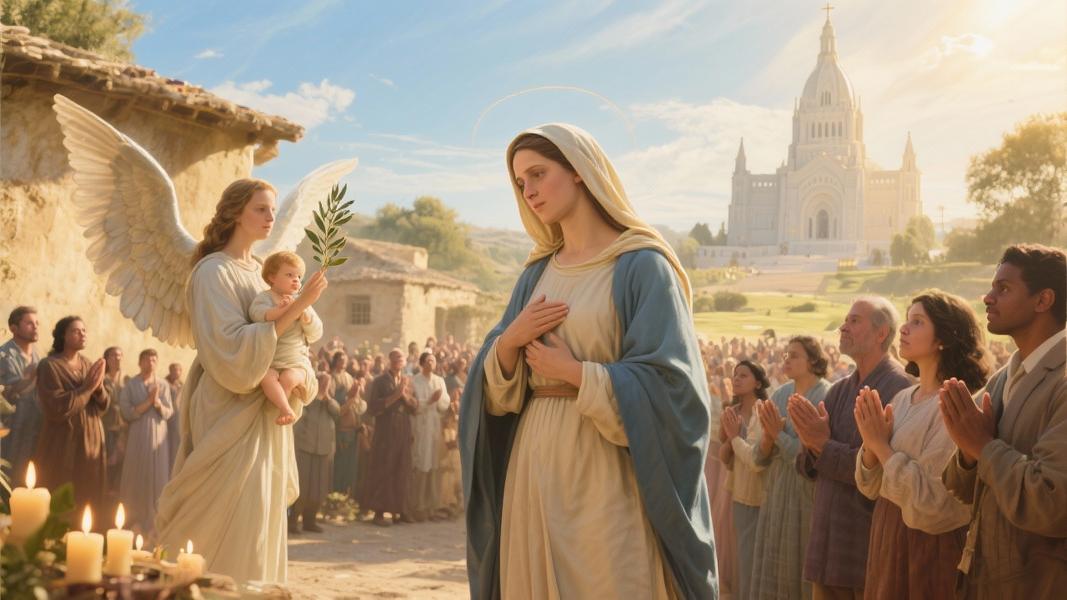
It was a moment that would forever change Catholic doctrine. On December 8, 1854, surrounded by cardinals and bishops in Rome, Pope Pius IX made a declaration that formalized centuries of belief: Mary, the mother of Jesus, had been conceived without original sin.
The proclamation of the Immaculate Conception as official Catholic dogma represented the culmination of theological development that had been brewing for centuries. Through his papal bull “Ineffabilis Deus,” Pius IX declared that the doctrine “was revealed by God and hence was to be firmly believed as such by all Catholics.”
A Dogma Centuries in the Making
What exactly does the Immaculate Conception mean? The doctrine specifically states that “from the first moment of her conception, the Blessed Virgin Mary was, by the singular grace and privilege of Almighty God, and in view of the merits of Jesus Christ, Savior of Mankind, kept free from all stain of original sin,” according to Marywood University’s religious archives.
This wasn’t a new idea in 1854. Church discussions about Mary’s sinlessness stretch back to early Christianity, but debate centered on a crucial distinction: Was Mary cleansed of original sin after conception, or was she completely preserved from it from the very beginning? The latter view eventually prevailed in Catholic thought, heavily influenced by the teachings of Duns Scotus, who explained Mary’s Immaculate Conception as God’s preemptive application of Christ’s saving grace.
“The Blessed Virgin Mary, in the first instant of her conception, by a singular grace and privilege of Almighty God, and in view of the foreseen merits of Jesus Christ, the savior of the human race, was preserved free from all stain of original sin,” Pius IX proclaimed, establishing what Catholics must “firmly and constantly” believe.
A Gradual Path to Dogma
The Council of Basel (1431-49) had previously taken up the matter. Bishops there had stated that Mary “through the workings of a singular preventive grace was never subject to original sin and always immune from original and actual sin.” The Council went further, declaring “that from now on no one should be allowed to preach or teach the contrary.”
But those declarations weren’t binding. It wasn’t until Pope Sixtus IV later approved local celebration of the feast that official recognition began to take shape. Still, full dogmatic definition would wait another four centuries.
Why did Pius IX finally make the proclamation in 1854? The timing wasn’t coincidental. The pope, who ruled from 1846 to 1878, faced increasing challenges to papal authority in a rapidly changing Europe. The dogmatic declaration served to reinforce both Marian devotion and papal spiritual authority during tumultuous times.
Following the proclamation, Pius IX didn’t stop there. On Christmas Day 1863, he mandated a new liturgical Office for the feast, abolishing all other versions previously in use throughout the Church, further cementing the doctrine’s place in Catholic practice.
Theological Significance and Controversy
On each December 8th, Catholics worldwide celebrate what they believe to be Mary’s freedom from original sin as the mother of God. The Feast of the Immaculate Conception has become one of the most important Marian celebrations in the liturgical calendar.
Critics, particularly from Protestant denominations, sometimes claim the dogma was simply “invented” in 1854. This fundamentally misunderstands Catholic teaching on doctrinal development, according to Catholic theologians who argue that formal proclamations confirm longstanding beliefs rather than create new ones.
The doctrine itself represents a profound theological concept: that God, knowing Mary would bear Christ, applied the saving grace of Jesus to his mother in advance. This paradoxical idea — that Mary needed Christ’s salvation before Christ was born — showcases the complex theological reasoning that underpins the dogma.
Nearly 170 years after Pius IX’s proclamation, the Immaculate Conception remains a distinctive element of Catholic identity and a testament to how religious doctrine can evolve over centuries before being formally defined in a single, historic moment.
