
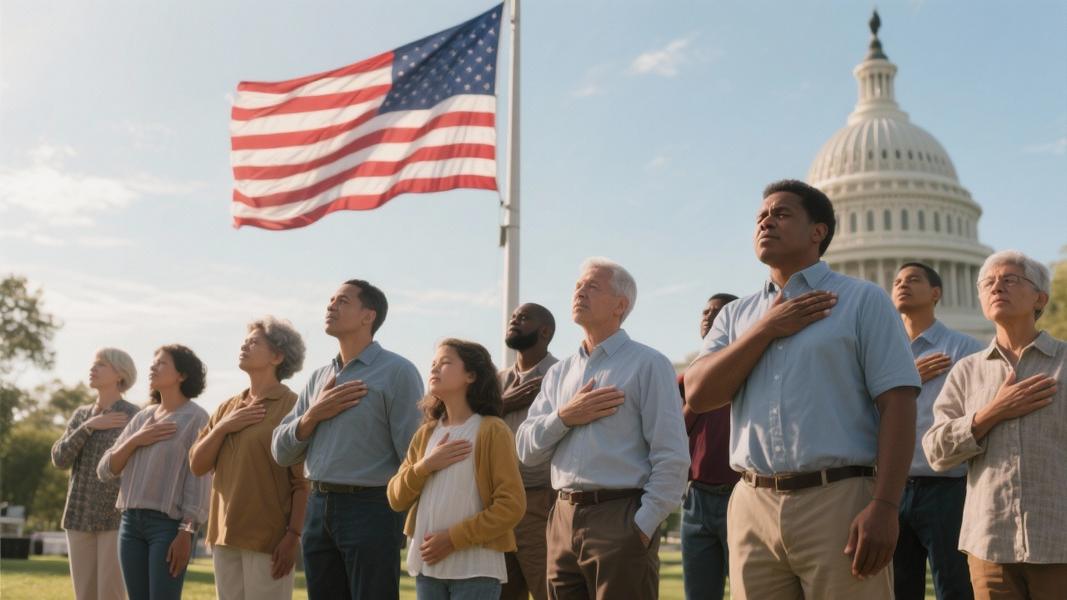
The iconic Pledge of Allegiance, a daily ritual for millions of American schoolchildren, turns out to have begun as something far more calculated: a marketing campaign tied to the 400th anniversary of Columbus’s arrival in the New World.
Long before it became a lightning rod for patriotic debate, the Pledge was crafted by Francis Bellamy in 1892, a former Baptist minister who created the 23-word statement as part of Columbus Day commemorations. Bellamy wasn’t just a random patriot with a flair for words — he served as chairman of a committee of state education superintendents within the National Education Association, giving him significant influence over what would become a national tradition, according to Washington state records.
A Mass Recitation
President Benjamin Harrison officially sanctioned the Pledge’s first use during Columbus Day observances on October 12, 1892, though the mass recitation would come days later. On October 21, an estimated 10 million schoolchildren across America simultaneously participated in the first nationwide recitation of what was then a much shorter pledge: “I pledge allegiance to my Flag and to the Republic for which it stands—one nation indivisible—with liberty and justice for all.”
The synchronized patriotic display wasn’t merely coincidental. The Pledge first appeared in the September 8, 1892, issue of The Youth’s Companion as part of the National Public-School Celebration of Columbus Day. The timing is particularly notable given the social context — America was experiencing a massive wave of immigration, prompting questions about national identity and assimilation.
“I pledge allegiance to my Flag and to the Republic for which it stands—one nation indivisible—with liberty and justice for all,” reads the original text, considerably shorter than today’s version, as documented by Smithsonian Magazine. The familiar “under God” phrase wouldn’t appear for another six decades.
Cold War Changes
How did those two words — “under God” — find their way into what’s now recited by schoolchildren every morning? The Cold War.
In 1954, amid heightening tensions with the Soviet Union, President Dwight D. Eisenhower encouraged Congress to add “under God” to the Pledge as a direct response to the perceived Communist threat, establishing a clear distinction between American values and “godless communism.” This addition, which occurred on Flag Day 1954, represents the last modification to the pledge’s wording, notes the American Legion.
That seemingly small change has proven anything but small in American civic life. Since its addition, the phrase “under God” has sparked numerous legal challenges regarding the separation of church and state, with cases reaching the Supreme Court multiple times, as the National Constitution Center has tracked through decades of litigation.
The Pledge’s journey from magazine promotion to national ritual wasn’t immediate. President Harrison’s directive for its use during Columbus Day celebrations helped propel it forward, but it would take decades — and several revisions — before it achieved its current status in American culture.
Today’s debates over the Pledge often focus on the religious implications of those two Cold War-era words, but perhaps the more remarkable story is how a patriotic promotion tied to a magazine subscription drive became one of America’s most enduring daily rituals — a testament to how symbols of national identity can emerge from the most unexpected places.
