
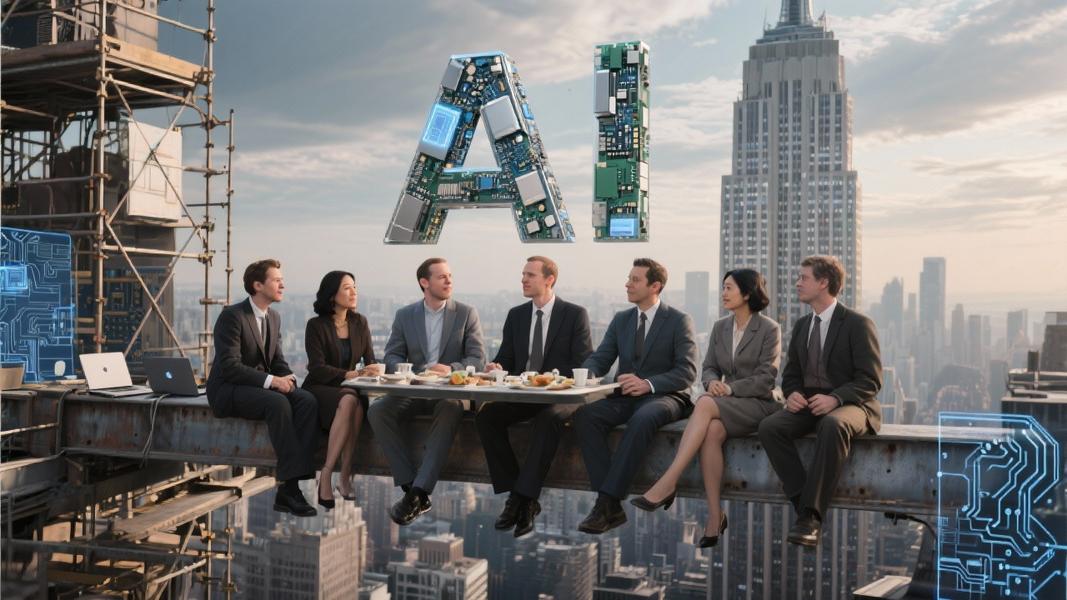
In an era where humanity is increasingly intertwined with technology, Time magazine has named the “Architects of AI” as its 2025 Person of the Year, recognizing a select group of tech visionaries who have fundamentally altered our world with artificial intelligence systems that have become inescapable in daily life.
“For delivering the age of thinking machines, for wowing and worrying humanity, for transforming the present and transcending the possible, the Architects of AI are TIME’s 2025 Person of the Year,” the magazine announced in a social media post that quickly went viral across platforms still largely moderated by the very AI these architects have created.
The Power Players
Time’s striking cover image features eight tech titans perched precariously on a skyscraper beam — a visual homage to the famous 1932 “Lunch atop a Skyscraper” photograph, but with AI pioneers instead of construction workers. Among them: Meta CEO Mark Zuckerberg, Tesla’s Elon Musk, OpenAI’s Sam Altman, and Nvidia CEO Jensen Huang, whose company’s stock has skyrocketed as AI development demands ever more powerful chips. The cover also features AMD CEO Lisa Su, Google DeepMind’s Demis Hassabis, Anthropic’s Dario Amodei, and pioneering AI researcher Fei-Fei Li — a selection that speaks to the diversity of approaches in the field.
Time editor-in-chief Sam Jacobs didn’t mince words about the significance of this moment. “Never before has so much power been concentrated in so few individuals,” he stated bluntly. “This was the year when artificial intelligence’s full potential roared into view, and when it became clear that there will be no turning back or opting out.”
2025: The Year Everything Changed
What makes 2025 different from previous years of AI hype? For one thing, the technology now writes most of its own code. At Anthropic, their AI assistant Claude now writes up to 90% of its own code, essentially self-improving with minimal human intervention. AMD’s Lisa Su has characterized 2025 as “the year that AI became really productive for enterprises,” as her company races to build a software ecosystem rivaling Nvidia’s dominant position.
OpenAI made perhaps the most significant breakthrough, allowing their models to “reason” in natural language over extended periods instead of responding immediately. This approach, while requiring substantially more computing power, has dramatically improved accuracy and problem-solving abilities. The technique involves specialized data from various professionals to enhance AI reasoning across domains.
But what about the human cost? Senator Bernie Sanders has been sounding alarm bells, warning that AI and automation could eliminate nearly 100 million American jobs over the next decade. The progressive firebrand has advocated for a “robot tax” to penalize companies replacing human workers with technology — a proposal that has gained surprising traction even among some conservatives worried about workforce displacement.
A New Era of Superintelligence?
How smart will these systems actually become? If SoftBank CEO Masayoshi Son’s predictions hold true, we’re only seeing the beginning. The Japanese billionaire investor has claimed machines will be 10,000 times smarter than humans within just a decade — a forecast he’s backing with hundreds of billions in AI investments.
That optimism (or hubris, depending on your perspective) seems to be shared among many of Time’s “Architects.” They’ve built systems that now write most of their own code, assist in medical research, draft legal documents, and increasingly make decisions that affect millions of lives — all with minimal oversight or regulation.
“We’re witnessing the birth of a new form of intelligence,” one researcher told this reporter, speaking on condition of anonymity because they weren’t authorized to discuss their company’s roadmap. “The question isn’t whether AI will transform society — it’s whether we’ll recognize the society it creates.”
As these eight architects sit perched on their metaphorical beam high above the rest of humanity, one thing seems certain: the world they’re building will look dramatically different from the one we’ve known. The only real question is whether we’ll all have a place in it.
