
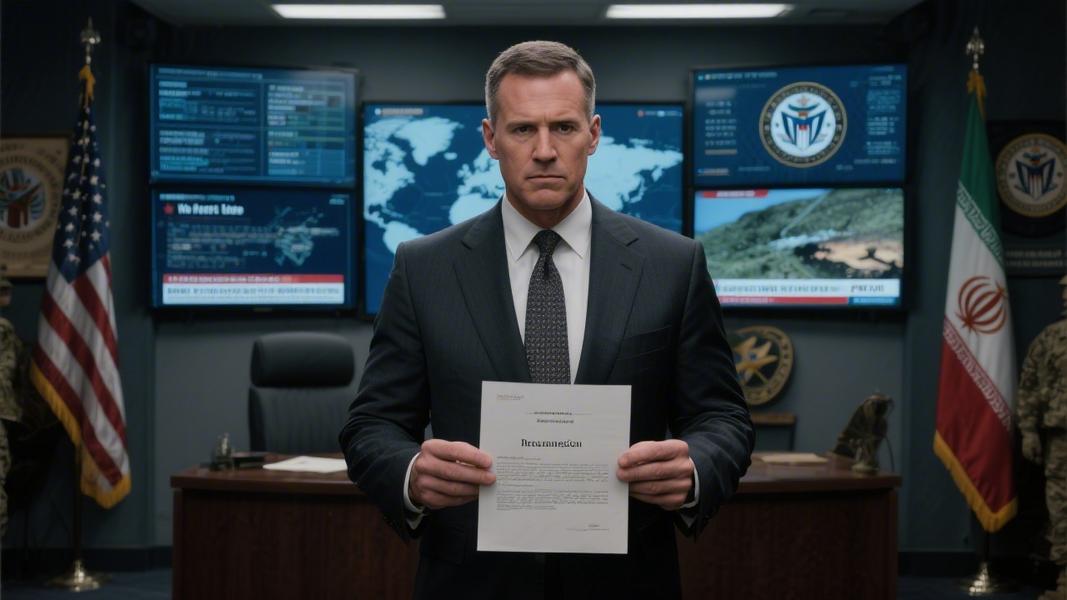
The top counterterrorism official in the United States just walked out the door — and he didn’t go quietly. Joe Kent, director of the National Counterterrorism Center, resigned on Tuesday, March 18, 2026, delivering a pointed rebuke of the Trump administration’s ongoing military campaign against Iran and alleging that the war was driven not by genuine national security concerns, but by foreign political pressure.
It’s the kind of resignation that lands differently than most. Kent didn’t cite personal reasons or a desire to spend more time with family. He went straight for the jugular, claiming that Iran posed no imminent threat to the United States and that the war was launched at the behest of Israel and what he described as its “powerful American lobby.” The statement immediately sent shockwaves through Washington and reignited a fierce debate over why, exactly, the U.S. is at war with Iran at all.
“I cannot in good conscience support the ongoing war in Iran,” Kent wrote. “Iran posed no imminent threat to our nation, and it is clear that we started this war due to pressure from Israel and its powerful American lobby.” Those are extraordinary words from someone who, until Tuesday, sat at the center of America’s counterterrorism apparatus.
How It Started
The airstrikes on Iran began on February 28, 2026, when President Trump announced the campaign in a televised address, framing it as a necessary response to a dangerous and destabilizing regime. “Its menacing activities directly endanger the United States, our troops, our bases overseas, and our allies throughout the world,” Trump declared. The administration’s posture, from day one, was that the threat was real, urgent, and undeniable.
Director of National Intelligence Tulsi Gabbard reinforced that line just days before Kent’s resignation. “After carefully reviewing all the information before him, President Trump concluded that the terrorist Islamist regime in Iran posed an imminent threat and he took action based on that conclusion,” she stated. It was a full-throated endorsement of the president’s judgment — and an implicit counter to the whispers already circulating inside the intelligence community.
But it’s not that simple. Kent wasn’t some mid-level analyst lodging a bureaucratic complaint. He ran the National Counterterrorism Center. His access to classified intelligence was, by definition, among the most comprehensive in the government. When someone at that level says the threat wasn’t real, it’s not easy to just wave it away.
The Official Pushback
The White House didn’t waste time. Press Secretary Karoline Leavitt fired back almost immediately, making clear the administration had little patience for Kent’s framing. “The Commander-in-Chief determines what does and does not constitute a threat, because he is the one constitutionally empowered to do so — and because the American people went to the ballot box and entrusted him and him alone to make such final judgments,” she wrote. Pointed, but notably, not a direct rebuttal of the intelligence itself.
Trump, for his part, was blunter. Asked about the resignation, he seemed almost relieved. “It’s a good thing that he’s out because he said that Iran was not a threat,” Trump said. “Iran was a threat. Every country realized what a threat Iran was.” Short sentences. Firm delivery. Classic Trump — and a clean, if thin, dismissal of a man who spent his career in the intelligence world.
House Speaker Mike Johnson offered perhaps the most substantive defense of the administration’s position. Citing his access to classified briefings as a member of the Gang of Eight, Johnson told reporters that the threat picture was unambiguous. “We all understood there was clearly an imminent threat that Iran was very close to the enrichment of nuclear capability, and they were building missiles at a pace that no one in the region could keep up with,” he explained. It’s a credible counter — Johnson does, in fact, receive the highest-level intelligence briefings available to Congress.
A Question That Won’t Go Away
So who’s telling the truth? That’s the question now hanging over every briefing room, every Senate hearing, every editorial board in the country. The administration says the intelligence was clear. Kent says it wasn’t. Both sides have access to the same classified record — and they’re drawing opposite conclusions. Or, at least, they’re claiming to.
What makes Kent’s resignation particularly combustible isn’t just what he said about the intelligence. It’s the allegation about why the war was started — the suggestion that a foreign government and its domestic political network shaped a decision that sent American forces into combat. That’s not a charge that fades quietly into the news cycle. Whether or not it’s ultimately proven, it’s the kind of claim that tends to echo.
Still, administrations have weathered dissenting resignations before. Officials quit over policy disagreements all the time, and the machinery of government keeps moving. The war in Iran continues. The airstrikes haven’t stopped. And the White House shows no sign of reconsidering its position, regardless of who walks out the door.
The deeper question — one Kent’s resignation has now forced into the open — is whether the American public will ever get a full accounting of what the intelligence actually said, and who was really in the room when the decision was made.
