
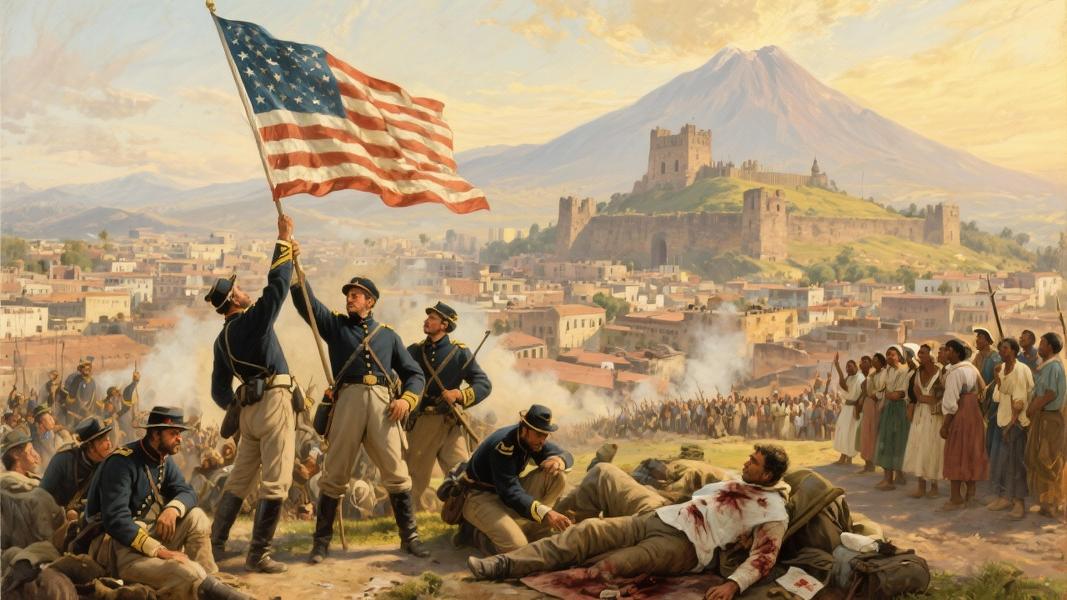
The Treaty of Guadalupe Hidalgo, signed 178 years ago today, remains one of the most consequential yet contentious territorial agreements in American history, fundamentally reshaping the map of North America while leaving a complex legacy that continues to reverberate through U.S.-Mexico relations.
The Massive Land Transfer That Redefined America
On February 2, 1848, American and Mexican diplomats put pen to paper on an agreement that would forever alter the continent’s geography. The treaty forced Mexico to cede 55 percent of its territory — a staggering 525,000 square miles — to the United States following its defeat in the Mexican-American War, a conflict that had begun two years earlier under President James K. Polk’s administration, according to historical records.
The territorial windfall for the United States was enormous. California, Nevada, Utah, most of Colorado, New Mexico, Arizona, and even a slice of Wyoming all came under American control through this single document. Mexico also relinquished all claims to Texas and accepted the Rio Grande as the southern boundary of its former territory.
What drove this massive territorial acquisition? The concept of “Manifest Destiny” — the belief that American expansion across the continent was both inevitable and divinely sanctioned — provided the ideological foundation for the war that preceded the treaty.
A War of Questionable Origins
The conflict itself remains controversial among historians. After American forces under General Zachary Taylor routed Mexican troops at Palo Alto and Resaca de Palma, the U.S. launched a protracted campaign into Mexico’s northern territories and heartland.
But was it a just war? Even some American military officers at the time expressed serious doubts. Col. Ethan Allan Hitchcock, who served as an aide to General Taylor, wrote candidly in his journal: “I have said from the first that the United States are the aggressors… We have not one particle of right to be here… It looks as if the government sent a small force on purpose to bring on a war, so as to have a pretext for taking California and as much of this country as it chooses.”
Such contemporary critiques highlight the moral ambiguity surrounding what some historians have described as a war of territorial ambition thinly veiled behind diplomatic pretexts.
The Treaty’s Lasting Impact
For $15 million — roughly $530 million in today’s dollars — the United States acquired territories that would eventually become some of its most economically vital states. California alone would soon experience the Gold Rush, triggering a population boom that would transform the new acquisition.
But what about those who already lived on these lands? The treaty technically guaranteed citizenship rights to Mexicans who remained in the ceded territories, but historical evidence shows these protections were often ignored. Many Mexican landowners lost their property through legal challenges or outright fraud, while indigenous peoples saw no meaningful protection of their rights.
Could the modern border debates and cultural tensions between the United States and Mexico trace their origins to this 19th-century agreement? Many scholars believe the treaty created not just a physical border but a psychological one that continues to shape relations between the two nations.
The Treaty of Guadalupe Hidalgo stands as a stark reminder that borders are rarely just lines on a map — they’re the physical manifestations of power dynamics that can reshape societies for generations to come.
