
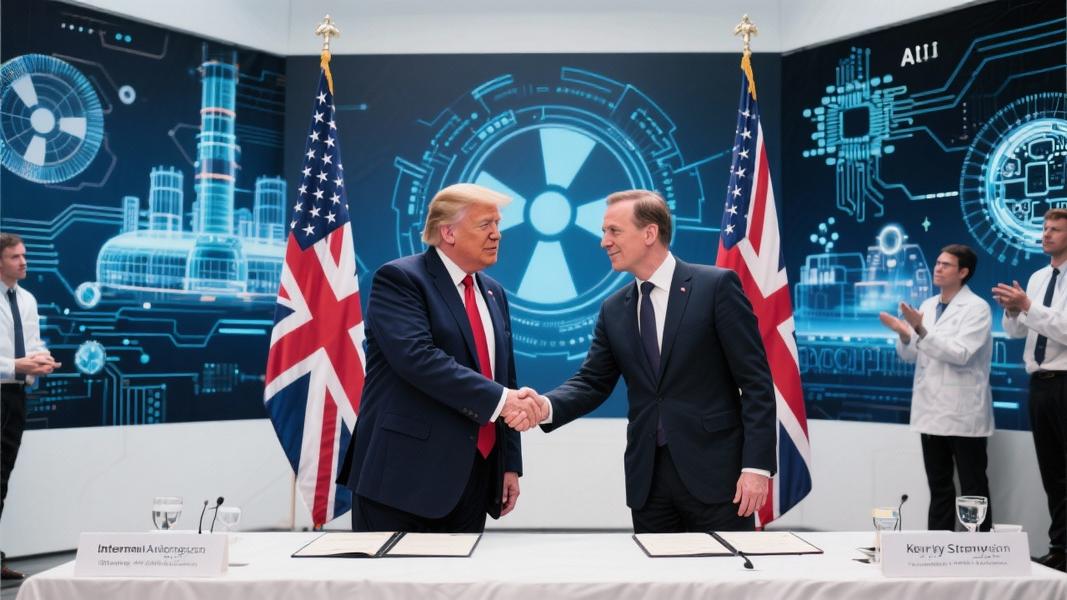
President Donald Trump and British Prime Minister Keir Starmer unveiled a sweeping $350 billion technology agreement on Thursday, marking what both leaders described as a transformative partnership that will reshape the technological landscape on both sides of the Atlantic.
A “Life-Changing” Tech Alliance
The Technology Prosperity Deal (TPD) aims to deepen U.S.-UK collaboration in artificial intelligence, nuclear energy, and quantum computing — three fields both nations see as critical to economic growth and national security. During a joint press conference, Starmer called it “life changing” and “the biggest investment package of its kind in British history, by a country mile,” while Trump emphasized how the deal would cement American technological leadership globally.
“President Trump signed another game-changing deal that furthers American technology leadership and strengthens ties to one of our closest allies,” the White House stated. “With the TPD, the United States is exporting its world-class tech stack, accelerating scientific discovery, and advancing pro-innovation policies worldwide.”
The ambitious agreement promises substantial economic benefits: up to 15,000 new jobs in Britain and 2,500 in the United States, with an estimated $50 billion in economic value. Perhaps most tangibly, the deal outlines the development of 12 advanced nuclear reactors capable of powering approximately 1.5 million homes across both countries.
Tech Giants Back the Initiative
What’s driving this massive investment? Several American technology behemoths have already thrown their weight behind the agreement. “We have huge new investments from Nvidia, Nscale, OpenAI, Google, Salesforce and many more backing cutting-edge British jobs for years to come,” Starmer explained during the announcement.
The prime minister framed the deal as “a blueprint to win this new era together. Shape it according to our shared values, and seize the incredible opportunities that are on offer.” His enthusiasm was matched by Trump, who characterized the TPD as a win-win that would strengthen America’s global technological influence while creating jobs and economic growth.
Behind the political fanfare lies a detailed framework for collaboration across three key technology domains. But why these particular sectors?
AI, Nuclear, and Quantum: The Triple Play
The TPD’s artificial intelligence provisions will refocus collaboration between U.S. and UK AI organizations to share best practices in metrology and standards. It also enhances research in automation labs with a particular emphasis on cancer and chronic diseases, while promoting talent exchange between institutes in both countries, according to White House documents.
In the nuclear energy sector, the agreement takes aim at regulatory hurdles that have historically slowed development. The deal aligns U.S. and UK regulatory bodies to accelerate licensing processes for new nuclear technologies, while also targeting British independence from Russian nuclear fuel by 2028 — a strategic priority for both nations in the current geopolitical climate.
Quantum computing, still in its relative infancy but promising revolutionary capabilities, gets special attention through a joint benchmarking taskforce. This body will develop interoperable standards covering hardware, software, and algorithms, while strengthening partnerships to secure quantum supply chains for applications across defense, finance, and energy sectors.
Strategic Implications
The timing of this agreement can’t be overlooked. As China and other competitors rapidly advance their own technological capabilities, the U.S.-UK partnership represents a concerted effort to maintain Western technological supremacy. The deal’s emphasis on nuclear energy independence from Russia by 2028 similarly reflects growing concerns about energy security and supply chain resilience.
“It’s a win for both sides,” Starmer remarked, underscoring the mutual benefits the partnership brings to both nations at a time of increasing global competition.
Still, questions remain about implementation timelines and how the benefits will be distributed across regions and industries in both countries. The agreement outlines ambitious goals — catalyzing development of a dozen advanced nuclear reactors isn’t something that happens overnight — but specific timelines for many initiatives remain vague.
For now, both leaders are celebrating what they view as a landmark achievement in the “special relationship” between the United States and United Kingdom. Whether this technological partnership delivers on its lofty promises may well determine not just economic growth, but also the future technological leadership position of both nations on the world stage.
