
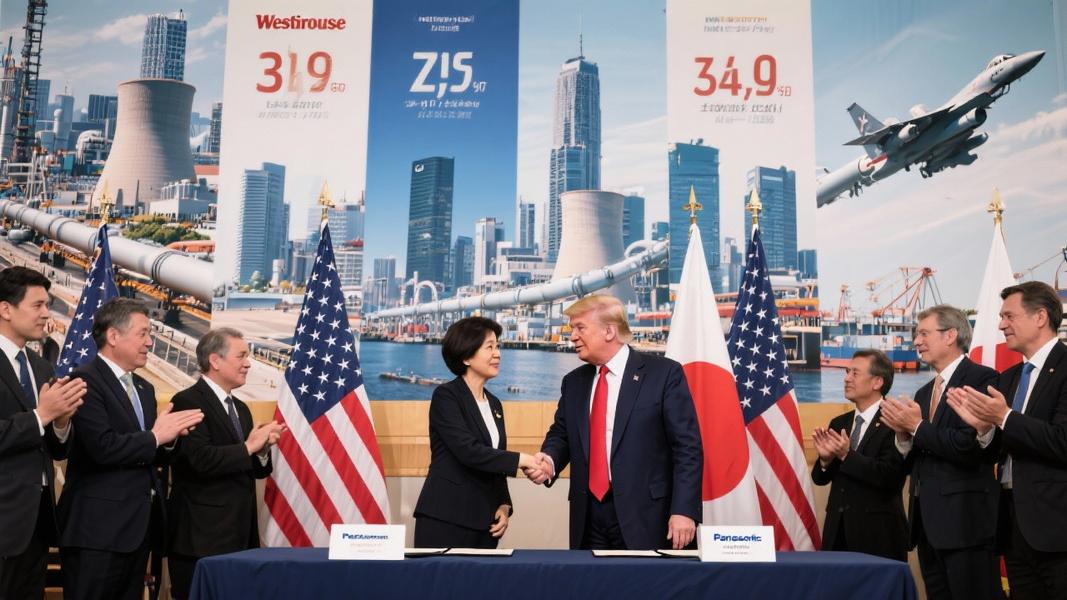
President Trump has unveiled a massive expansion of Japanese investment into the United States, announcing projects that advance Japan’s earlier commitment of $550 billion aimed at revitalizing American industry and securing critical supply chains.
During his visit to Tokyo, Trump announced specific projects that will channel Japanese capital into U.S. energy infrastructure, AI technology, electronics manufacturing, and more — with energy investments alone potentially reaching $332 billion.
Energy Dominance Takes Center Stage
The largest portion of the investment package targets America’s energy sector. Japanese firms have committed up to $332 billion to support energy infrastructure projects, including nuclear reactors in partnership with Westinghouse, along with an additional $25 billion for gas turbines with GE Vernova, and $25 billion for power-generation substation equipment with Toshiba.
“Today in Tokyo, President Donald J. Trump announced major projects advancing Japan’s previous $550 billion investment commitment to the United States to further revitalize the U.S. industrial base, signed a landmark critical minerals agreement with Japan, secured historic purchases of U.S. energy, and deepened U.S.-Japan cooperation in combatting illegal drug trafficking,” the White House stated in a fact sheet.
Energy purchases are already materializing. Tokyo Gas and JERA have signed LNG offtake agreements for an Alaska pipeline project, representing over 10% of the project’s export capacity. JERA will also invest $1.5 billion in Louisiana’s Haynesville Shale, bringing their total U.S. investments to more than $6 billion.
Tech Sector Gets Massive Boost
What about America’s tech future? The agreement delivers substantial investment there too, with up to $30 billion from Mitsubishi Electric for data center equipment, $25 billion from TDK for advanced electronic components, and $20 billion from Fujikura to supply optical fiber cables — critical infrastructure for AI development and deployment.
Electronics manufacturing will see $15 billion for production of advanced components with Murata Manufacturing and another $15 billion for energy storage devices with Panasonic, potentially creating thousands of American jobs in high-tech sectors.
The two nations also signed a Memorandum of Cooperation for a Technology Prosperity Deal that aims to accelerate development in AI, 6G networks, biotechnology, quantum science, fusion energy, and space technology. “Both nations will cooperate to accelerate AI adoption and innovation by driving innovative research for applications in science, industry, and society, advancing pro-innovation AI policy frameworks, and promoting export,” the White House explained.
Critical Minerals and Supply Chain Security
Perhaps the most strategically significant element of the package is a new critical minerals agreement. The deal aims to diversify supply chains for minerals essential to modern technologies, reducing dependence on potentially hostile nations.
“Today’s critical minerals agreement builds on similar deals President Trump has secured with foreign partners to strengthen America’s mineral supply chain resilience,” the White House noted.
Specific investments include $3 billion for an ammonia and urea fertilizer facility and $2 billion for a copper smelting and refining facility in the western United States — addressing vulnerabilities in America’s industrial base.
Opening Japan’s Markets to American Goods
The agreement isn’t just about Japanese money flowing into the U.S. — it also opens Japanese markets to American products. Toyota plans to export U.S.-made vehicles to Japan and will help open distribution channels for American automakers. Japan has also committed to accepting U.S. manufactured and safety-certified vehicles without requiring additional testing.
American farmers stand to benefit as well. The broader framework agreement includes Japanese commitments to purchase $8 billion in U.S. agricultural goods and increase purchases of American rice by 75%.
Defense and Security Cooperation
Is this just about economics? Not entirely. The package includes significant security components as well.
“The United States welcomed Japan’s commitment to significantly increase defense capabilities. This commitment supports the U.S.-Japan Alliance’s goal of peace through strength by rapidly strengthening deterrence in the Indo-Pacific,” the White House indicated.
The U.S. has accelerated deliveries of Advanced Medium-Range Air-to-Air Missiles for Japan’s F-35 jets and agreed to enhance intelligence sharing, risk profiling, and customs cooperation. Japan will also adopt new sanctions frameworks targeting vessels linked to shadow fleets, working in coordination with the U.S. and G7 partners.
Implementing the Framework Agreement
These announcements represent the implementation phase of the broader U.S.-Japan framework agreement that was announced on July 22, 2025. That agreement established a baseline 15% tariff on most Japanese imports while securing the $550 billion investment commitment.
“The framework agreement provides American producers and manufacturers well over $15 billion of unprecedented access to Japanese markets while still accounting for U.S. national security needs,” according to White House documents.
President Trump has emphasized the importance of the U.S.-Japan relationship throughout his Asia trip. “President Trump recognizes that Japan is one of America’s closest allies and most important trading partners, and he has worked to deepen this relationship,” the White House remarked.
As the implementation of these investments unfolds over the coming years, the true test will be whether they deliver the promised manufacturing renaissance and job creation that American workers in key industrial states have been waiting for.
