
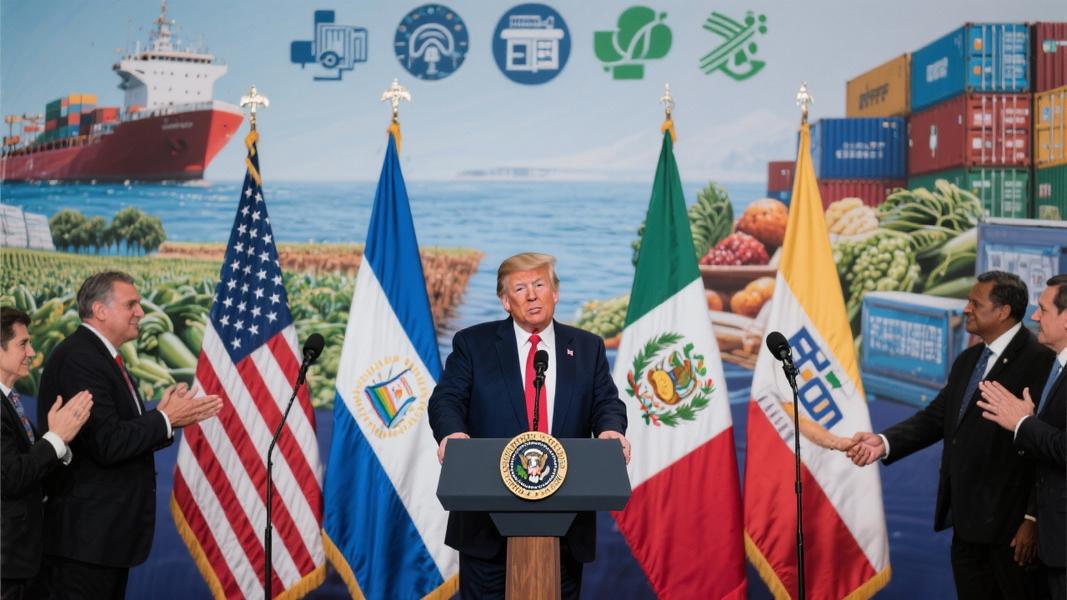
President Donald Trump unveiled a sweeping series of trade agreements with four Latin American nations Thursday, marking what the White House calls a “breakthrough” in his administration’s efforts to reshape America’s economic relationships in the Western Hemisphere.
The deals with El Salvador, Argentina, Ecuador, and Guatemala represent the first concrete results of Trump’s “America First” trade agenda since his return to office, establishing new market access for U.S. exporters while addressing long-standing complaints about regulatory barriers and uneven playing fields in Central and South American markets.
“These deals secure commitments on economic and national security issues to strengthen supply chains and trade partnerships in the region, deepening bilateral trade and investment cooperation to provide American exporters with unprecedented access to markets in Central and South America,” the White House stated in a joint announcement with the partnering nations.
Addressing the Trade Deficit
The agreements come seven months after Trump declared a national emergency on April 2 regarding what he characterized as a “large and persistent U.S. goods trade deficit” resulting from unfair practices by trading partners. That dramatic move signaled his administration’s willingness to use tariffs and other leverage to forge more favorable terms.
What’s in it for American businesses? Plenty, according to the White House. El Salvador has committed to “streamlining regulatory requirements and approvals for U.S. exports,” including accepting vehicles built to U.S. safety standards and FDA certifications for medical devices and pharmaceuticals — eliminating costly duplication of testing and certification.
Argentina, meanwhile, will provide preferential market access for a range of U.S. goods including medicines, chemicals, machinery, IT products and motor vehicles, while also addressing structural issues related to intellectual property, the White House announced.
Digital Trade and Environmental Commitments
Perhaps most notable for tech companies, Guatemala has pledged to facilitate digital trade by refraining from imposing digital services taxes on U.S. products and ensuring free data transfer across borders. The agreement also includes Guatemala’s support for a permanent WTO moratorium on customs duties for electronic transmissions, as outlined in the joint statement.
Ecuador’s commitments lean heavily toward environmental protection, with the nation agreeing to maintain high environmental standards, combat illegal logging, and implement WTO fisheries subsidy obligations. U.S. agricultural producers stand to benefit as Ecuador will “remove or reduce tariffs on goods including tree nuts, fresh fruit, pulses, wheat, wine, distilled spirits,” according to the agreement.
The deals also include provisions for Most Favored Nation tariff treatment on certain goods that “cannot be grown, mined, or naturally produced in the United States in sufficient quantities,” a move that could lower prices for American manufacturers who rely on imported inputs while protecting domestic producers from direct competition.
Countering China’s Influence
Behind the agreements lies a broader strategic aim. The administration has made little secret of its desire to counter China’s growing economic influence in Latin America, where Beijing has rapidly expanded its footprint through infrastructure investments and trade deals.
“I will immediately begin the overhaul of our trade system to protect American workers and families,” Trump promised during his January inauguration address. These agreements appear to be the first step in that direction, aiming to cement U.S. economic relationships in what has historically been considered America’s backyard.
For El Salvador and Guatemala specifically, the United States will remove reciprocal tariffs from certain products, including textiles and apparel products originating under the Dominican Republic-Central America Free Trade Agreement (DR-CAFTA). This move is designed to boost both U.S. textile production and partner economies.
Trade experts note that while these agreements mark a significant shift in approach, they fall short of comprehensive free trade agreements that require congressional approval. Instead, they represent executive actions focused on specific sectors and barriers — a hallmark of Trump’s preference for bilateral dealmaking over multilateral frameworks.
The real test? Whether these agreements actually translate into measurable reductions in the trade deficit and tangible benefits for American workers — the ultimate yardstick by which Trump has asked his trade policies to be judged.
