
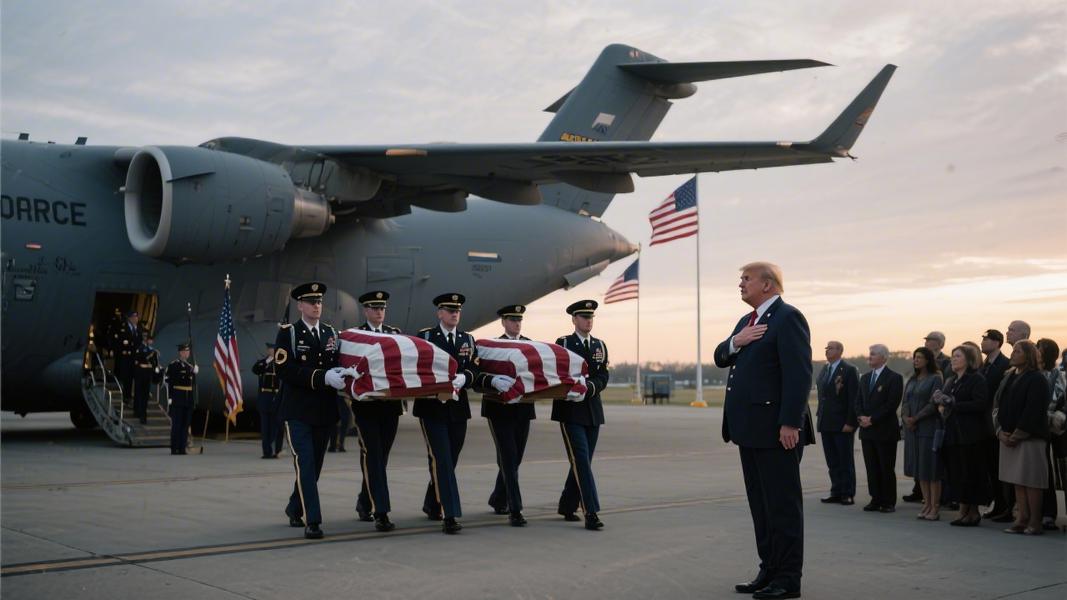
Six flag-draped transfer cases. One president making the trip to Dover. And six families about to face the hardest moment of their lives.
President Donald Trump has announced he will attend the dignified transfer of six U.S. Army Reserve soldiers killed in an Iranian drone strike on a command center in Port Shuaiba, Kuwait, during an operation designated Operation Epic Fury. The White House confirmed the visit, saying Trump intends “to stand in grief alongside their families” — a rare and symbolically weighty gesture from a sitting commander in chief.
The Fallen
The six soldiers were all assigned to the 103rd Sustainment Command, based in Des Moines, Iowa — a unit that, until now, may not have been a household name. They were Sgt. 1st Class Nicole Amor, 39, of White Bear Lake, Minnesota; Capt. Cody Khork, 35, of Winter Haven, Florida; Sgt. Declan Coady, just 20 years old, from Des Moines, Iowa; Chief Warrant Officer 3 Robert Marzan, 54, of Sacramento, California; Maj. Jeffrey O’Brien, 45, of Waukee, Iowa; and Sgt. 1st Class Noah Tietjens, 42, of Bellevue, Nebraska. Six people. Six communities that will never be quite the same.
The range of ages alone tells a story. Declan Coady was 20 — barely past the point where most young men are figuring out what to do with their lives. Robert Marzan was 54, a career soldier who’d given more than three decades to the uniform. That gap, that breadth, is a quiet reminder of just how wide a net military service casts across American life.
The Transfer at Dover
What happens at Dover Air Force Base is not a ceremony in the pageantry sense. It’s something more intimate, and in many ways more raw. A specially trained carry team moves flag-draped transfer cases — one by one — from the aircraft to a waiting vehicle, bound for the base mortuary. There are no speeches. No crowd. Just the sound of boots on tarmac and, often, the quiet grief of families who’ve been waiting for their loved ones to come home one last time. The White House confirmed Trump will be present for that moment.
Live footage of the transfer, as it unfolded, was broadcast for those following the news from home — a reminder that in the social media age, even the most solemn of military traditions now unfolds in public view, for better or worse.
The Broader Context
An Iranian drone. A command center. Six soldiers who didn’t make it back. The strike in Kuwait is a stark escalation in what has been a persistently volatile regional picture, and it puts renewed pressure on the administration to define what comes next — both militarily and diplomatically. Good Morning America noted Trump’s planned attendance as one of the significant developments in a fast-moving news cycle surrounding the broader Iran situation.
Still, whatever the geopolitical calculus, Tuesday’s transfer at Dover isn’t about policy. It’s about six people who left home and didn’t return. And a president who, at least for one afternoon, put down the briefings and showed up.
There’s a reason these transfers carry so much weight — and why a president’s presence there lands differently than a speech or a statement ever could. It doesn’t require explanation. The gesture speaks for itself.
