
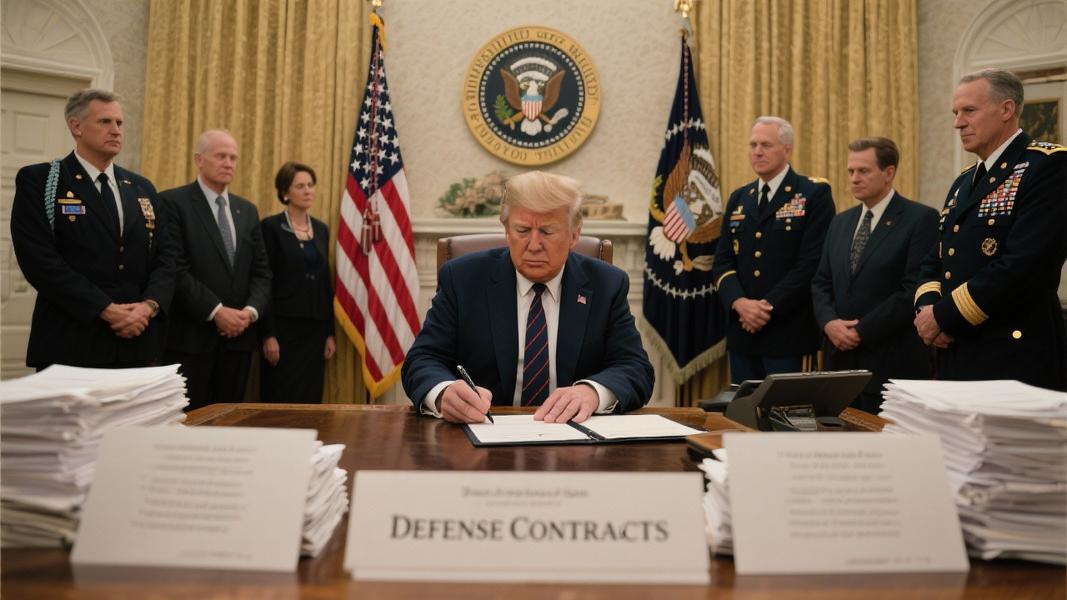
President Trump has drawn a firm line for defense contractors: prioritize national security production over corporate profits or face consequences. In a sweeping executive order signed Monday, the administration imposed new restrictions on stock buybacks and dividend payments for major defense companies that fail to meet critical production needs for the military.
“Major defense contractors will no longer conduct stock buy-backs or issue dividends at the expense of accelerated procurement and increased production capacity,” states the executive order, which represents one of the most aggressive interventions into defense industry practices in recent memory.
Pentagon Procurement Gets Teeth
The order specifically empowers the Secretary of War to identify contractors that “underperform, fail to invest their own capital in production capacity, insufficiently prioritize U.S. government contracts, or maintain inadequate production speed” while simultaneously spending on stock buybacks or corporate distributions, according to a White House factsheet.
What’s particularly striking about the new approach? It directly targets executive compensation, requiring that incentive packages be tied to “on-time delivery, increased production, and necessary operating improvements rather than short-term financial metrics” in future defense contracts.
The administration isn’t stopping at domestic pressure. The executive order also directs the Secretary of War, working with State and Commerce Department counterparts, to consider halting advocacy efforts for underperforming contractors competing for international Foreign Military or Direct Commercial Sales — potentially cutting off lucrative foreign markets.
Part of Broader Defense Overhaul
This executive action comes just weeks after Trump signed the FY 2026 National Defense Authorization Act, which authorizes a staggering $900.6 billion for the Department of Defense and national security programs, including $161.7 billion in supplemental funding.
The 2026 NDAA itself represents a significant shift in defense procurement, codifying 15 executive orders, including E.O. 14265 on “Modernizing Defense Acquisitions and Spurring Innovation in the Defense Industrial Base.”
Beyond procurement reforms, the legislation takes a hard stance on national security supply chains. Section 851 implements the BIOSECURE Act, which effectively prohibits federal contractors from procuring goods and services from specified Chinese companies for use in federally-funded contracts.
“Wartime Footing” for Defense Acquisitions
Perhaps most tellingly, the Department of War recently issued a memorandum that formally redesignates the Defense Acquisition System (DAS) as the Warfighting Acquisition System (WAS), placing the entire acquisition enterprise on what it terms a “wartime footing” with substantial governance, structural, and process reforms, according to defense contracting experts.
The shift in terminology from “Defense” to “Warfighting” signals a fundamental realignment in how the Pentagon views its procurement mission — less bureaucratic management, more direct support for combat readiness.
“This is about putting the warfighter first,” said a senior Defense Department official speaking on background. “For too long, we’ve seen contractors prioritize shareholder value over national security deliverables.”
Defense industry analysts note that major contractors like Lockheed Martin, Boeing, and Raytheon have spent billions on stock buybacks in recent years while simultaneously facing criticism for production delays on key military systems.
Still, some industry representatives argue the new restrictions could hamper their ability to attract investment capital in a competitive market.
The question now becomes whether these reforms will actually accelerate weapons production and technology development or simply add another layer of compliance burden. With global tensions rising and military modernization programs behind schedule, the administration is clearly betting that a firmer hand on defense industry practices will yield better results than market forces alone.
