
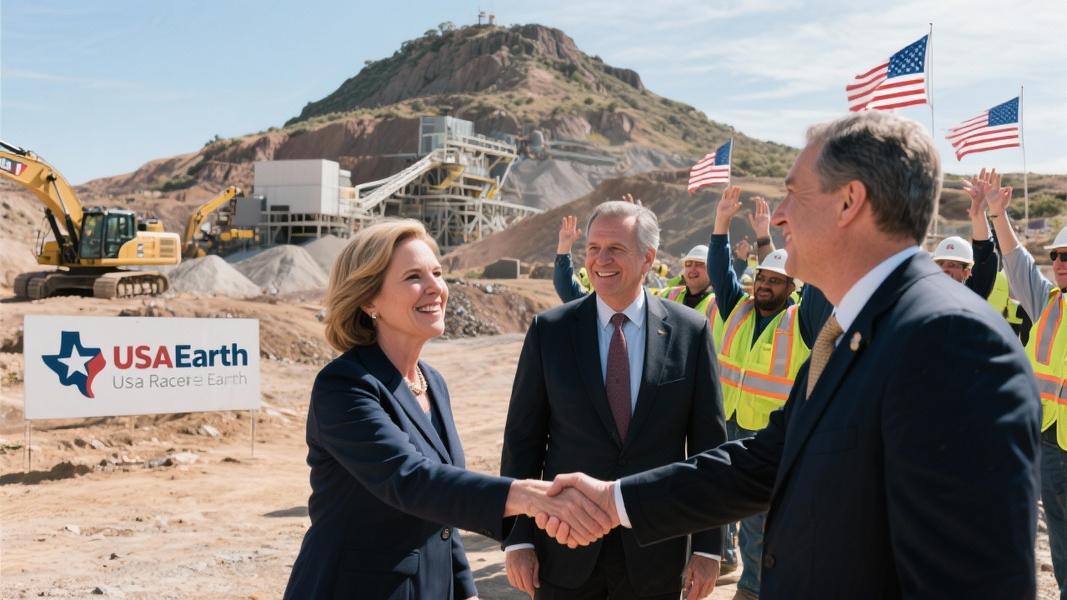
The Trump administration is betting big on American soil — $1.6 billion big — to break China’s stranglehold on critical minerals essential to everything from smartphones to fighter jets.
In a move that signals a renewed push for mineral independence, the Commerce Department has announced a massive investment package for USA Rare Earth’s Round Top deposit in Texas, a project expected to begin commercial production by 2028. The deal, finalized this week, includes $1.3 billion in loans and $277 million in direct support through the CHIPS Act, giving the federal government between 8-16% ownership stake in the operation, according to officials familiar with the arrangement.
Breaking China’s Monopoly
Why does this matter? For decades, China has maintained a vice-like grip on the global rare earths market, controlling over 90% of processing capacity and nearly half of known reserves worldwide. These minerals — with exotic names like praseodymium, terbium, and yttrium — are crucial components in semiconductors, aerospace technology, defense systems, and clean energy infrastructure. The Pentagon has invested in several domestic producers in recent years, including MP Materials and partnerships with Vulcan Elements and ReElement Technologies.
Texas Land Commissioner Dawn Buckingham celebrated the announcement, calling it a critical step toward mineral independence. “This partnership between the U.S. Department of Commerce and USA Rare Earth will help break China’s hold on rare earth minerals, strengthen our national security, and create jobs here in Texas,” she stated in a press release.
The ambitious project aims to extract 40,000 metric tons per day from Round Top Mountain, located on state-owned land in Texas. It’s not just about volume, though — it’s about securing what many defense experts consider the building blocks of modern military and technological supremacy.
Years in the Making
The path to this investment wasn’t overnight. Buckingham had urged federal action in a December 2025 letter to Commerce officials, writing: “The GLO … respectfully urges the Department of Commerce to consider accelerating the mine’s development, as a matter of national importance for elemental independence from foreign nations,” according to documents released by her office.
What makes this deal particularly significant? The structure of the investment provides the federal government with 16.1 million shares in USA Rare Earth and rights to acquire 17.6 million more, effectively making American taxpayers partial owners of this critical mineral supply chain.
“USA Rare Earth’s heavy critical minerals project is essential to restoring U.S. critical mineral independence. This investment ensures our supply chains are resilient and no longer reliant on foreign nations,” a Commerce Department spokesperson explained.
Geopolitical Implications
The timing couldn’t be more strategic. With mounting tensions between Washington and Beijing across multiple fronts — from Taiwan to trade policy — the rare earths sector has become yet another battlefield in the escalating competition between the world’s two largest economies.
China has, in the past, hinted at using its dominance in rare earth minerals as leverage in trade disputes. That vulnerability hasn’t been lost on U.S. policymakers, who have increasingly viewed mineral independence through a national security lens.
But challenges remain. Even with substantial investment, building a complete supply chain takes time. The Round Top project isn’t expected to reach commercial production until 2028, leaving a significant gap where American industries remain dependent on foreign sources.
Still, industry observers note that the scale of this investment — particularly the direct ownership component — represents a meaningful shift in how the U.S. government approaches critical resource security.
For residents near the Round Top site, the project promises economic benefits beyond the strategic implications. New mining operations typically create hundreds of direct jobs and additional support positions throughout the supply chain.
As one administration official put it off the record: “This isn’t just about competing with China — it’s about not asking for permission to build our own future.”
