
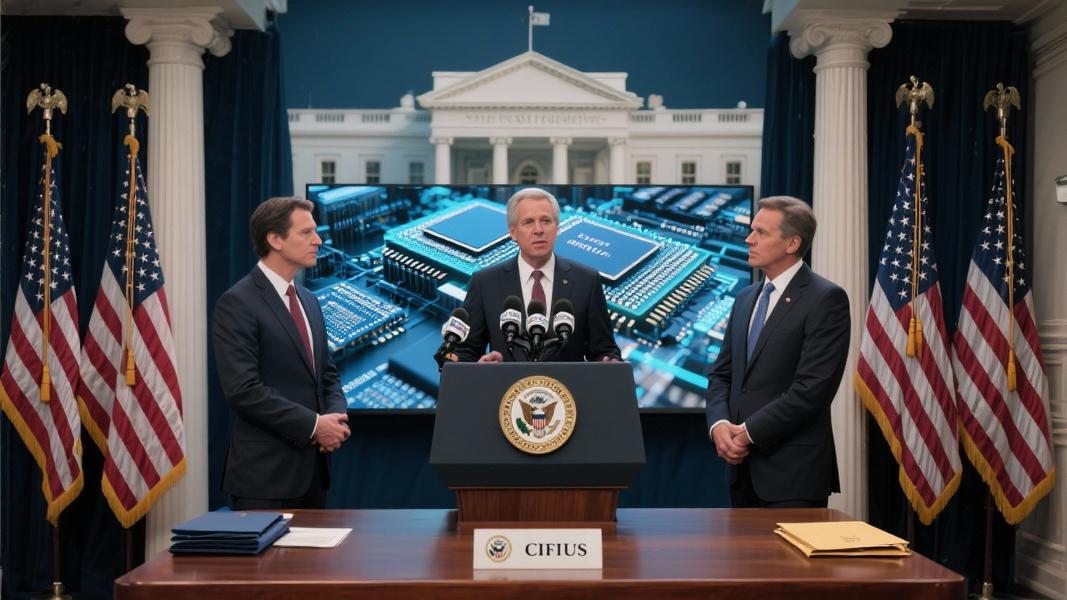
President Trump has ordered the unwinding of a Chinese-linked semiconductor acquisition, citing national security concerns in his first major foreign investment intervention since returning to office. The executive action, issued Thursday, forces HieFo Corporation to divest all interests in EMCORE’s digital chips business, including a semiconductor manufacturing facility the company acquired last year.
The White House announced the presidential order titled “Regarding the Acquisition of Certain Assets of Emcore Corporation by Hiefo Corporation” after a review by the Committee on Foreign Investment in the United States (CFIUS) identified significant security risks in the transaction.
National Security Red Flags
What exactly triggered the administration’s concerns? The $2.9 million deal, which closed on April 30, 2024, gave HieFo control of EMCORE’s chips business and its indium phosphide wafer fabrication capabilities, as detailed by local reports. Though modest in financial terms, the acquisition caught regulators’ attention due to HieFo’s ownership structure — the Delaware-registered corporation is controlled by a Chinese citizen.
CFIUS conducted its review under Section 721 of the Defense Production Act and determined the transaction posed unacceptable risks to national security. The committee specifically flagged concerns about potential access to EMCORE’s valuable intellectual property and the possible diversion of indium phosphide chips away from U.S. supply chains, according to sources familiar with the decision.
“The protection of American semiconductor technology remains a top priority,” a senior administration official said, speaking on condition of anonymity. “This action reflects our commitment to preventing critical technologies from falling into hands that could compromise our national interests.”
Industry Implications
The move signals a continued tough stance on Chinese investment in U.S. technology sectors, particularly semiconductors, which have become central to economic and military competition between the two countries. Indium phosphide chips, though less widely discussed than silicon-based semiconductors, are crucial components in high-speed communications, military applications, and next-generation computing.
Market analysts suggest the order could have ripple effects beyond this specific transaction, potentially chilling other pending deals involving foreign investment in U.S. tech assets. EMCORE’s stock fluctuated in after-hours trading as investors processed implications of the forced divestiture.
This isn’t the first time U.S. presidents have blocked Chinese acquisitions in the semiconductor space, but it’s notable as Trump’s first major CFIUS intervention since beginning his second term. The administration has yet to outline a comprehensive policy on Chinese tech investment, though this action suggests continuity with the previous hardline approach.
HieFo now faces the complicated task of unwinding a nearly two-year-old acquisition, likely requiring the company to find a buyer acceptable to U.S. regulators within a specified timeframe. Neither HieFo nor EMCORE had issued formal responses to the order as of Thursday evening.
For an industry already navigating export controls and supply chain disruptions, the forced divestiture adds another layer of complexity to the increasingly politicized semiconductor landscape — one where even relatively small transactions now face intense scrutiny when they involve technology with potential national security applications.
