
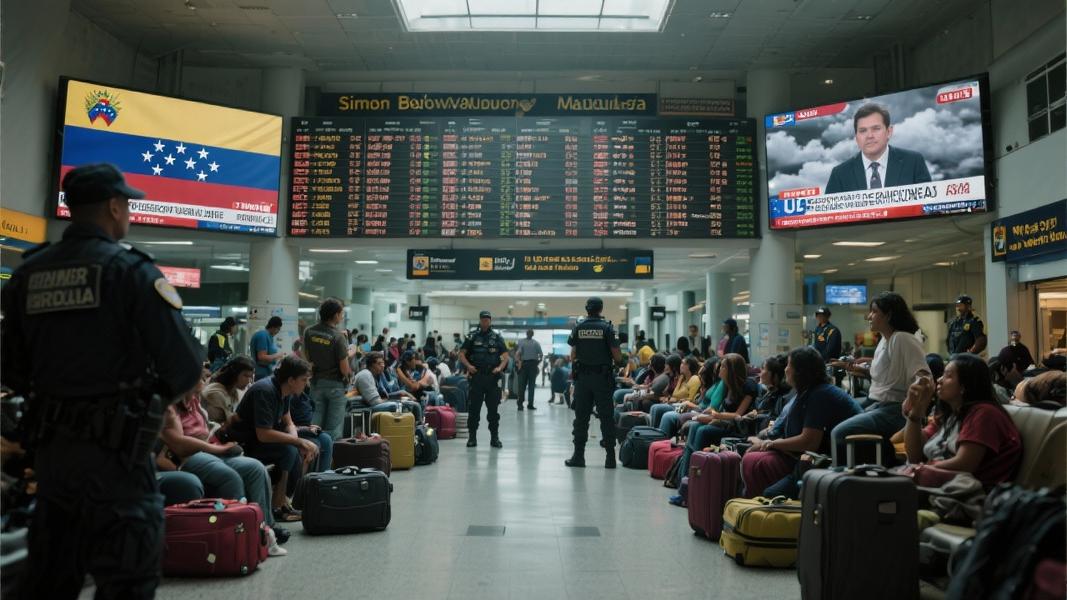
Trump’s declaration that Venezuelan airspace is “closed in its entirety” has triggered a diplomatic firestorm, with Nicolás Maduro’s government denouncing what it calls a “colonial threat” against its sovereignty as U.S. military presence in the region reaches its highest level in generations.
The former and incoming president stated on his Truth Social platform that airspace “above and surrounding” Venezuela should be considered “closed in its entirety,” a pronouncement that came without clarification from the White House about whether it represents new policy or simply reinforces existing pressure on the Maduro regime. International airlines have already begun canceling flights following Federal Aviation Administration warnings about heightened military activity in the region.
Venezuela Rejects “Colonial Threat”
Venezuela’s government wasted no time in its response, declaring it “forcefully rejects Trump’s claim about closing the airspace,” which it characterized as a “colonial threat” intended to undermine the country’s “territorial integrity, aeronautical security and full sovereignty.”
The Foreign Ministry went further, stating that “such declarations constitute a hostile, unilateral and arbitrary act.” This fierce pushback comes amid already strained relations between Washington and Caracas, with Maduro facing narcoterrorism charges in U.S. courts.
What’s behind this escalation? Trump’s administration is reportedly considering both military and nonmilitary options regarding Venezuela, including potential covert action by the CIA, even as Trump has publicly floated the possibility of direct talks with Maduro. The New York Times reported Friday that Trump and Maduro had spoken, though the White House declined to confirm details.
Operation Southern Spear: Massive Military Buildup
Meanwhile, the U.S. has assembled its largest military presence in the region in decades. Operation Southern Spear includes nearly a dozen Navy ships and approximately 12,000 sailors and Marines, with the USS Gerald R. Ford — America’s most advanced aircraft carrier — serving as the flagship of this imposing armada.
The operation has already proven deadly. More than 80 people have been killed in U.S. military strikes in the Caribbean Sea and eastern Pacific Ocean since early September, targeting small boats accused of drug trafficking.
“This is essentially a naval blockade in everything but name,” said a former State Department official who requested anonymity to discuss sensitive matters. “The administration is applying maximum pressure through multiple channels.”
Congressional Oversight of Controversial Kill Order
The Senate Armed Services Committee has announced it will conduct “vigorous oversight” following troubling reports that Defense Secretary Pete Hegseth issued a verbal order to kill all crew members during a September 2 military strike.
In a rare show of bipartisanship, Republican Senator Roger Wicker and Democratic Senator Jack Reed jointly stated they “will be conducting vigorous oversight to determine the facts related to these circumstances.” The alleged kill order has raised serious questions about rules of engagement and command protocols in the ongoing operation.
Migration Standoff Intensifies
The airspace controversy comes against the backdrop of a complex migration situation. More than 13,000 Venezuelans have been deported to Venezuela this year on dozens of chartered flights following negotiations between the U.S. and Venezuelan governments.
The latest deportation flight arrived late Friday in Caracas, though Venezuela claims U.S. immigration authorities have unilaterally suspended the biweekly deportation flights that had become routine. This suspension further complicates an already tangled diplomatic relationship.
Commercial aviation has been caught in the crossfire. Following the FAA warning about heightened military activity, international carriers began diverting flights away from Venezuelan airspace despite questions about whether the FAA has jurisdiction beyond U.S. territories.
Stranded passengers at Simon Bolivar Maiquetia International Airport expressed frustration at the sudden cancellations. “We’re the ones paying the price for these political games,” said Maria Gonzalez, who had been attempting to fly to Panama when her flight was canceled.
As tensions escalate between Washington and Caracas, the Venezuelan airspace declaration represents just the latest flashpoint in what appears to be a rapidly evolving strategy toward the Maduro regime — one that combines diplomatic pressure, military posturing, and economic leverage in ways that remain largely unpredictable to observers on all sides.
