
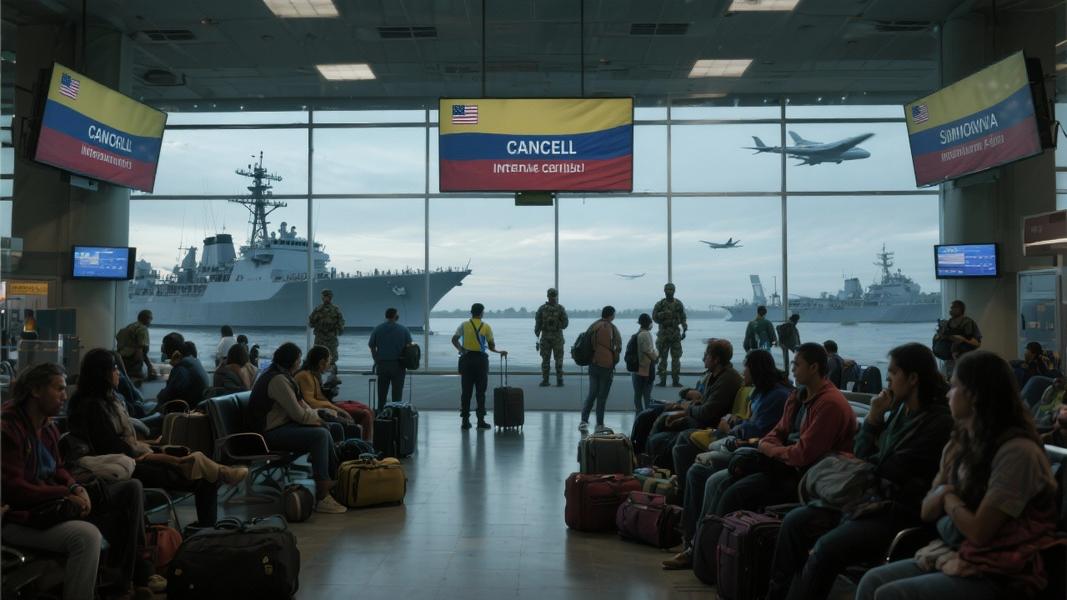
Trump Declares Venezuelan Airspace “Closed,” Escalating Tensions with Maduro Regime
President Donald Trump stunned observers Saturday by unilaterally declaring Venezuelan airspace “closed in its entirety,” a move that dramatically escalates tensions with the Maduro regime and hints at possible military action in the region.
In a brief statement posted to his Truth Social platform and later on X, Trump announced in Spanish: “A todas las aerolíneas, pilotos, narcotraficantes y traficantes de personas: les rogamos que consideren que el espacio aéreo sobre Venezuela y sus alrededores permanecerá cerrado en su totalidad” — directing airlines, pilots, drug traffickers, and human traffickers to consider Venezuelan airspace completely closed.
Military Buildup Suggests Possible Action
The extraordinary declaration comes amid an increasing U.S. military presence in the region, including the deployment of the aircraft carrier USS Gerald R. Ford and thousands of troops. Defense analysts view these moves as potential preparation for a land invasion, though the White House has not explicitly confirmed such plans.
Trump provided no additional details about the implementation or enforcement of the airspace closure, leaving airlines and international observers scrambling to interpret the implications. The announcement represents a dramatic escalation in U.S. policy toward Venezuela just weeks after Trump returned to office.
What’s behind this sudden escalation? The timing suggests Trump is making good on campaign promises to take a harder line against what his administration has repeatedly called the “illegitimate” Maduro government.
Venezuela Denounces “Colonialist Threat”
The Venezuelan government responded within hours, condemning Trump’s announcement as a “hostile, unilateral, and arbitrary act” and a “colonialist threat” to its sovereignty.
“Ninguna autoridad ajena a la institucionalidad venezolana tiene facultad para interferir, bloquear o condicionar el uso del espacio aéreo nacional,” the statement read — asserting that no foreign authority has the right to interfere with Venezuela’s national airspace.
Caracas further demanded “respeto irrestricto de su espacio aéreo, protegido bajo las normas de la Organización de Aviación Civil Internacional,” calling for strict respect of its airspace under international aviation norms.
The Maduro regime specifically accused Trump of making an “explicit threat of force” — an action it claims violates the United Nations Charter. Venezuelan officials stated they would not accept orders or threats from any foreign power regarding their territorial sovereignty.
International Law Questions Loom
International legal experts are questioning whether the U.S. has the authority to unilaterally close another nation’s airspace. Under normal circumstances, only a sovereign nation can determine access to its own airspace, or the United Nations Security Council through formal resolutions.
“El régimen de Venezuela rechazó este sábado la advertencia del presidente de Estados Unidos, Donald Trump, quien afirmó que el espacio aéreo … no aceptará órdenes, amenazas ni injerencias de ningún poder extranjero,” reported local media — highlighting Venezuela’s refusal to accept foreign interference.
Still, Trump’s warning to airlines and pilots creates immediate practical concerns about flight safety and international air travel in the region. Commercial carriers will likely need to make immediate decisions about route changes, potentially affecting thousands of passengers.
Echoes of Pre-Invasion Tactics
Military analysts note that airspace closures often precede military action, as seen before previous U.S. interventions. The deployment of the USS Gerald Ford carrier strike group, alongside thousands of troops to the region, suggests preparations for a potential operation beyond mere posturing.
The Venezuelan government responded with its own communication calling Trump’s announcement “una amenaza explícita de uso de la fuerza” — an explicit threat of force — marking a dangerous new chapter in already fraught U.S.-Venezuela relations.
Trump has reiterated his demand for airlines and pilots to consider Venezuelan airspace closed, further increasing pressure on the Maduro regime amid rising tensions.
As diplomatic channels remain uncertain and military assets continue to gather in the region, the question now isn’t if relations have deteriorated — but how far the Trump administration is willing to go in confronting what it has long considered an illegitimate government in Caracas.
