
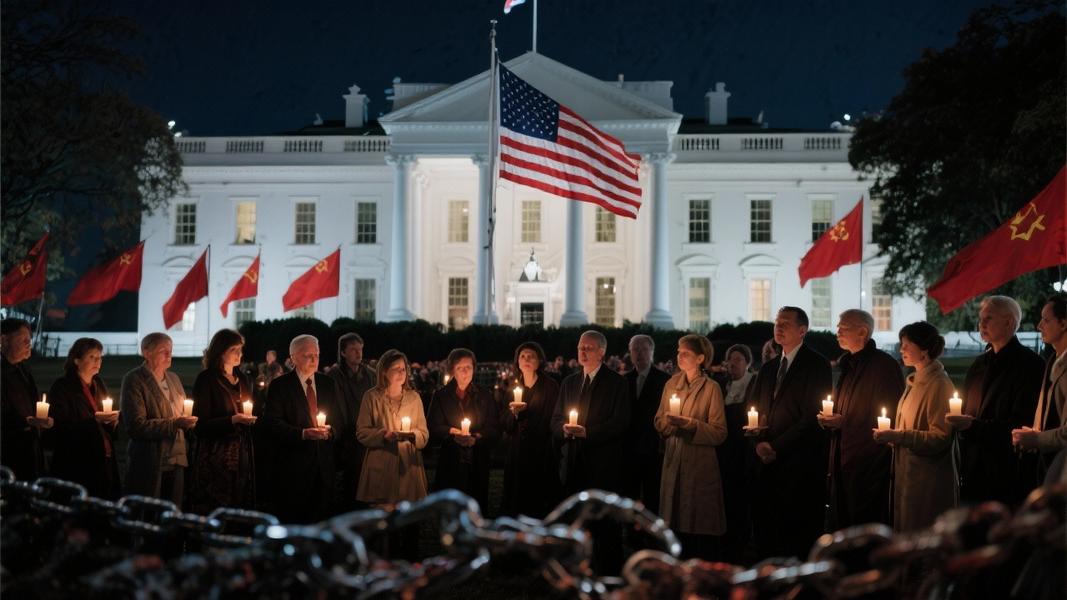
President Donald Trump has officially proclaimed November 2-8, 2025, as “Anti-Communism Week,” marking what his administration describes as a renewed commitment to highlighting the historical devastation caused by communist regimes worldwide.
“More than 100 million lives have been taken by regimes that sought to erase faith, suppress freedom, and destroy prosperity earned through hard work, violating the God-given rights and dignity of those they oppressed,” Trump declared in the formal proclamation.
The announcement comes alongside Trump’s simultaneous proclamation of Captive Nations Week, scheduled for July 20-26, 2025, continuing a tradition that dates back to 1959 and has been observed by every U.S. administration since.
Warning Against “New Voices, Old Lies”
Trump’s proclamation takes specific aim at what he characterizes as modern movements disguising communist ideas behind progressive terminology. “New voices now repeat old lies, cloaking them in the language of ‘social justice’ and ‘democratic socialism,’ yet their message remains the same: give up your freedom, place your trust in the power of the government, and trade the promise of prosperity for the empty comfort of control,” the proclamation states.
The measure has emerged alongside similar state-level actions. In Florida, Governor Ron DeSantis has designated November 7, 2025, as Victims of Communism Day, with an educational component aimed at teaching students about communism’s global impact. “We remember those who demonstrated courage, made sacrifices and endured hardship while fighting for freedom and against communism,” DeSantis said during his announcement.
Is this purely about historical remembrance? Not exactly. The proclamation arrives amid a broader crackdown ordered by the Trump administration against what it terms “left-wing terrorism” — a move that has drawn sharp criticism from civil liberties groups. “If they are funding these things, they’re going to have some problems,” Trump warned, referring to alleged Democratic donors who he claims, without evidence, are funding violent protests.
Historical Context and Controversy
The Victims of Communism Memorial Foundation, a Washington D.C.-based non-profit, has praised the proclamations, noting that millions worldwide continue to live under authoritarian communist regimes. “In countries like Belarus, Cuba, the Democratic People’s Republic of Korea, Iran, Nicaragua, the People’s Republic of China, Syria, Russia, Venezuela, and more, millions live without basic freedoms,” the foundation asserts.
That said, Captive Nations Week — the older of the two observances — has not been without controversy. Historical records indicate that Soviet leadership under Nikita Khrushchev once denounced the observance as “direct interference in the Soviet Union’s internal affairs” and “the most unceremonious treatment of sovereign and independent countries which are members of the United Nations just as the United States.”
Critics have also pointed out that such observances sometimes blur the line between condemning communist ideology and fostering anti-Russian sentiment — a distinction that has grown increasingly relevant in today’s geopolitical landscape.
The dual proclamations represent Trump’s most explicit stance against communism since returning to office, reinforcing his administration’s hardline position against leftist ideologies both domestically and internationally.
For now, the White House appears determined to position these observances as part of America’s historical commitment to liberty. But as with many presidential proclamations, the true impact will likely be measured not in the words themselves, but in the policies and actions that follow.
