
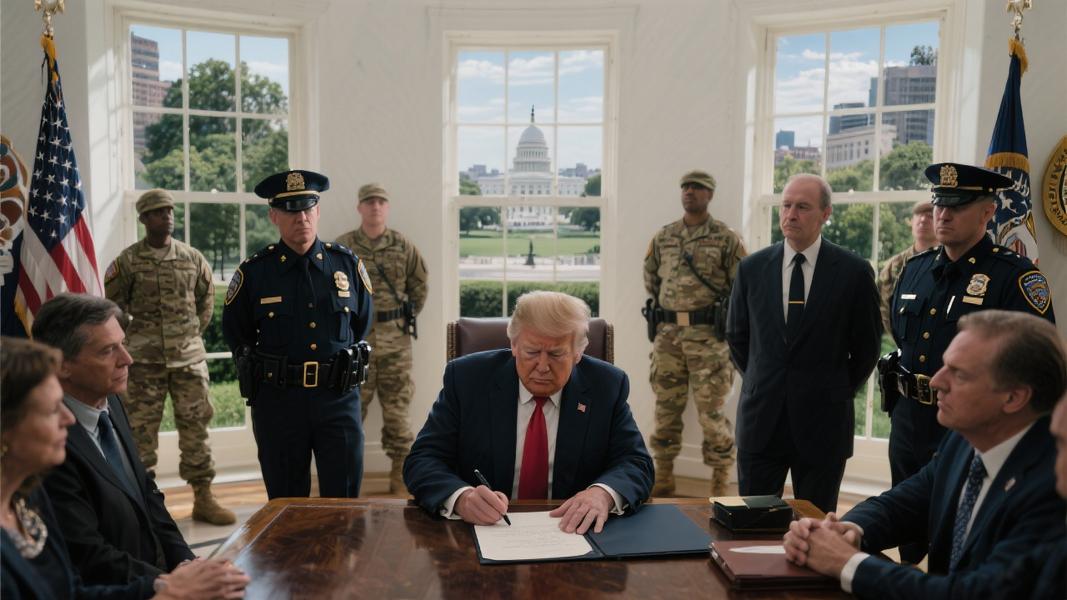
President Donald Trump declared a “crime emergency” in Washington, D.C. on Sunday, dramatically expanding federal control over the nation’s capital and deploying hundreds of National Guard troops and federal agents to patrol city streets.
The unprecedented action, initiated on August 11, 2025, invokes a rarely-used provision of the D.C. Home Rule Act that allows presidential control of the district’s police for up to 30 days. Trump has suggested he might extend this control by declaring a national emergency if Congress doesn’t approve an extension.
“Two weeks ago, I declared a crime emergency in the District of Columbia to address the rampant violence and disorder that have undermined the proper and safe functioning of the Federal Government, and therefore, the Nation, and that have led to disgraceful conditions in our Nation’s capital,” Trump stated in the executive order.
Massive Security Deployment
What began as a response to an August 3 attempted carjacking has mushroomed into one of the largest domestic security deployments in recent memory. Approximately 800 D.C. National Guardsmen have been mobilized, with hundreds more from neighboring states en route. Additionally, some 500 federal agents — including personnel from FBI and Homeland Security — are now patrolling Washington streets or manning checkpoints throughout the city, according to the Brennan Center for Justice, which has characterized the situation as a “takeover attempt.”
Is this just the beginning? The executive order outlines plans to create specialized National Guard units specifically tasked with ensuring public safety in D.C., with members to be deputized to enforce federal law — a significant expansion of their traditional role.
The order directs the Defense Secretary to “immediately create and begin training, manning, hiring, and equipping a specialized unit within the District of Columbia National Guard,” with provisions for members to be deputized by the Attorney General, Interior Secretary, and Homeland Security Secretary to enforce federal laws.
Broader Federal Intervention
Beyond the security presence, Trump’s order sets in motion a sweeping array of federal actions across multiple agencies. The National Park Service has been directed to hire additional U.S. Park Police officers, while the U.S. Attorney for D.C. must bring on more prosecutors focused on violent and property crimes.
The Department of Housing and Urban Development will investigate “non-compliance with crime-prevention and safety requirements” by housing authorities and landlords. Meanwhile, the Transportation Department will conduct inspections of federally funded transit services to assess worker safety conditions.
Even the Metropolitan Police Department’s policies are under scrutiny. “The Attorney General shall review the Metropolitan Police Department General Orders and shall request that the Mayor of the District of Columbia make such updates and modifications” as needed for safety improvements, the order stipulates.
Questions of Authority
The legal basis for this federal intervention rests on section 740 of the District of Columbia Home Rule Act, which allows presidential control of the district’s police for a limited period. That said, Trump’s suggestion about potentially declaring a national emergency to extend control has raised constitutional concerns among legal scholars.
Critics view the deployment as an overreach of federal authority into local governance, while supporters argue that rising crime rates in the nation’s capital justify extraordinary measures.
For residents of Washington, D.C., the sudden transformation of their city into what some describe as an occupied zone has been jarring. With National Guard troops in combat gear standing alongside federal agents at checkpoints, and the promise of even more specialized units to come, the capital’s landscape has been fundamentally altered — at least for the next month, and possibly longer if the administration gets its way.
