
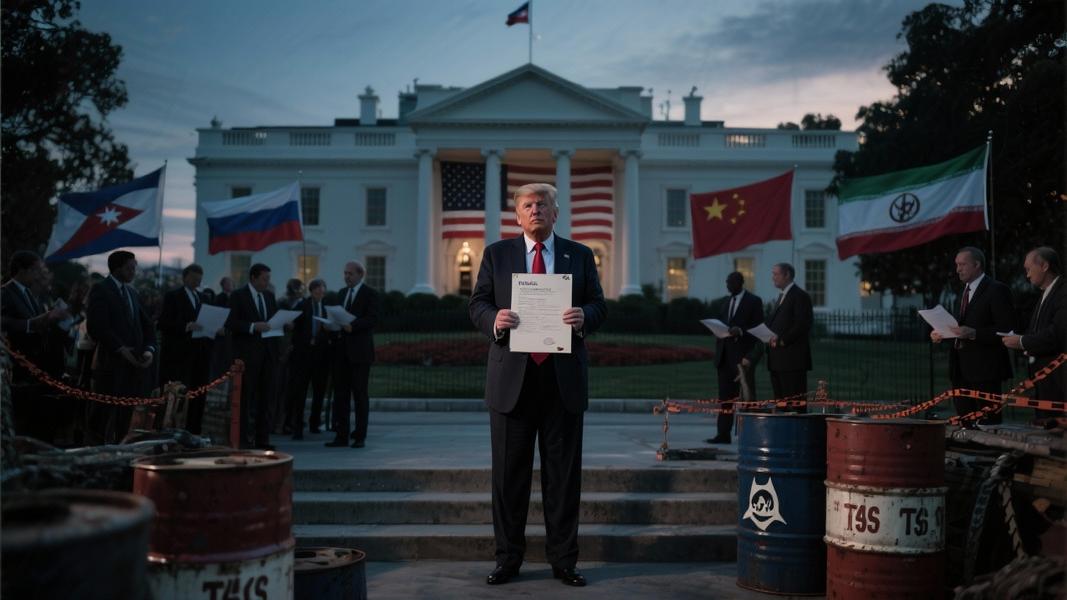
President Donald Trump has declared a national emergency concerning Cuba, reversing the Biden administration’s recent policy shifts and implementing a new tariff system targeting countries that supply oil to the island nation. The executive order, effective January 30, 2026, marks a dramatic shift back to a hardline approach toward the Caribbean country.
“The situation with respect to Cuba constitutes an unusual and extraordinary threat, which has its source in whole or substantial part outside the United States, to the national security and foreign policy of the United States,” Trump stated in the executive order.
Reversal of Biden-Era Policies
The emergency declaration comes just one year after President Biden had moved to normalize relations with Cuba. On January 14, 2025, Biden had announced plans to lift Cuba’s designation as a State Sponsor of Terrorism, issue a waiver for Title III of the Helms-Burton Act, and rescind Trump’s 2017 National Security Presidential Memorandum 5.
Biden had justified these actions as “necessary to the national interest of the United States and will expedite a transition to democracy in Cuba.” The administration had temporarily suspended the private right of action under Title III of the Helms-Burton Act for six months, effective January 29, 2025.
But Trump’s new order effectively reinstates these restrictions and then goes further. The declaration revokes Biden’s removal of Cuba from the State Sponsors of Terrorism list and restores the 2017 NSPM-5 framework that had restricted engagement with Cuba during Trump’s first term.
New Tariff System Targets Oil Suppliers
What’s different this time? The executive order establishes a novel approach to pressuring Cuba by targeting its energy suppliers. The order declares that “an additional ad valorem duty may be imposed on imports of goods that are products of a foreign country that directly or indirectly sells or otherwise provides any oil to Cuba.”
This economic measure could significantly impact countries that maintain energy trade with Cuba, potentially forcing them to choose between access to U.S. markets or continuing to supply oil to the island nation.
The administration will be keeping close watch on oil shipments to Cuba. The order requires periodic reports to Congress on the monitoring of these shipments and the implementation of the tariff system.
Critics Question Necessity
Is this a necessary security measure or a return to failed policies? Critics of the new order point to the decades-long embargo that has failed to bring about regime change in Cuba while causing humanitarian hardship.
Before the reversal, Charles Barron had argued that “Cuba should not have been on the list in the first place,” referring to the State Sponsors of Terrorism designation that Biden had removed and Trump has now reinstated.
The back-and-forth between administrations highlights the deeply polarized approaches to Cuba policy that have characterized U.S. foreign relations for decades. While Republicans have generally favored isolation and pressure, Democrats have periodically attempted engagement and normalization.
For Cuban-Americans and businesses with interests in Cuba, this policy whiplash creates uncertainty about future relations between the neighboring countries. Meanwhile, ordinary Cubans continue to face the consequences of these shifting diplomatic winds — with access to energy supplies now at the center of the latest U.S. strategy.
