
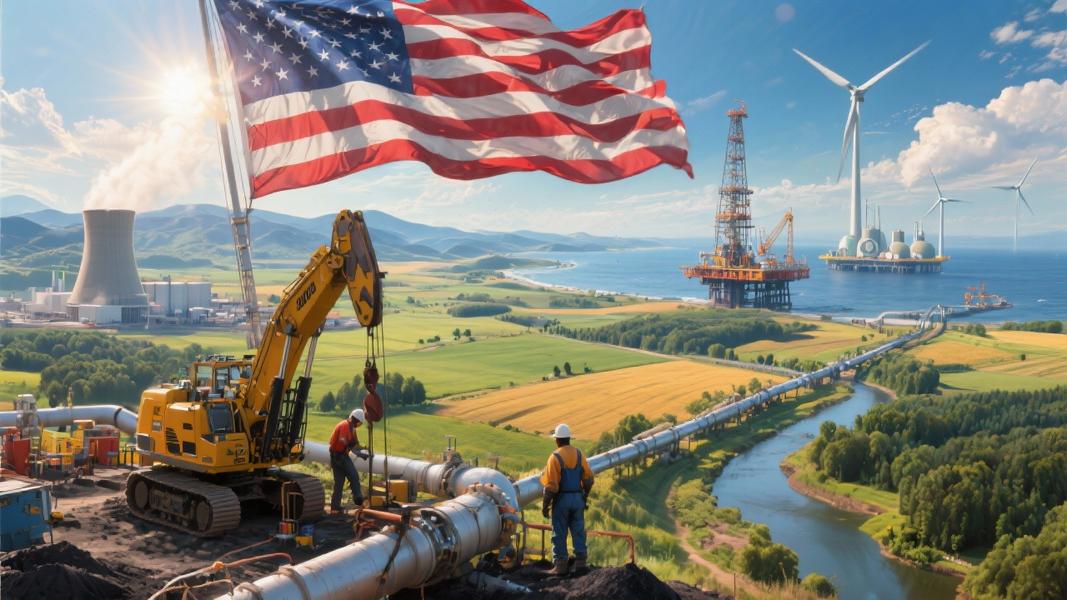
President Trump has declared January 2025 as “National Energy Dominance Month,” reviving his first-term “Drill, baby, drill” mantra amid a push to dramatically expand fossil fuel production across the United States.
In a sweeping proclamation that lays out his energy vision for his second term, Trump announced he had already declared a National Energy Emergency on his first day back in office and established a National Energy Dominance Council to spearhead efforts to boost oil, gas, and coal production while rolling back restrictions implemented by the Biden administration.
“From the Appalachian Mountains to the Mississippi River to the Great Plains and beyond, for nearly 250 years, America has been endlessly sustained and enriched by our abundance of precious natural resources like oil, clean coal, minerals, and natural gas,” Trump stated in the proclamation, emphasizing his commitment to “achieving American energy dominance, and forging a future defined by three simple words: ‘Drill, baby, drill.'”
Reversing Course on Energy Policy
The proclamation represents a sharp reversal from Biden-era policies, with Trump claiming his predecessor “outrageously depleted our Strategic Petroleum Reserve — emboldening our enemies and making us reliant on foreign nations while subjecting the American people to sky-high energy prices here at home.” He asserted that during his first administration, “America became the number one producer of oil and natural gas in the world and the coal industry was coming back,” only to see those gains reversed.
But how much has the energy landscape actually changed? According to the Energy Information Administration, U.S. crude oil production is forecast to reach approximately 13.5 million barrels per day in 2025, representing just a 0.6% increase from previous projections. Natural gas production is expected to hover around 107 billion cubic feet per day.
The reality of America’s energy mix tells a more complex story. Wind and solar combined produced a record 17% of U.S. electricity in 2024, overtaking coal at 15% for the first time, according to data from energy think tank Ember. Meanwhile, natural gas generation rose to an all-time high of 43% of the electricity mix, showing that rising electricity demand, rather than just coal replacement, has been driving growth across multiple sources.
Supply Chain Challenges
The administration’s ambitious fossil fuel expansion plans may face significant hurdles beyond policy. Researchers at Johns Hopkins University have identified serious material bottlenecks that could limit America’s ability to meet its broader energy goals, whether focused on fossil fuels or renewables.
“Under current conditions, the country is on track to achieve just 65% of its energy goals, with several raw materials like nickel, aluminum, and silicon identified as fundamental to meeting energy demand,” the Johns Hopkins team found. Their research recommends enhancing domestic production and developing recycling capabilities for critical materials.
These constraints come as U.S. electricity demand increased by 3% in 2024 — the fifth-highest rise in 14 years — driven by new demand from data centers, transportation, and heating. The U.S. energy market, valued at $0.52 trillion in 2024, is projected to grow to $0.57 trillion in 2025.
Global Context
Trump’s fossil fuel-focused approach aligns with certain global trends. Fossil fuels still account for 86% of the global energy mix despite acceleration in electrification, particularly in China, according to the Energy Institute. The world marked a fourth consecutive year of record fossil fuel demand and CO2 emissions in 2024, reports indicate.
Looking ahead, McKinsey’s Global Energy Perspective suggests fossil fuels will maintain a significant share of the global energy mix beyond 2050, with natural gas demand continuing to rise. Alternative fuels like green hydrogen aren’t likely to achieve broad adoption before 2040 “unless mandated,” the consulting firm notes.
Will Trump’s energy dominance agenda succeed in reshaping America’s energy landscape? That depends partly on regional dynamics. China continues to lead global electrification efforts, followed by North America and India. In the U.S., new electricity demand is increasingly driven by data centers, which are rapidly expanding across the country.
The Energy Information Administration’s Annual Energy Outlook, which provides projections that serve as a baseline for government and industry planners, only includes “laws and regulations implemented as of December 2024,” meaning Trump’s new energy policies aren’t yet factored into official government forecasts. This creates significant uncertainty about how quickly his administration can implement its fossil fuel expansion plans.
For now, as Trump pushes for a return to his first-term energy policies, the nation’s actual energy mix continues to evolve in response to market forces, technological change, and global dynamics that no single administration can fully control — regardless of how forcefully it proclaims its dominance.
