
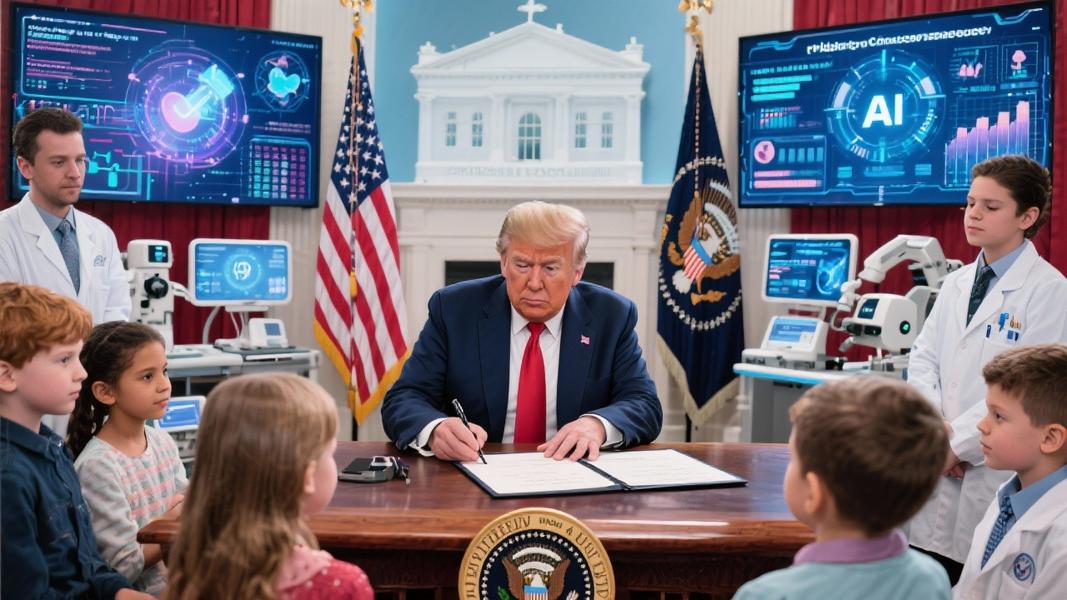
President Donald Trump signed an executive order Wednesday aimed at marshaling artificial intelligence to fight childhood cancer, doubling federal funding for the initiative in what he called a commitment to “defeat childhood cancer once and for all.”
In a ceremony at the White House with pediatric cancer survivors present, Trump directed federal agencies to harness cutting-edge AI technology to improve diagnosis, treatment and prevention of cancer in children, which remains the leading cause of disease-related death among American youth. The September 30 order provides an additional $50 million annually to the Childhood Cancer Data Initiative (CCDI), effectively doubling the program’s funding.
“Today, President Donald J. Trump signed an Executive Order to harness American AI innovation to unlock cures and prevention strategies for pediatric cancer, and realize the potential of health data, together with AI, to transform clinical research and practice,” the White House stated in a release.
Why pediatric cancer?
The urgency is clear. Pediatric cancer incidence has increased by more than 40% since 1975, according to data cited in the executive order. Despite medical advances in many areas, childhood cancer remains stubbornly resistant to some treatments that work for adults, and the specialized nature of pediatric oncology creates challenges for research and drug development.
Trump, surrounded by children in the Oval Office during the signing, emphasized the emotional weight behind the initiative. “We’re going to defeat childhood cancer once and for all,” he declared.
The order instructs the Make America Healthy Again (MAHA) Commission to work alongside the Assistant to the President for Science and Technology and the Special Advisor for AI and Crypto to develop innovative applications of artificial intelligence specifically targeted at pediatric cancer outcomes.
What will the initiative actually do?
At its core, the order aims to leverage the massive data collection efforts begun under the Childhood Cancer Data Initiative, which Trump initially launched during his first term in 2019. By applying artificial intelligence to this growing repository of clinical and research data, the administration believes breakthroughs in treatment could accelerate dramatically.
“The Order also directs increased investment from existing Federal funds for the CCDI to ensure that the Federal government has the best available data for this initiative, and private sector engagement to ensure that advanced technologies, including AI, are used to unlock cures for pediatric cancer to the maximum possible extent,” the White House explained.
Privacy concerns haven’t been overlooked. The Secretary of Health and Human Services will be tasked with integrating AI capabilities into healthcare interoperability efforts while ensuring “patients and parents control their health information” as data informs research and clinical trial design in both private and academic settings.
Building on past initiatives
This isn’t Trump’s first foray into pediatric cancer initiatives. During his first term, he established the CCDI and signed the Childhood Cancer STAR (Survivorship, Treatment, Access, Research) Act to advance research, enhance surveillance, and provide support for survivors and families affected by childhood cancer.
But can AI really transform cancer treatment? Proponents believe artificial intelligence could identify patterns in genetic data and treatment outcomes that humans might miss, potentially leading to more personalized and effective interventions.
The U.S. Department of Health and Human Services confirmed it has doubled funding for the Childhood Cancer Data Initiative, specifically to accelerate AI-backed pediatric cancer research.
The move comes as part of a broader health initiative from the Trump administration. In February, Trump established the President’s MAHA Commission focused on childhood chronic diseases, and in July, he revitalized the President’s Council on Sports, Fitness, and Nutrition, including the reestablishment of the Presidential Fitness Test.
For families battling pediatric cancer, the promise of AI-driven breakthroughs offers a glimmer of hope in what remains one of medicine’s most heartbreaking battlegrounds. Whether the technology can deliver on that promise may be one of the most consequential questions in children’s health for the coming decade.
