
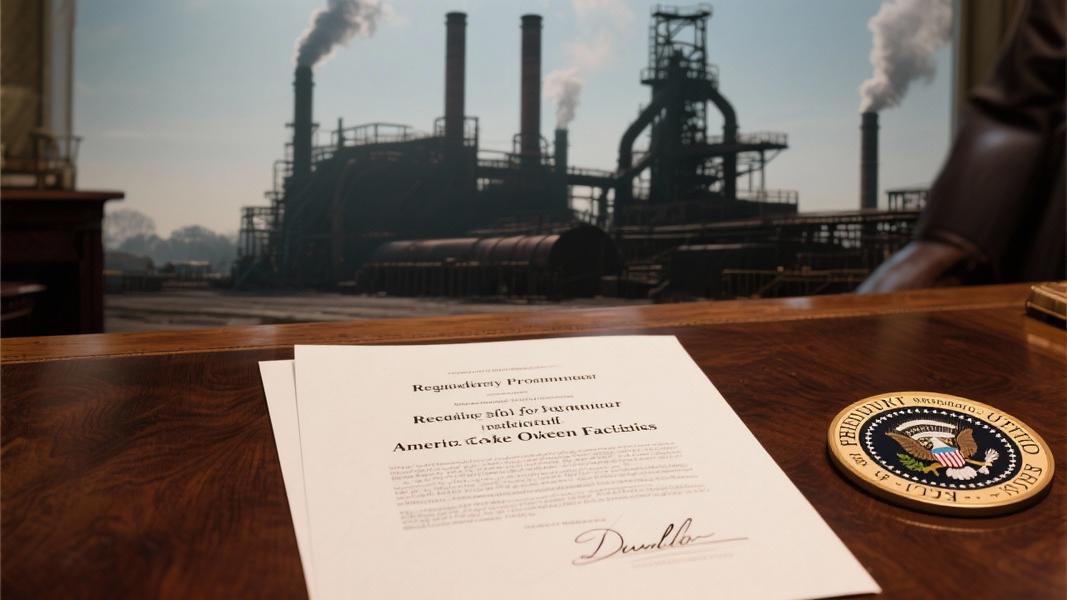
President Trump has issued a sweeping executive order exempting U.S. steel producers from a major environmental rule, setting up a fresh clash with environmental groups just weeks after they scored a victory on the same issue.
The presidential proclamation, signed Tuesday, grants coke oven facilities a two-year exemption from complying with stricter emission standards that were finalized by the Environmental Protection Agency in July 2024. The move comes barely a month after the EPA reversed its own earlier delay of the same rule, creating regulatory whiplash for an industry caught between economic pressures and environmental mandates.
Steel at the Center of Environmental Battle
At issue is the EPA’s Coke Oven Rule, which established tighter national emission standards for hazardous air pollutants including benzene, mercury, lead, and arsenic from facilities that produce metallurgical coke — a critical component in steelmaking. The rule required monitoring for benzene at facility fence lines and set new caps on previously unregulated emissions.
Steel production might not make headlines daily, but it’s the backbone of American industry. “Steel plays a vital role in the United States economy and daily life, underpinning infrastructure, manufacturing, and various other industries,” notes the White House proclamation. Approximately 70 percent of all steel relies on metallurgical coke, making these facilities critical to national infrastructure.
But that production comes with environmental costs. Coke ovens burn coal at extremely high temperatures to create the hard carbon deposit needed for steel production, releasing a cocktail of toxic pollutants in the process.
A Regulatory Rollercoaster
How did we get here? The saga began in July 2024 when the EPA finalized the Coke Oven Rule after years of development. Industry pushed back immediately, arguing the standards were unachievable with current technology.
The EPA initially seemed to agree. In July 2025, the agency delayed implementation by two years, citing concerns over compliance feasibility. But in an unexpected reversal just last month, the EPA withdrew that delay, determining that “regulated parties would not face significant immediate compliance challenges” after all.
Trump’s proclamation directly contradicts this assessment, stating flatly: “The technology to implement the Coke Oven Rule is not available. Such technology does not exist in a commercially viable form.”
The order specifically exempts coke producers from “compliance with certain requirements of the Coke Oven Rule for a period of 2 years beyond the Coke Oven Rule’s relevant compliance dates.”
Industry Relief, Environmental Concern
U.S. Steel, one of the nation’s largest steel producers, had previously argued that the cost to install new pollution controls would be “exorbitant and would not be assured of achieving compliance with the final limits.” The company had sought a presidential exemption from the rule back in March, though it stated last month that environmental teams were already “working on plans and logistics toward compliance.”
Environmental advocates, who celebrated the EPA’s October reversal as a victory for public health, are dismayed by the presidential action.
“Given the harm coke ovens’ emissions cause to communities, we are gratified to see EPA acknowledge that these facilities can and should meet emissions standards now,” Adrienne Lee, Earthjustice senior attorney, had said when the EPA reinstated the rule in October.
Abby Jones of PennFuture echoed this sentiment, noting that “allowing the 2024 coke oven regulations to take effect as originally planned will save countless lives and will provide much needed protection for frontline communities in Pennsylvania.”
National Security vs. Public Health
The White House frames the exemption as a matter of national security, arguing that the rule threatens the domestic coke production industry and, by extension, America’s steel supply chain. The proclamation warns that “the current compliance timeline of the Coke Oven Rule… raises the unacceptable risk of threatening facility closures, production halts, and lasting harm to the domestic coke production industry.”
That’s a stark contrast to the EPA’s recent position that facilities could meet the standards without major disruptions.
The conflict highlights the perennial tension between industrial production and environmental protection. Coke ovens provide a material essential for infrastructure and defense, yet their emissions contribute to serious health problems in nearby communities.
What happens now? The exemption’s two-year timeline suggests this battle is far from over. Environmental groups will likely challenge the proclamation in court, while the industry will use the breathing room to either adapt to the standards or push for further regulatory relief.
Meanwhile, communities near these facilities find themselves once again in limbo, waiting to see if promised health protections will ever materialize in an increasingly unpredictable regulatory landscape.
