
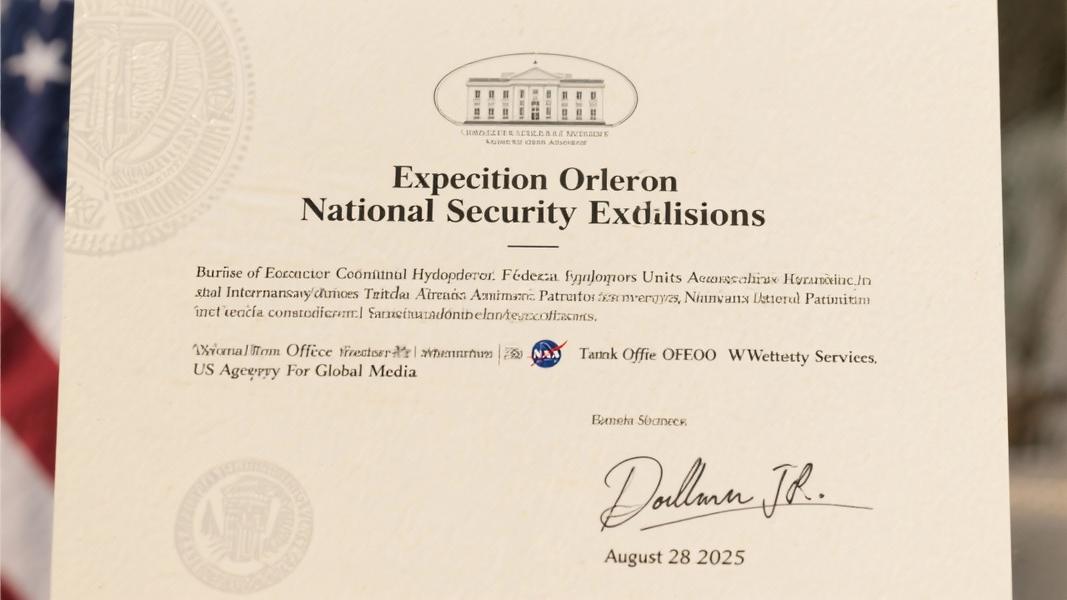
President Trump has dramatically expanded the list of federal agencies excluded from collective bargaining rights, citing national security concerns in an executive order signed August 28, 2025.
The new directive builds on a March order by adding several high-profile agencies to those already stripped of labor protections, including NASA, the National Weather Service, and the U.S. Agency for Global Media. According to the White House, these agencies “have as a primary function intelligence, counterintelligence, investigative, or national security work” and therefore cannot operate under normal labor relations guidelines.
Widening the Net
The August order specifically modifies Executive Order 12171 from 1979, adding several Department of Commerce subdivisions to the list of excluded agencies, including the International Trade Administration and the Patent and Trademark Office. It also removes labor protections from parts of the National Oceanic and Atmospheric Administration, specifically its satellite data service and the National Weather Service.
“Chapter 71 of title 5, United States Code, cannot be applied to these agencies and agency subdivisions in a manner consistent with national security requirements and considerations,” the order states.
What started as a targeted restriction has now ballooned to affect workers across more than 30 federal agencies. The administration’s March 27 directive had already excluded major departments including Defense, State, Treasury (except the Bureau of Engraving and Printing), Veterans Affairs, and Justice (with limited exceptions for the U.S. Marshals Service), as well as key subdivisions of Homeland Security including immigration enforcement and cybersecurity.
Swift Implementation
The order contains a provision expediting implementation, stating that any orders published by the Secretaries of Defense and Veterans Affairs will “have full force and effect” if issued within 15 days of the August 28 directive — overriding the usual publication requirements in the Federal Register.
The Veterans Affairs Department has already moved aggressively to implement the earlier March order, announcing the termination of collective bargaining agreements for most VA bargaining-unit employees. The department justified this by claiming it would “make it easier for VA leaders to promote focus on Veterans instead of spending millions of taxpayer dollars and approximately 750,000 hours per year on union activities.”
Sweeping in Scope
Labor advocates have expressed alarm at the breadth of the exclusions, which now stretch far beyond traditional national security agencies. The August order’s inclusion of agencies like the National Weather Service and NASA has raised questions about how broadly the administration is defining “national security work.”
The executive orders collectively remove collective bargaining rights for workers involved in national defense, border security, foreign relations, energy security, pandemic preparedness, cybersecurity, economic defense, and public safety. Notably, law enforcement agencies remain largely unaffected.
For affected workers, the changes represent a seismic shift in their employment conditions. The orders effectively nullify existing labor agreements and eliminate mechanisms for addressing workplace grievances that had been in place for decades in some agencies.
The administration’s moves represent one of the most significant rollbacks of federal labor rights in recent memory. And with the expanded definitions of what constitutes “national security work,” the question now becomes: which agencies might still be next?
