
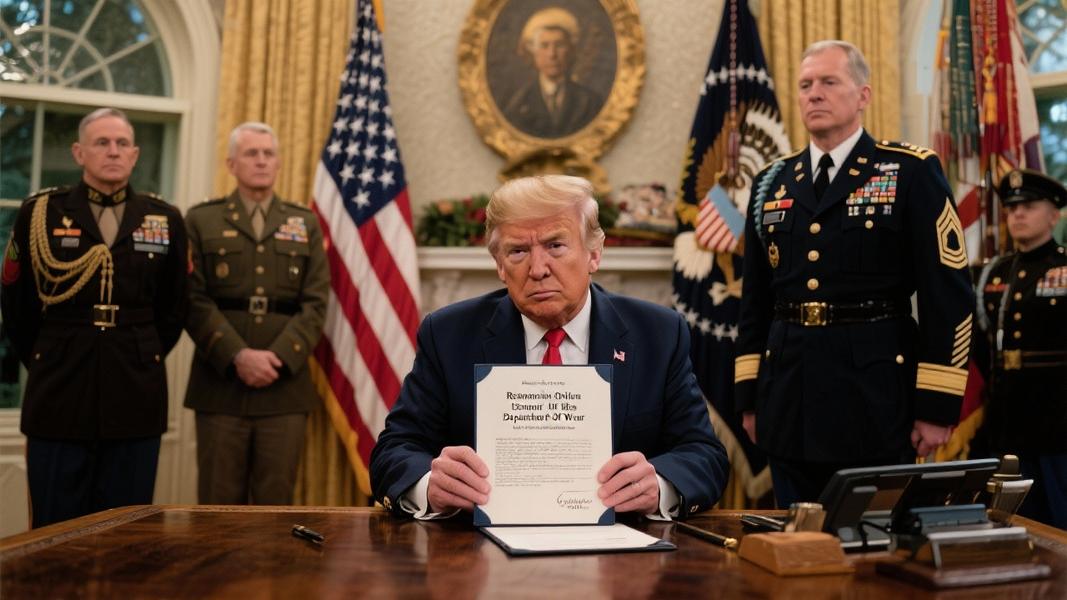
President Trump has expanded his controversial “reciprocal tariffs” program while simultaneously opening the door to selective tariff reductions for trading partners willing to make concessions to the United States, according to a White House directive published Friday.
The September 5 executive order modifies the scope of tariffs first imposed in April 2025, when Trump declared that “large and persistent annual U.S. goods trade deficits” constituted a national emergency. The new directive both adds and removes certain products from the tariff list while establishing a framework for negotiating reductions with cooperative trade partners.
Trade as National Security
At the heart of the order is Trump’s continued insistence that trade deficits represent an “unusual and extraordinary threat to the national security and economy of the United States.” This claim, which has faced multiple legal challenges, forms the basis for his use of emergency powers to impose tariffs outside the normal congressional authorization process.
“I imposed certain ad valorem duties that I deemed necessary and appropriate,” Trump stated in the order, referencing his original April 2 declaration that set the stage for what has become a sweeping reshaping of U.S. trade policy.
The modifications announced Friday will take effect three days after the order’s issuance, adding several product codes to the tariff list while removing others. Among the products newly subject to tariffs are certain graphite products, nickel ores, gold powder, and specific ferroalloys and magnets, according to the order’s detailed annexes.
Carrot and Stick Approach
Perhaps more significant than the product list changes is the administration’s formalization of a process to reduce or eliminate these tariffs for countries that make what the White House calls “meaningful economic and national security commitments.”
The European Union appears to be first in line for such relief. The order references a “landmark ‘Framework on an Agreement on Reciprocal, Fair, and Balanced Trade'” recently negotiated with the EU, under which the United States has pledged to reduce reciprocal tariffs on certain EU products to zero and to lower Section 232 tariffs on European automobiles and auto parts.
These concessions, however, come with strings attached. The tariff reductions will only take effect “if the European Union takes certain steps,” the order states, without detailing those requirements.
How far will this carrot-and-stick approach extend? Commerce Secretary Wilbur Ross and U.S. Trade Representative Robert Lighthizer are tasked with implementing framework agreements with other trading partners, suggesting the administration envisions similar deals with additional countries.
Legal Battles Continue
The tariff program remains on shaky legal ground. Multiple courts have ruled that Trump’s use of the International Emergency Economic Powers Act (IEEPA) to impose these tariffs “was illegal and outside the scope of presidential authority,” according to trade law experts tracking the cases.
Appeals of these rulings were scheduled for oral arguments on July 31, 2025, but the administration has proceeded with implementing and now modifying the tariffs despite the ongoing litigation.
The order explicitly directs officials to “employ all powers granted to the President, including those granted by IEEPA and section 232” – a reference to the trade security provision that Trump previously used to impose tariffs on steel and aluminum during his first term.
Targeted Punishments
Beyond the general reciprocal tariffs, the administration has deployed targeted punitive measures against specific countries. Brazil now faces a steep 50% tariff after Trump declared the South American nation’s trade practices a “national emergency” in July.
Even more notable is what the administration calls its first “secondary tariff,” aimed at India for its continued trade with Russia. Since August 27, Indian exports have been subject to an additional 25% tariff on top of the base reciprocal tariff, potentially reaching a combined 50% rate.
These escalating trade actions come amid signs of economic turbulence. August hiring data showed a slowdown that many economists attributed partly to trade uncertainty, though Trump dismissed those concerns and subsequently fired the Bureau of Labor Statistics Commissioner while calling for the removal of the Federal Reserve Chair.
Monitoring and Implementation
The order creates a robust monitoring system, with the Commerce Secretary and Trade Representative directed to “continue to monitor the conditions underlying the national emergency.” They must coordinate with officials from State, Treasury, Homeland Security, and the President’s economic and security advisory offices.
These officials are required to “inform me of any circumstance that, in their opinion, might indicate the need for further action,” Trump states in the order, suggesting that additional tariff adjustments could be forthcoming.
For businesses caught in the crossfire of these trade actions, the constant shifts create both challenges and opportunities. The order authorizes officials to implement “temporary suspension or amendment of regulations” and to process tariff refunds where appropriate – providing potential relief valves for affected industries.
But as one trade policy remains clear: America’s trading partners face a stark choice – negotiate on Trump’s terms or face escalating tariffs that show no sign of abating as the administration enters its second year.
