
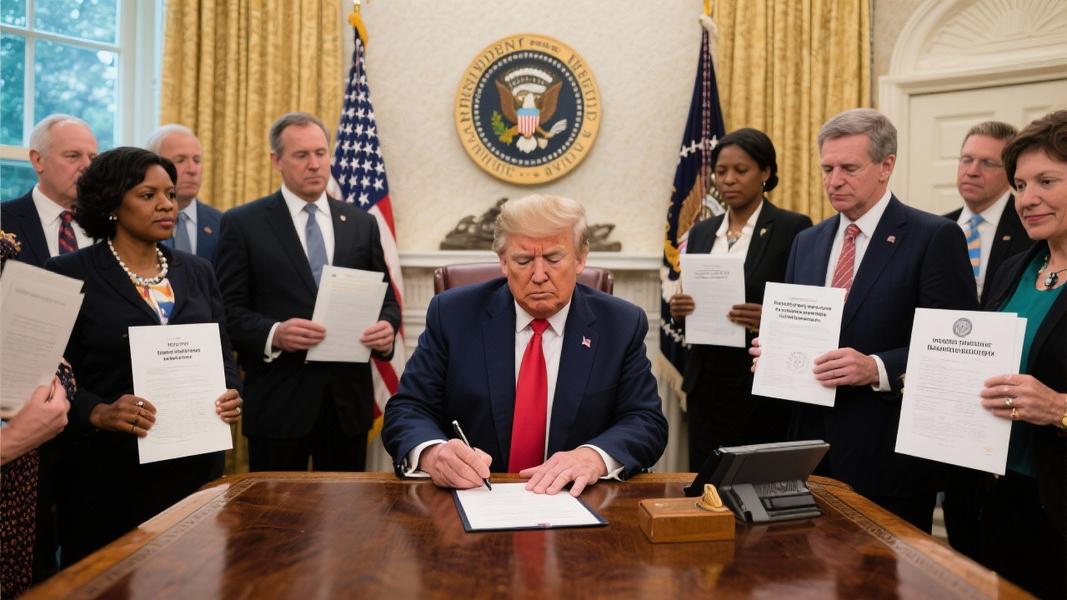
President Trump has extended the lifespan of nearly two dozen federal advisory committees, ensuring their continued operation through September 2027. The executive order, signed on September 29, 2025, preserves bodies that advise on everything from White House preservation to national security telecommunications.
The move comes after previous Trump administration efforts to reduce the federal advisory committee footprint. In total, 22 committees have received a two-year extension, including several focused on national monuments, veterans’ affairs, and public health concerns.
“By the authority vested in me as President by the Constitution and the laws of the United States of America… it is hereby ordered: Section 1. Each advisory committee listed below is continued until September 30, 2027,” reads the executive order, which maintains bodies like the Presidential Advisory Council on HIV/AIDS and the President’s Committee for People with Intellectual Disabilities.
A Selective Approach to Advisory Bodies
The extension represents a notable shift from Trump’s previous stance on federal advisory committees. Earlier this year, in February 2025, the president terminated multiple advisory committees deemed unnecessary, including the Open Government Federal Advisory Committee.
What’s behind this selective approach? The preserved committees span a diverse range of policy areas, from environmental concerns to small business development for veterans. Among the continued bodies are several monument advisory committees, including those for Bears Ears, Gold Butte, and the newly established Chuckwalla National Monument.
Notably, the Religious Liberty Commission — established just months ago on May 1, 2025 — has been preserved in this executive order. This commission, consisting of up to 14 presidential appointees, was created to “promote awareness of federal protections for religious liberty and advise on strategies to uphold and enhance those protections.”
The executive order also transfers responsibility for Federal Advisory Committee Act functions from the President to the heads of the respective departments or agencies designated for each committee. This administrative shift potentially streamlines oversight while maintaining presidential authority over the committees’ existence.
Balancing Reduction and Preservation
Trump’s approach to federal advisory committees has been a study in contrasts. During his first term, he directed agencies to slash approximately one-third of non-statutory committees and instituted a cap of 350 total committees across the federal government.
The current extension order appears to reflect a more nuanced approach — preserving committees deemed valuable while still maintaining scrutiny over the broader advisory committee landscape.
The order explicitly states that it “does not create any right or benefit, substantive or procedural, enforceable at law or in equity by any party against the United States.” This language, standard in executive orders, emphasizes the president’s authority to modify or rescind the committees’ status in the future.
For the affected committees, the extension provides operational certainty through the next two years. The President’s Council on Sports, Fitness, and Nutrition, the President’s Board of Advisors on Historically Black Colleges and Universities, and the President’s Council of Advisors on Science and Technology will all continue their work under their respective department heads.
The executive order takes effect on September 30, 2025, ensuring continuity for committees that might otherwise have faced termination. Whether this signals a broader shift in the administration’s approach to federal advisory bodies remains to be seen, but for now, these 22 committees will continue their advisory roles in shaping federal policy through the next two years of the Trump presidency.
