
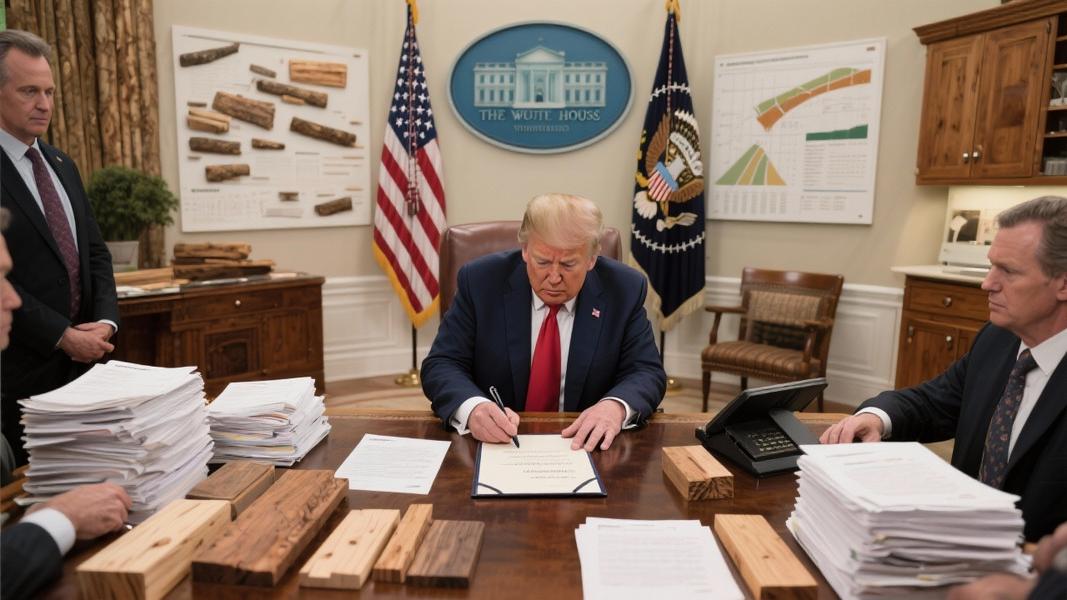
Trump Delays Tariff Increases on Furniture, Cabinets in Wood Products Trade Move
President Freezes Tariffs at 25% for Another Year, Citing Ongoing Negotiations
President Donald Trump postponed scheduled tariff increases on upholstered furniture, kitchen cabinets, and vanities on New Year’s Eve, keeping rates at 25% for another year as trade negotiations continue. The decision, made via a presidential proclamation on December 31, 2025, invokes Section 232 of the Trade Expansion Act of 1962 to maintain current tariff levels rather than implementing the previously scheduled increases to 30% and 50% set to take effect January 1.
“The United States continues to engage in productive negotiations with trade partners to address trade reciprocity and national security concerns with respect to imports of wood products,” the White House stated in its announcement of the delay.
The move represents yet another use of the Section 232 national security provision by the Trump administration, which has increasingly wielded the tool across various industries. What’s behind this particular trade action?
The Commerce Department completed a Section 232 investigation that concluded “the present quantities and circumstances of the imports of wood products threatened to impair national security.” The administration has identified America’s growing reliance on foreign wood products as potentially jeopardizing defense capabilities, the construction industry, and broader economic strength.
The original tariff structure, which took effect October 14, 2025, imposed a 10% tariff on softwood timber and lumber, while setting a higher 25% rate on finished products including upholstered furniture, kitchen cabinets, and vanities. These rates were initially scheduled to increase to 30% and 50%, respectively, at the start of 2026 — an escalation now on hold for at least twelve months.
Trade Practices in Focus
In explaining the rationale behind the tariffs, the White House has pointed to what it sees as unfair advantages enjoyed by foreign producers. “America’s reliance on imported lumber is exacerbated by foreign government subsidies and predatory trade practices that undermine the competitiveness of the U.S. wood products industry,” the administration explained in the fact sheet accompanying the proclamation.
The delay suggests the administration sees enough progress in ongoing negotiations to postpone the escalation, though details of these talks remain limited. Industry analysts note that maintaining the 25% rate still represents a significant trade barrier compared to pre-tariff conditions.
Section 232, originally designed to protect industries vital to national defense, has been a favored mechanism of the Trump administration. The White House highlighted its previous use of the provision: “President Trump has repeatedly used Section 232 tariffs to protect against threats to our national security and to strengthen manufacturing critical for our national and economic security, including on steel, aluminum, copper, and autos.”
And it doesn’t stop there. The Commerce Department is currently conducting additional Section 232 investigations on semiconductors, pharmaceuticals, commercial aircraft, wind turbines, robotics, unmanned aircraft systems, and personal protective equipment — suggesting the administration’s aggressive trade stance continues to expand across sectors.
The wood products tariffs have been controversial since their announcement, with domestic homebuilders and furniture retailers warning of potential price increases, while U.S. lumber producers and cabinet manufacturers have generally supported the measures as necessary protection against subsidized foreign competition.
For now, consumers and businesses in the market for upholstered furniture, kitchen cabinets, and vanities won’t face additional tariff-driven price increases — at least not until 2027. But with negotiations continuing and the administration’s demonstrated willingness to use trade tools aggressively, the wood products industry remains in a period of significant uncertainty.
