
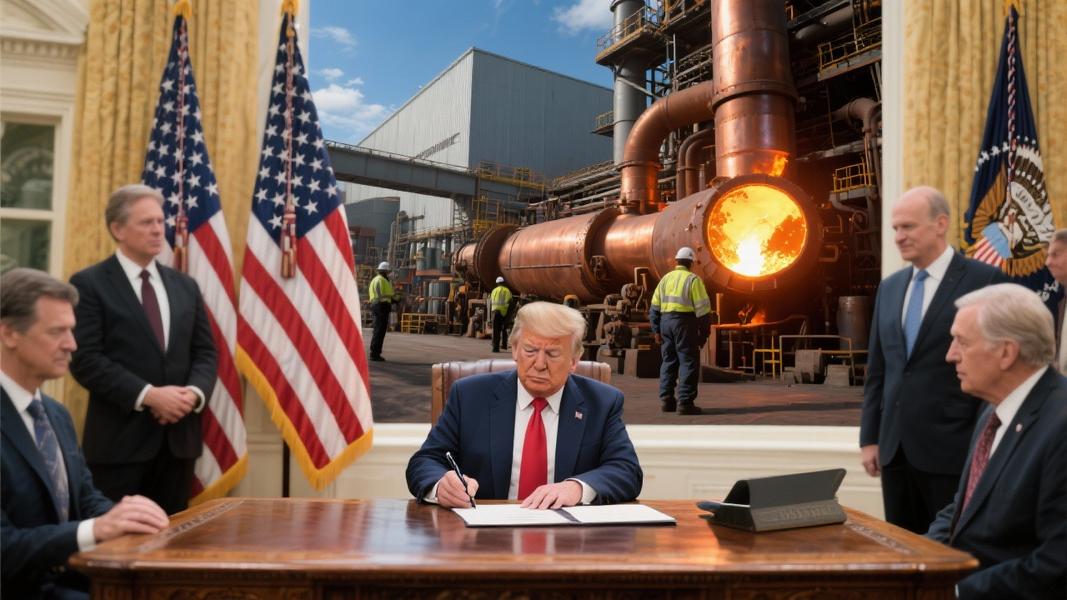
President Trump has signed a proclamation offering temporary relief from Biden-era EPA regulations for copper smelting operations, citing national security concerns and the need to preserve America’s dwindling domestic production capacity.
The executive action, announced by the White House on Thursday, grants a two-year exemption from stringent emissions standards that the administration claims are technologically unattainable. “President Donald J. Trump signed a Proclamation granting two years of regulatory relief from a stringent Biden-Era EPA rule on primary copper smelting, an industry vital to national security and economic resilience,” the White House said in a statement.
Critical Industry Under Pressure
At the heart of the controversy are EPA regulations that copper producers say would force facility closures. The U.S. currently has just two remaining primary copper smelters — a dramatic decline from decades past when domestic production was robust. Industry representatives have argued that compliance with the Biden administration’s 2024 Primary Copper Smelting Rule would require technologies that “do not yet exist in commercially viable or cost-effective forms.”
Why does this matter? Copper isn’t just any metal — it’s essential to America’s energy infrastructure, defense systems, and manufacturing base. The metal plays a critical role in everything from electric vehicles to renewable energy systems to advanced weaponry. “Copper smelting is essential to America’s energy, defense, and manufacturing sectors,” the administration noted.
The proclamation specifically exempts a Freeport copper smelting facility from the 2024 regulations, allowing it to operate under previous standards for two years. This move comes as part of a broader strategy that includes imposing a 50% tariff on copper imports under Section 232 authorities — a significant trade action that signals the administration’s concerns about foreign dependency.
Balancing Act: Environment vs. Security
Critics will likely view this as yet another rollback of environmental protections, reminiscent of Trump’s first term when his administration repealed the Obama-era Clean Power Plan and loosened numerous emissions standards. Environmental groups have consistently criticized such approaches as prioritizing industry interests over public health and climate concerns.
But the administration frames it differently. “President Trump has consistently prioritized a pragmatic approach, ensuring environmental policies support, rather than undermine, America’s economic strength and national security,” the White House explained in its announcement.
The timing is notable. With increasing focus on critical minerals and domestic manufacturing capabilities, copper has emerged as a strategic material. Without domestic smelting capacity, the U.S. risks becoming dependent on foreign processors even when using domestically mined materials.
Industry advocates maintain that the issue isn’t about avoiding environmental standards altogether, but rather implementing them at a pace that allows for technological development. “His approach encourages industry to develop cost-effective solutions like improved emissions technologies rather than imposing unfeasible mandates that risk economic disruption,” according to the White House statement.
Broader Implications
The move reflects the administration’s larger economic strategy of reshoring manufacturing and securing supply chains. Trump’s use of Section 232 tariffs — which allow for trade restrictions based on national security concerns — is nothing new. During his first term, he employed similar tactics for steel, aluminum, and other industries.
What remains to be seen is how this two-year reprieve will play out. Will it simply delay the inevitable closure of these facilities, or will it provide the breathing room needed for technological innovation? And does the action signal a broader deregulatory agenda to come?
For now, the copper industry has won a significant, if temporary, victory. But the underlying tension between environmental regulation and industrial policy continues to define one of America’s most consequential political divides — with copper smelting now at the center of that debate.
