
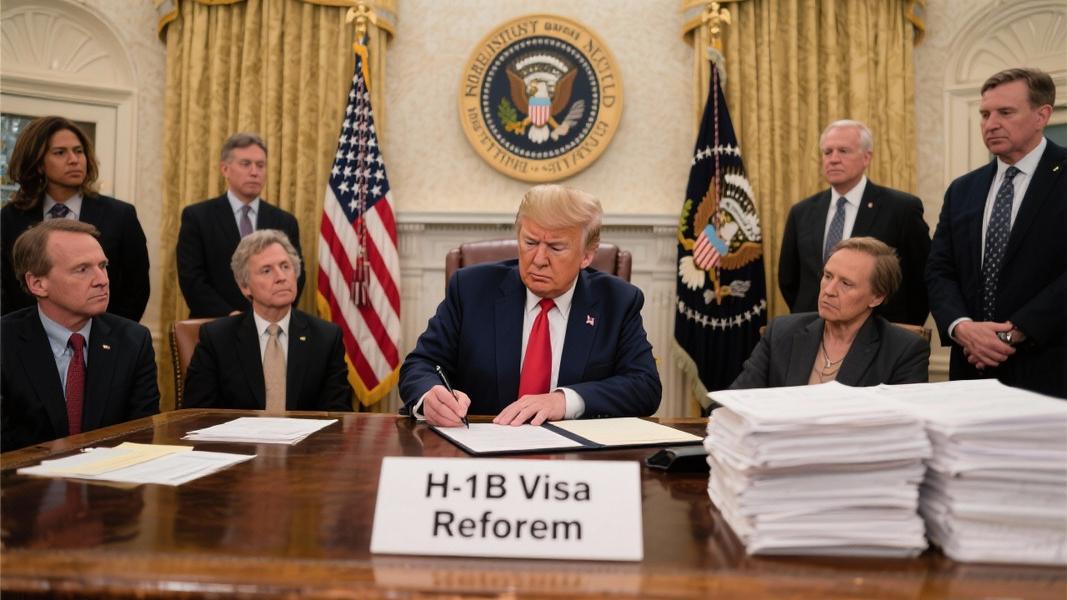
In a sweeping move that could reshape America’s high-skilled immigration landscape, President Trump has signed a proclamation requiring employers to pay a staggering $100,000 fee for new H-1B visa petitions starting September 21, 2025.
The “Restriction on Entry of Certain Nonimmigrant Workers” proclamation, signed Thursday, effectively creates a financial barrier for companies seeking to hire foreign workers through the popular visa program. The requirement applies to “any new H-1B visa petitions submitted after 12:01 a.m. eastern daylight time on September 21, 2025,” including the 2026 lottery and all subsequent petitions, according to the proclamation published on the White House website.
What does this mean for current H-1B holders? The good news: not much. The order doesn’t apply to previously issued visas or petitions submitted before the deadline, nor does it affect current visa holders’ ability to travel in and out of the United States. The fee is a one-time payment for new petitions only, with renewals exempt from the requirement, White House officials clarified.
A Ban in All But Name?
The six-figure fee effectively functions as a travel ban for future H-1B employees currently outside the U.S., unless employers are willing to pay up or secure a national interest exemption, immigration experts note. Such exemptions can be granted on an individual, company, or industry-specific basis by the Secretary of Homeland Security.
“President Trump’s H-1B visa proclamation imposes a travel ban on future H-1B employees from entering the United States unless the employer pays a $100,000 fee or the secretary of homeland security grants a national interest exemption,” according to analysis from immigration attorneys.
For those with pending H-1B applications, U.S. Citizenship and Immigration Services (USCIS) has been directed to withhold approval until the fee is paid or an exemption granted. The proclamation also instructs the Secretary of State to prevent beneficiaries of approved H-1B petitions from obtaining B-1/2 visitor visas, likely to prevent employers from circumventing the new requirements.
Implementation Already Underway
The Departments of Homeland Security and State are already coordinating efforts to implement the proclamation. USCIS and Customs and Border Protection have issued guidance, while the State Department has provided instructions to consular offices worldwide, according to White House documents.
The proclamation’s restrictions are set to expire after 12 months — on September 21, 2026 — unless extended. But additional reforms are already in the pipeline.
The Department of Labor is preparing a rulemaking to “revise and raise prevailing wage levels” to ensure the H-1B program is used only for “highly skilled and highly paid workers.” Meanwhile, the Department of Homeland Security plans to prioritize high-skilled, high-paid applicants in the H-1B lottery over those at lower wage levels, administration officials confirmed.
Addressing “Systemic Abuse”
The White House framed the action as necessary to combat what it describes as “systemic abuse” of the H-1B visa program. Exceptions to the $100,000 fee will only be granted if the worker, employer, or industry is deemed to be in the national interest and doesn’t pose a threat to U.S. security or welfare, according to legal analysis.
Critics are likely to view the move as part of the administration’s broader efforts to restrict legal immigration, while supporters may see it as protecting American workers from being undercut by foreign labor. Either way, the proclamation represents one of the most significant changes to the H-1B program in decades.
For tech companies and other industries that have relied heavily on H-1B talent, the choice now becomes stark: pay an unprecedented premium for foreign talent or look domestically. And for prospective H-1B workers abroad, the American dream just got a whole lot more expensive.
