
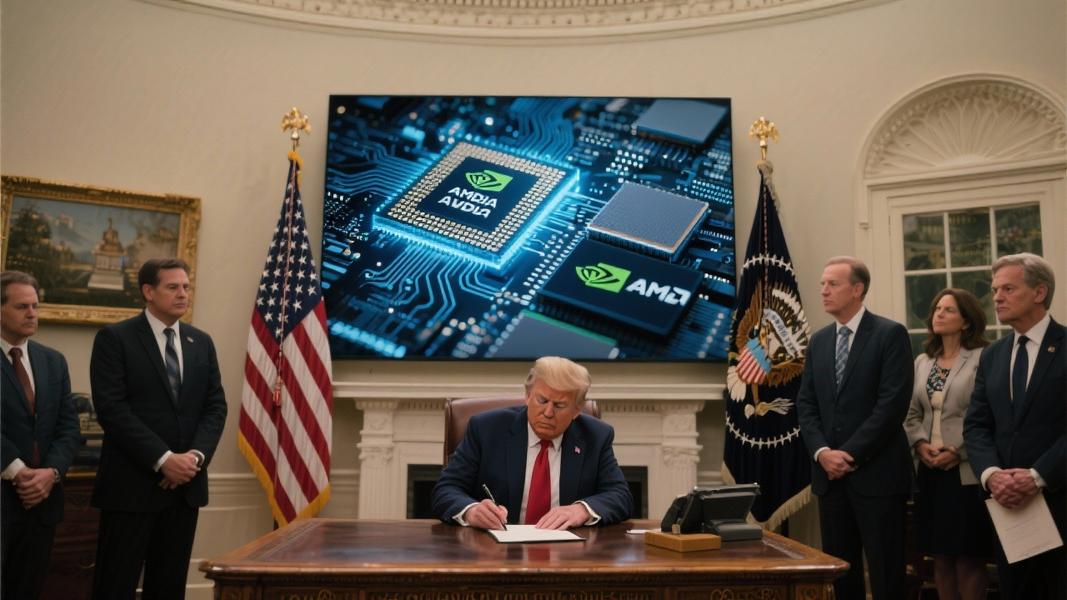
President Trump has launched a major semiconductor offensive, signing a proclamation that imposes immediate 25% tariffs on advanced computing chips while threatening broader actions to reshape America’s technology supply chains.
The January 14 action invokes Section 232 of the Trade Expansion Act, a rarely-used national security provision that allows the president to restrict imports deemed threatening to U.S. security interests. The move specifically targets high-end AI accelerators like the NVIDIA H200 and AMD MI325X, though it exempts chips supporting domestic technology infrastructure development.
National Security Concerns Drive Policy Shift
“Semiconductors are essential to the United States’ economic, industrial, and military strength, and a disruption of import-reliant supply chains could strain the nation’s industrial and military capabilities,” the White House explained in a fact sheet accompanying the proclamation.
The administration’s concerns aren’t just theoretical. Just two weeks earlier, on January 2, President Trump ordered HieFo Corporation to divest digital chip assets it had acquired from EMCORE Corporation, citing national security risks. The Committee on Foreign Investment in the United States (CFIUS) determined the acquisition posed significant risks, including “potential access to EMCORE’s intellectual property, proprietary know-how, and expertise and to the potential diversion of supply of indium phosphide chips manufactured by the EMCORE Digital Chips Business away from the United States,” according to a legal analysis.
What makes the HieFo case particularly notable? The company was identified as being “controlled by a citizen of the People’s Republic of China,” highlighting the administration’s specific concerns about Chinese influence in the semiconductor sector.
Beyond Tariffs: A Multi-Pronged Approach
The proclamation directs the Commerce Secretary and U.S. Trade Representative to begin negotiations with foreign governments to address the identified security threats, with potential additional tariffs looming if those talks don’t yield results.
“In my judgment, based on current circumstances as well as the future needs of the United States, the actions in this proclamation are necessary and appropriate to address the threat to impair the national security posed by imports of semiconductors, semiconductor manufacturing equipment, and their derivatives,” Trump stated in the official proclamation.
The administration has set a tight timeline for progress, requiring updates within 90 days and a more comprehensive report by July 1, 2026. This suggests the White House is prepared to move quickly with additional measures if negotiations stall.
Incentivizing Domestic Production
But the strategy isn’t just about restricting imports. The administration is simultaneously proposing a tariff offset program designed to encourage domestic semiconductor manufacturing and reduce dependence on foreign supply chains.
“Today’s action will address the threat to national security by, among other things, incentivizing domestic production of semiconductors and reducing our nation’s reliance on foreign sources and foreign supply chains,” the White House noted.
Is this just the beginning of a broader technology independence push? The administration’s focus on both immediate tariffs and longer-term manufacturing incentives suggests a comprehensive strategy rather than a one-off trade action.
The moves come amid growing bipartisan concern about U.S. dependence on foreign semiconductor manufacturing, particularly for chips used in artificial intelligence, quantum computing, and advanced military applications. While previous administrations have attempted to address these issues through legislation like the CHIPS Act, the Trump administration appears to be taking a more aggressive, tariff-centered approach to reshaping the global semiconductor landscape.
