
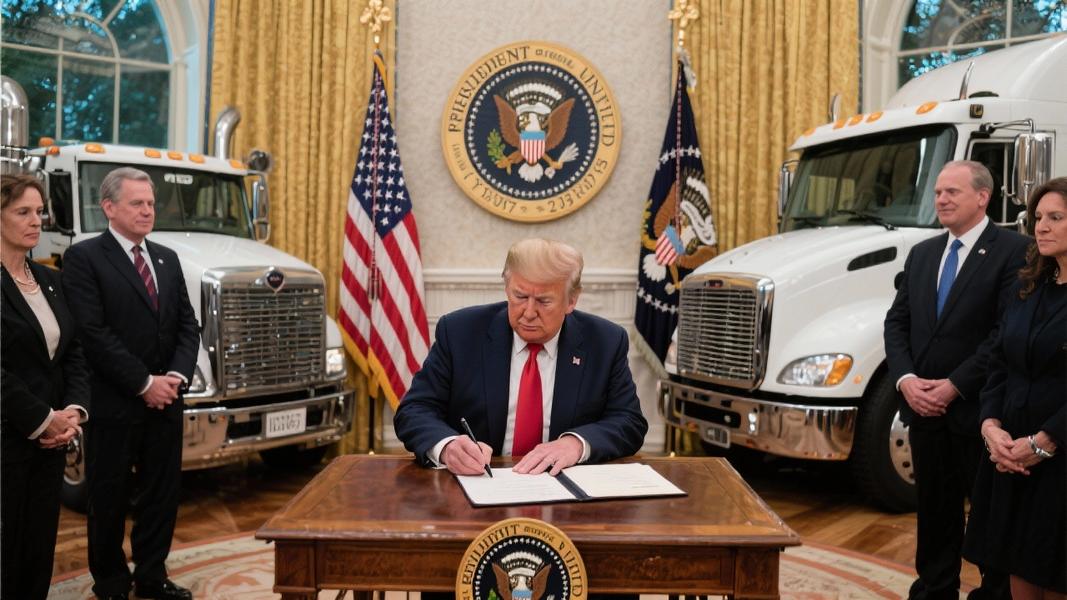
In a sweeping move to protect America’s industrial base, President Donald Trump has announced substantial new tariffs on imported trucks and buses, citing national security concerns. The measures, which take effect November 1, 2025, will impose a 25% duty on medium- and heavy-duty vehicles and their parts, along with a 10% tariff on buses.
National Security Concerns Drive New Trade Policy
The action follows a Commerce Department investigation that determined foreign imports of these vehicles “threaten to impair the national security of the United States.” According to the administration, medium- and heavy-duty vehicles play a critical role in military readiness, emergency response, and maintaining critical infrastructure — moving over 70% of the nation’s freight by weight, including food, fuel, and medical supplies.
“From the 1950s through the 1990s, the United States was an undisputed leader in MHDV manufacturing,” the White House noted, referencing iconic American brands like Ford, General Motors, Chrysler, Peterbilt, Kenworth, Freightliner, and Mack Trucks. But that dominance has eroded significantly in recent decades.
Growing dependence on foreign suppliers has created what officials see as dangerous vulnerabilities. The Secretary of Commerce found that import penetration has reached alarming levels — with foreign-assembled trucks now accounting for 43% of all Class 4 through 8 vehicles sold in the U.S. market. For Class 8 trucks — the heaviest-duty category that includes tractor-trailers — foreign penetration has hit 50%.
Why the dramatic shift? The administration points to “favorable dynamics for offshoring” created by foreign industrial practices that have incentivized American companies to move production abroad. Critical components like engines, batteries, transmissions, castings, and forgings increasingly come from overseas manufacturers.
Buses Also Under Scrutiny
The national security concerns extend to buses as well. The administration argues that buses are “vital for United States national security” because they support “United States military troop movements, Government disaster response and evacuations, and basic operations in critical infrastructure sectors like energy, healthcare, and emergency services.” Yet here too, foreign dependence is growing and the U.S. trade balance in buses has worsened in recent years.
The tariffs represent the latest use of Section 232 of the Trade Expansion Act of 1962, which allows the president to adjust imports on national security grounds. The Trump administration has previously used this authority for tariffs on steel, aluminum, copper, and automobiles.
Complex Implementation with USMCA Considerations
But it’s not a simple across-the-board tariff. The new system includes nuanced provisions for vehicles imported under the United States-Mexico-Canada Agreement (USMCA). Importers can submit documentation to apply the 25% duty rate only to the non-U.S. content value of the vehicle — creating an incentive to increase American-made components.
Additionally, the plan includes an import adjustment offset program for manufacturers assembling vehicles in the United States. From 2025 through 2030, these companies can receive offsets equal to 3.75% of the value of vehicles assembled domestically, partially offsetting duties on imported parts that typically account for about 15% of a vehicle’s value.
Goals and Monitoring
What’s the endgame? According to the Commerce Secretary’s recommendations, the administration aims for “a long-term stabilization of United States-produced MHDVs’ market share at approximately 80 percent” — a dramatic reversal from current trends.
President Trump has promised to “protect our Great Heavy Truck Manufacturers from unfair outside competition” and ensure companies like Peterbilt, Kenworth, Freightliner, and Mack Trucks “will be protected from the onslaught of outside interruptions.”
The Commerce Department will continue to monitor imports and may expand the list of vehicle parts subject to tariffs if imports increase or further threaten national security. Officials say the measures will strengthen supply chains, boost industrial resilience, create skilled jobs, increase domestic capacity, and drive innovation to support military and critical logistics needs.
The tariffs cover a broad range of commercial vehicles. Medium- and heavy-duty trucks include Class 3 to Class 8 vehicles such as large pick-up trucks, moving trucks, cargo trucks, dump trucks, and tractor-trailers. The parts tariffs target key components including engines, transmissions, tires, and chassis.
Will these measures actually bring manufacturing back to American soil? That remains to be seen. While the administration projects confidence in the tariffs’ power to reshape the industry, the response from manufacturers, trading partners, and consumers will ultimately determine whether this national security gambit achieves its ambitious goals.
