
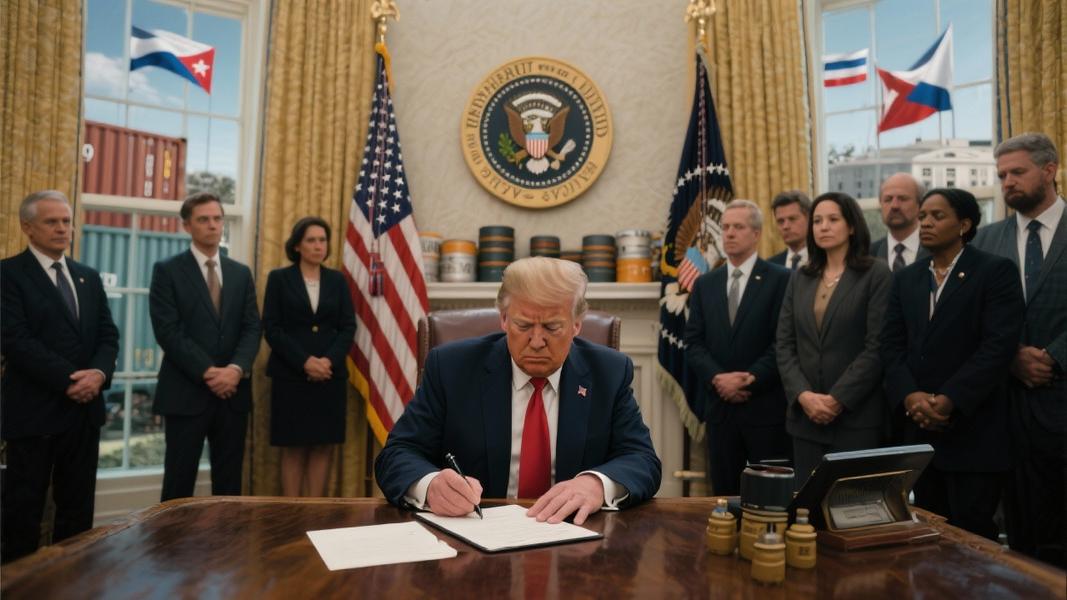
President Trump has taken his toughest stance yet against Cuba, signing an executive order that targets countries providing oil to the island nation with new tariffs. The January 29, 2026 order declares a national emergency and establishes a process to impose import tariffs on nations that directly or indirectly supply Cuba with oil, marking a significant escalation in the administration’s approach to the Caribbean country.
The executive order, which authorizes the Secretaries of State and Commerce to implement the tariff process, represents the latest in a series of increasingly restrictive measures against Cuba since Trump returned to office in 2025.
Reversing Course on Cuba
Trump wasted no time in reinstating a hardline Cuba policy. Just days after his January 2025 inauguration, he issued an executive order that revoked Cuba’s removal from the State Sponsor of Terrorism list and reinstated the Cuba Restricted List, which prohibits transactions with Cuban military-linked entities. The move was designed according to administration officials “to deny resources to the very branches of the Cuban regime that directly oppress and surveil the Cuban people while controlling large swaths of the country’s economy.”
By mid-2025, the administration had implemented partial travel restrictions on Cuban nationals, citing terrorism sponsorship concerns among other issues. The president also rescinded nearly 80 executive actions from previous administrations related to Cuba policy.
Why the dramatic policy shift? The administration points to national security concerns and what it characterizes as Cuba’s destabilizing influence in the Western Hemisphere. Critics, however, question whether these moves represent effective foreign policy or primarily serve domestic political interests.
Economic Pressure Points
The latest executive order aims to choke off Cuba’s oil supply by targeting its international partners. It’s a strategy that could have far-reaching implications, potentially affecting relations with countries like Venezuela, Mexico, and even Russia, which have historically provided petroleum products to Cuba.
In June 2025, Trump had already begun applying economic pressure by sanctioning third-country entities engaging with Grupo de Administracion Empresarial S.A. (GAESA), a Cuban military-run conglomerate that controls approximately 60 percent of the Cuban economy. “If I lived in Havana and I was in the government, I’d be concerned at least a little bit,” one analyst noted at the time.
That concern has likely grown exponentially with this latest move. The oil-related tariffs could potentially impact major trading partners of the United States, creating diplomatic and economic complications beyond just U.S.-Cuba relations.
What Comes Next?
The immediate effects of the executive order remain to be seen. The Secretaries of State and Commerce now have the task of determining which countries will face tariffs and at what levels. The process could take months to fully implement, but markets are already reacting to the uncertainty.
For Cuba itself, the potential loss of oil imports represents an existential threat to its already fragile economy. The island nation has faced fuel shortages in recent years, leading to power outages and transportation disruptions.
As the Biden administration’s Cuba policy thaw recedes further into the rearview mirror, it appears the U.S.-Cuba relationship has entered one of its chilliest phases in recent memory. And with this latest executive order, President Trump has made it clear that the pressure will only continue to build.
