
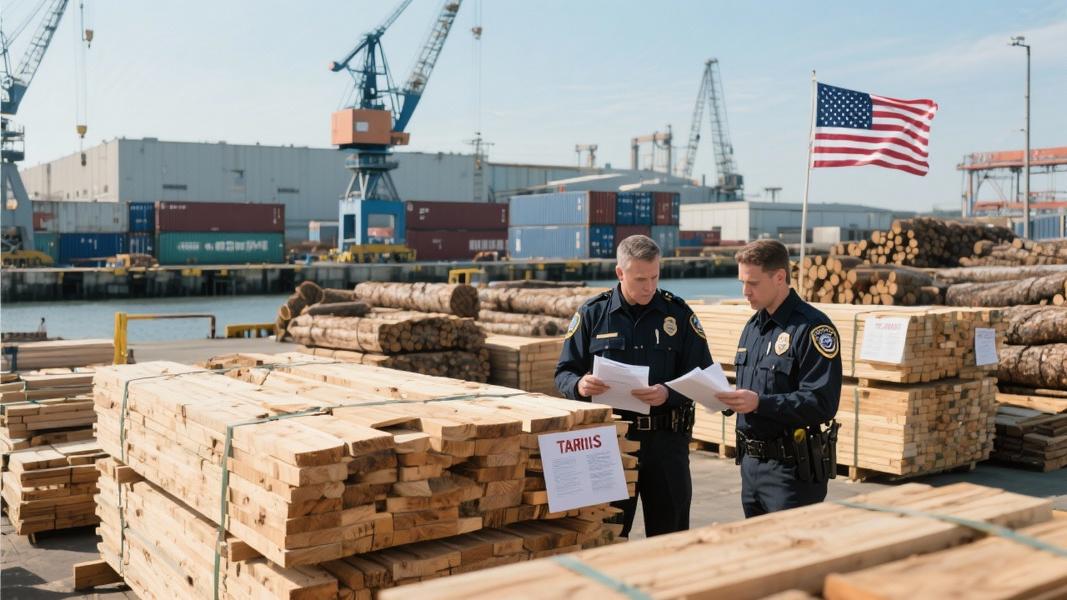
President Trump is slapping hefty new tariffs on imported wood products, citing national security concerns in a move that will reshape America’s timber industry and ripple through housing and construction markets.
The announcement comes after a months-long Section 232 investigation by the Commerce Department concluded that foreign wood imports are weakening the domestic industry and threatening critical supply chains. Beginning October 14, 2025, imports of softwood timber and lumber will face a 10% tariff, while certain wooden furniture and kitchen products will see duties of 25% — with some rates climbing even higher in January 2026.
“Foreign subsidies and unfair trade practices are eroding the competitiveness of the United States wood products industry and disincentivizing investment and modernization,” the Commerce Secretary’s report stated, highlighting concerns that have driven the administration’s protectionist trade agenda.
National Security Implications
Wood might seem like an unlikely national security concern. Yet the administration’s investigation found that timber products play crucial roles in defense infrastructure, including military testing facilities, personnel housing, and even components in sophisticated weapons systems.
Perhaps most surprisingly, wood is used in “thermal-protection systems for nuclear-reentry vehicles,” according to the presidential proclamation. The U.S. military spends over $10 billion annually on construction, with wood products featuring prominently in both traditional and innovative building materials.
The Commerce Secretary found that “present quantities and circumstances of wood product imports are weakening our economy, resulting in the persistent threats of closures of wood mills and disruptions of wood product supply chains… and diminishing the utilization of production capacity of our domestic wood industry.”
Escalating Tariff Structure
What’s the actual impact for importers? The tariff schedule is tiered and escalating:
Softwood timber and lumber will face a 10% duty starting in October. But the real sting comes for manufacturers of upholstered wooden products, which will initially face a 25% tariff that rises to 30% on January 1, 2026. Kitchen cabinets and vanities get hit hardest — starting at 25% in October before jumping dramatically to 50% in January.
Notably, imports from key allies will receive preferential treatment, with duties on UK products capped at 10%, while EU and Japanese imports won’t exceed 15% in total duties.
“In my judgment… I also determine that it is necessary and appropriate to adopt a plan of action that imposes tariffs to adjust imports of wood products so that such imports will not threaten to impair the national security of the United States,” President Trump declared in the official proclamation.
Domestic Capacity Underutilized
A central argument for the tariffs is that America has more than enough capacity to meet its own needs but has increasingly relied on imports. The U.S. has been a net importer of lumber since 2016, despite having “the practical production capacity to supply 95% of the United States’ 2024 softwood consumption,” according to industry data.
This dependency on foreign suppliers — particularly for products like kitchen cabinets, which have seen a surge in imports from Asia — has left the country vulnerable to supply chain disruptions and undermined domestic manufacturing capacity.
The investigation, which began on March 1, 2025, was conducted under Section 232 of the Trade Expansion Act of 1962, which gives the president broad authority to adjust imports that threaten national security. It’s the same mechanism Trump previously used to impose tariffs on steel, aluminum, and other products during both his administrations.
Diplomatic Off-Ramps
The door hasn’t completely closed on negotiations. The proclamation directs the U.S. Trade Representative to pursue agreements with trading partners that could potentially reduce or eliminate these tariffs if they “address the threatened impairment of the national security with respect to imported wood products.”
This creates potential leverage in ongoing trade talks, especially with the EU, UK, and Japan — all of whom have already received more favorable treatment under the tariff structure.
The Commerce Department will also establish a monitoring system and may expand the tariffs to additional wood products if necessary to “reduce or eliminate the national security threat.”
For domestic lumber producers, particularly those in states like Oregon, Washington, and Georgia, the tariffs represent a significant victory after years of competing against what they view as unfairly subsidized foreign competition. But for homebuilders and furniture manufacturers, who’ve warned that such tariffs could increase costs during an already challenging housing market, the announcement represents a concerning development.
As with previous Section 232 actions, legal challenges are likely. Still, the administration appears confident in its authority to implement these measures, which will take effect in just over a month.
Whether these tariffs actually revitalize domestic wood production or simply raise prices for American consumers remains the lumber industry’s million-dollar question.
