
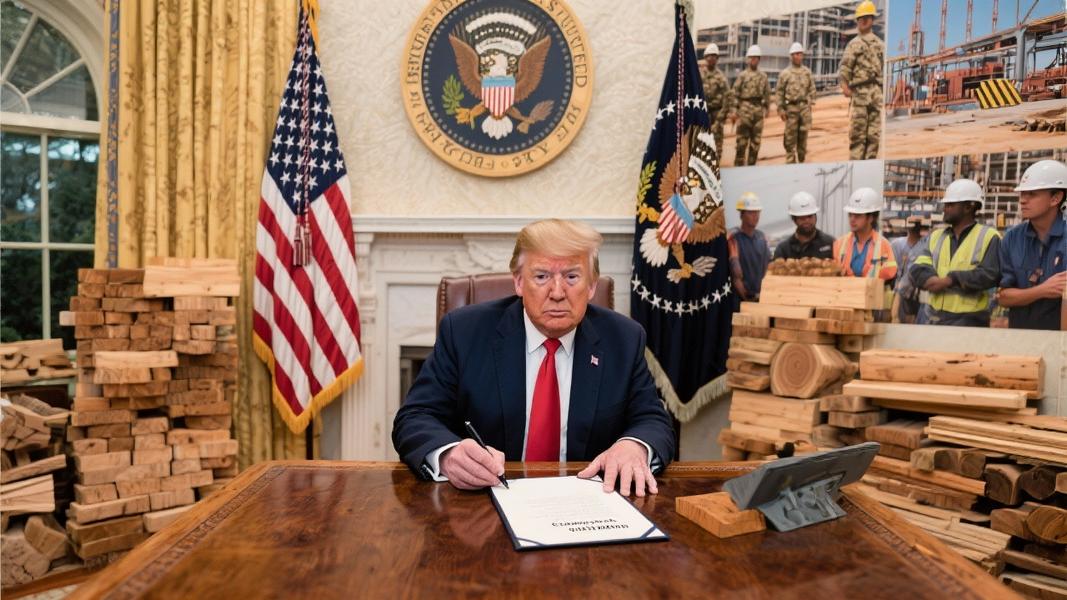
President Trump has imposed new tariffs on imported wood products, marking another significant move in his “America First” trade agenda. The sweeping action targets softwood lumber, upholstered furniture, and kitchen cabinets with tariffs ranging from 10% to 50% in an effort to protect domestic industry.
The presidential proclamation, signed under Section 232 of the Trade Expansion Act of 1962, comes after a Commerce Department investigation concluded that current import levels of timber, lumber, and derivative products threaten to impair national security. The move represents one of the most aggressive trade actions of Trump’s second term thus far, with potential ripple effects across construction, manufacturing, and international trade relations.
Escalating Tariffs Target Multiple Wood Products
The new tariffs create a complex structure that varies by product category. A 10% global tariff will hit softwood lumber imports immediately, while certain upholstered furniture will face a 25% tariff that increases to 30% on January 1. Perhaps most dramatically, kitchen cabinets and vanities will see tariffs start at 25% before jumping to 50% at the beginning of next year.
“By imposing tariffs on wood products, President Trump is countering foreign subsidies and predatory practices that distort markets,” the administration explained in materials accompanying the announcement, arguing the move would make “imported lumber less competitive and incentivizing the growth of domestic wood production.”
Notably, some key U.S. trading partners will receive more favorable treatment. The United Kingdom will see wood import tariffs capped at 10%, while the European Union and Japan will have combined tariffs limited to 15% — reflecting existing trade agreements with those nations.
National Security Justification
Why wood products? That’s the question many trade experts are asking. The administration’s justification centers on national security concerns, emphasizing that lumber and related products are essential for military infrastructure and critical civilian construction.
According to the proclamation, the U.S. military spends over $10 billion annually on construction and has been testing innovative wood products such as cross-laminated timber. The Commerce Department’s investigation determined that America’s growing dependence on foreign wood products threatens defense capabilities, construction capacity, and broader economic strength.
“Wood products serve as essential inputs across multiple sectors, supporting national defense, critical infrastructure, economic stability, and industrial resilience in the United States,” the administration stated in its announcement.
Addressing Import Dependence
The United States has been a net importer of lumber since 2016, despite having what the administration describes as “practical production capacity to supply 95% of the United States’ 2024 softwood consumption.” This reliance on foreign supply chains creates vulnerabilities that the administration claims are worsened by foreign subsidies and unfair trade practices.
The proclamation represents the latest in a series of Section 232 actions by Trump, who previously used the same authority to impose tariffs on steel, aluminum, copper, and automobiles. These actions align with what the White House has branded as an “America First Trade Policy” established on Trump’s first day back in office.
“President Trump has repeatedly used Section 232 tariffs to protect against threats to our national security and to strengthen manufacturing critical for our national and economic security,” the administration noted.
More Tariffs on the Horizon
The wood products tariffs likely won’t be the last such action. The Commerce Department is currently conducting additional Section 232 investigations covering a broad range of products including semiconductors, pharmaceuticals, commercial aircraft, wind turbines, robotics, unmanned aircraft systems, and personal protective equipment.
Beyond tariffs, Trump has issued several executive orders aimed at boosting domestic mining, manufacturing, and investment by reducing regulations and streamlining bureaucracy. The administration argues these reciprocal tariffs are necessary to “take back America’s economic sovereignty” and address imbalances in trade relationships.
The construction and home furnishing industries will likely feel immediate effects from these tariffs, potentially raising costs for homebuilders, furniture manufacturers, and ultimately consumers. Still, domestic lumber producers and cabinet makers stand to benefit from reduced foreign competition.
As with previous Section 232 actions, legal challenges may follow, particularly regarding the expansive interpretation of “national security” to include economic concerns. For now, though, the message from the White House is clear: America’s wood products industry is deemed too important to leave vulnerable to foreign competition.
