
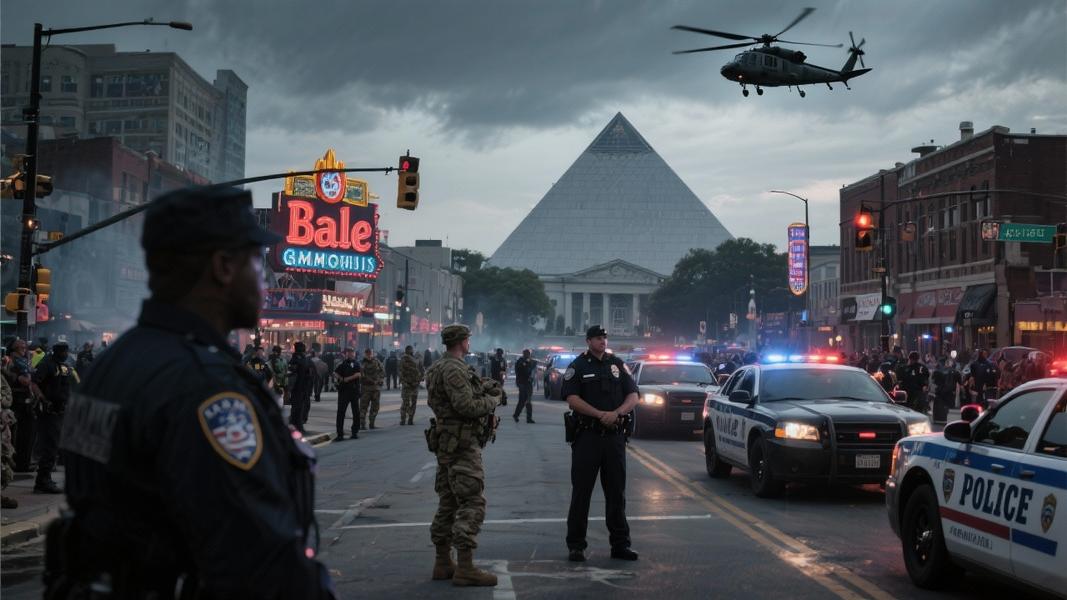
President Trump to Deploy ‘Memphis Safe Task Force’ Amid Conflicting Crime Data
The White House announced plans to establish a sweeping new federal task force aimed at combating crime in Memphis, Tennessee — even as local officials report historic drops in criminal activity across the city.
The presidential memorandum, signed on September 15, creates the “Memphis Safe Task Force” with a mandate to “end street and violent crime in Memphis to the greatest possible extent” through what it describes as “hypervigilant policing” and “aggressive prosecution” strategies. The initiative will coordinate resources from multiple federal departments including Treasury, Justice, Homeland Security and even the Department of War.
According to White House statements, the task force was prompted by Memphis’s troubling crime statistics from 2024, when the city reportedly had the highest violent crime rate, highest property crime rate, and third-highest murder rate in the nation. Officials cited that Memphis’s overall crime rate last year was 344% higher than the national average.
A tale of two crime narratives
But here’s the twist: the task force announcement comes as Memphis officials celebrate what they call “historic crime reductions” in 2025.
The Memphis Police Department has reported that overall crime has fallen to a 25-year low during the first eight months of this year. Several major crime categories — including robbery, burglary, and larceny — have reached their lowest points in a quarter century, while murder rates have dropped to a six-year low.
“These historic reductions reflect the dedication and resilience of the men and women of the Memphis Police Department, as well as the strong partnership with our community,” Memphis Police Chief CJ Davis said in a statement. “We remain focused on protecting our neighborhoods and creating a stronger, safer Memphis for all.”
Independent data seems to support the local assessment. The Council on Criminal Justice’s mid-year analysis found that 11 of 13 crime categories decreased in Memphis during the first half of 2025 compared to the same period in 2024. Homicides dropped 17%, aggravated assaults fell 10%, and gun assaults decreased by 21%.
Perhaps most notably, motor vehicle thefts — which had been surging in recent years — decreased by 25%, according to the council’s findings.
Local initiatives already underway
The Memphis Shelby Crime Commission has already launched a Five-Year Safe Community Action Plan with 20 specific steps to improve public safety. The commission focuses on evidence-based practices and has fostered partnerships with local businesses and schools.
Major companies headquartered in Memphis have thrown their support behind these local crime-fighting efforts. Sylvamo, which employs over 6,500 people and reported $3.6 billion in net sales in 2022, has expressed that “the health, safety and well-being of Sylvamo team members is its greatest responsibility,” citing this commitment as motivation for supporting the Crime Commission.
Similarly, International Paper, with 2,300 employees in Memphis among its 50,000 global workforce, has been a “strong supporter” of local crime reduction initiatives, according to company materials.
Questions about timing and approach
Why now? That’s what some local officials are asking about the federal intervention, given the improving crime statistics.
The presidential memorandum cites Shelby County’s 2022 bail reform as a contributing factor to crime concerns, claiming the policy has allowed serious offenders to be released without bail. One case highlighted in White House materials described an 18-year-old man who was “released without bail” after being arrested for auto theft and weapons charges, only to be involved in a shooting that killed a Memphis police officer a month later.
The new federal task force will be chaired by an appointee of the Attorney General and will report directly to the President. Its approach emphasizes “large-scale saturation of besieged neighborhoods with law enforcement personnel” — language that could raise questions about civil liberties and community relations.
Still, for a city that has struggled with its reputation for crime, the attention from Washington brings both resources and scrutiny. Whether the Memphis Safe Task Force will accelerate the city’s already improving crime trends or introduce new tensions remains to be seen — but one thing is clear: Memphis now finds itself at the center of the administration’s law enforcement agenda.
