
Trump Signs Executive Order to End Cashless Bail in D.C., Threatens Federal Funding
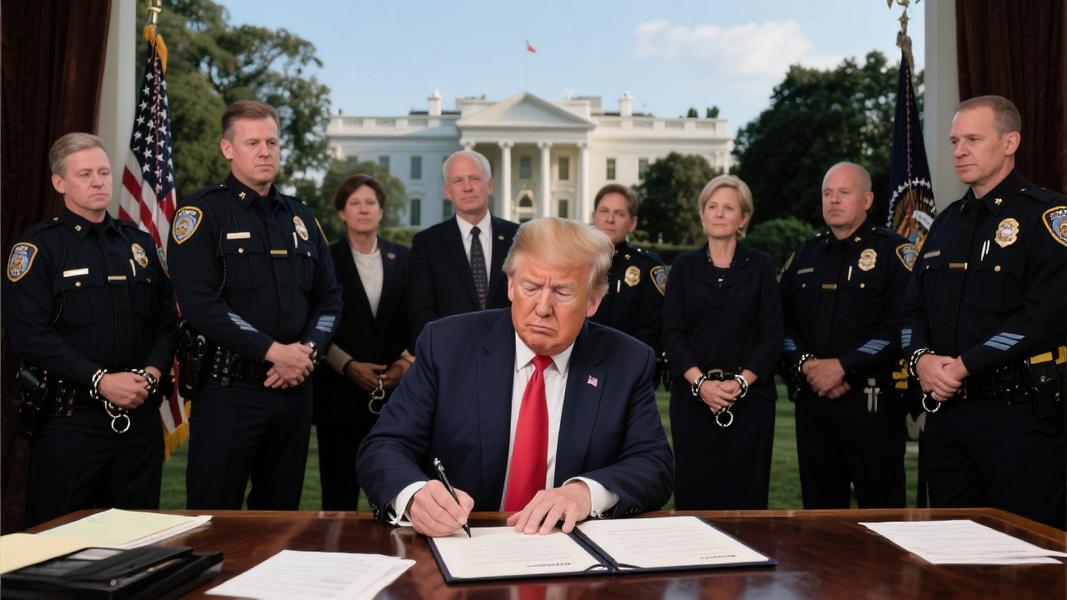
President Donald Trump signed an executive order Monday that aims to dismantle Washington D.C.’s cashless bail system, directing federal law enforcement to bypass local courts and hold arrestees in federal custody whenever legally possible.
The August 25 order represents a significant federal intervention into the District’s criminal justice system, framing the city’s pretrial release policies as a public safety emergency that interferes with federal government operations. Trump’s directive instructs the Attorney General to determine if D.C. still maintains cashless bail for serious offenses like murder, rape and carjacking — with potential federal funding consequences if the policy remains in place.
“We’re ending it,” Trump declared before signing the order in the Oval Office. “But we’re starting by ending it in D.C., and that we have the right to do through federalization.”
Targeting “Left-Wing Jurisdictions”
Under D.C. law, cash bail has been effectively eliminated, meaning most individuals arrested are released while awaiting trial. The White House argues this endangers residents, visitors and federal employees working in the nation’s capital.
Trump has positioned the order as part of a broader crackdown on progressive criminal justice reforms. “When I’m reelected, I will crack down on the left-wing jurisdictions that refuse to prosecute dangerous criminals and set loose violent felons on cashless bail,” he stated. “If you kill somebody, there’s no bond. Don’t worry about it. Go ahead. Kill somebody else. These people are crazy, I’ll tell you.”
The executive order specifically directs members of the D.C. Safe and Beautiful Task Force to ensure arrestees are held in federal custody “to the fullest extent permissible under applicable law” and to pursue federal charges whenever possible to bypass the District’s pretrial release system.
A Pattern of Federal Intervention
This isn’t Trump’s first move to assert federal control over the District. Earlier this month, he mobilized the National Guard and invoked emergency authority over the Metropolitan Police Department, citing a need to “restore law and order.”
Why target cashless bail specifically? The administration points to several high-profile incidents, including a journalist who was reportedly injured and sexually abused near Union Station by a homeless man who was then released before his trial. Other cases involve offenders released on their own recognizance who allegedly committed additional violent crimes shortly after being freed.
The White House cites a 2023 study from Yolo County, California, which found that its “Zero Bail” policy resulted in 163% more crime and 200% more violent crime compared to cases where defendants posted bail.
Constitutional Questions
The order’s assertion of federal authority over the District’s criminal justice system is likely to face legal challenges. D.C., while not a state, has operated with a degree of autonomy in its local affairs since the 1970s through home rule.
In the executive order, Trump characterizes the situation as a crisis that impedes federal functions, stating that “dangerous criminals are sometimes rapidly released. This leaves such criminals free to endanger American citizens visiting our Nation’s capital, Federal workers… and citizens of the District of Columbia trying to live their lives safely.”
Critics of cash bail systems argue they disproportionately impact low-income defendants who cannot afford to pay, effectively criminalizing poverty rather than actual risk to public safety. Supporters counter that removing financial consequences for release increases the likelihood that defendants will reoffend or fail to appear for court proceedings.
The Trump administration’s move signals a potential nationwide shift in approach to bail reform should he win reelection, with D.C. serving as both test case and warning to other jurisdictions with similar policies. As the president himself put it, they’re “starting with D.C.” — but clearly don’t intend to end there.
