
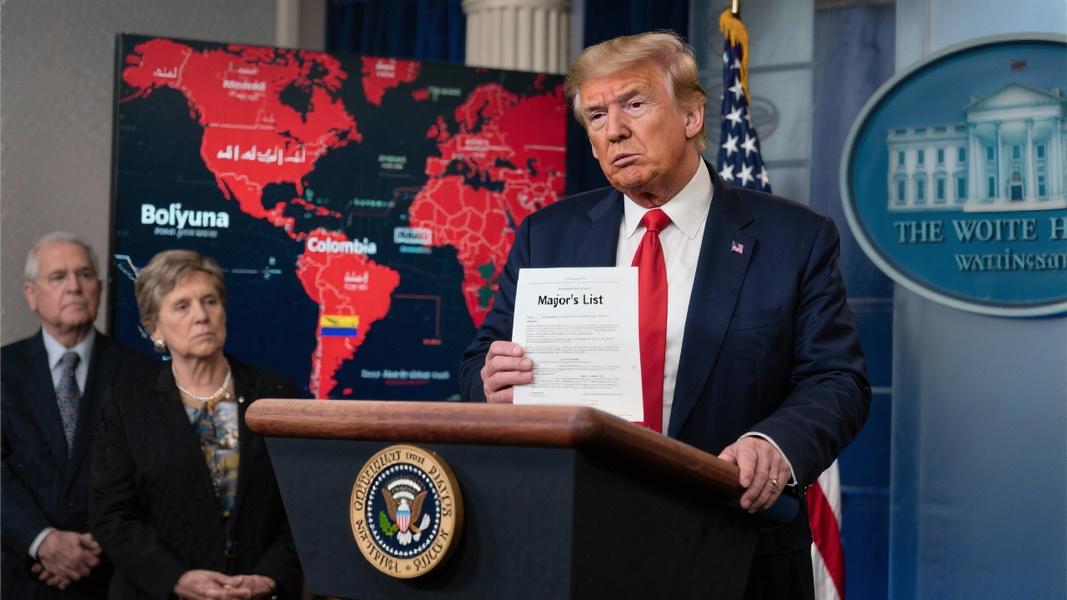
President Trump has designated 23 countries as “major drug transit or major illicit drug producing countries” for Fiscal Year 2026, with several Caribbean nations now finding themselves on a list no country particularly wants to join.
The annual Presidential Determination, which was submitted to Congress this week, includes The Bahamas, Belize, Haiti, Jamaica, and the Dominican Republic among the countries identified as significant transit routes or production hubs for illegal narcotics. Five countries — Afghanistan, Bolivia, Burma, Colombia, and Venezuela — were singled out as having “failed demonstrably” to meet their counter-drug obligations.
Caribbean Nations in the Crosshairs
For the Caribbean region, the inclusion represents a continuing challenge in the fight against drug trafficking. Four CARICOM member states — The Bahamas, Belize, Haiti, and Jamaica — are now listed among nations considered significant in the global drug trade. The Dominican Republic, meanwhile, was newly added to the roster this year.
Why does this matter? While the White House emphasized that a country’s presence on the list “is not necessarily a reflection of its government’s counter-drug efforts or level of cooperation with the United States,” the designation carries significant diplomatic and potential economic implications.
Trump stressed that under his leadership, “the White House Office of Drug Control Policy (ONDCP) will use every tool in our arsenal to hold these designated countries accountable and keep illicit drugs from pouring into our country and destroying American lives.”
Colombia’s Fall from Grace
Perhaps the most striking development in this year’s determination is Colombia’s dramatic shift in status. For the first time since 1997, Colombia has been removed from the list of countries considered cooperative in counter-narcotics efforts and placed among nations that have “manifestly failed” to meet their obligations under international agreements.
This represents a significant diplomatic setback for Colombia, which has received billions in U.S. aid for counter-narcotics operations over decades, and signals a potential recalibration of U.S.-Colombian relations under the second Trump administration.
The Fentanyl Crisis Driving Policy
The intensified focus on international drug control comes as the U.S. battles what officials describe as a national emergency — the fentanyl and synthetic drug crisis claiming more than 200 American lives daily.
Recent weeks have seen dramatic escalations in enforcement actions. On September 2, U.S. forces conducted a strike that killed 11 people aboard an alleged smuggling boat near Venezuelan waters, followed by another operation on September 15 that left three dead. Venezuela’s government condemned these operations as acts of aggression, while U.S. officials defended them as necessary steps to dismantle trafficking networks.
The Trump administration appears to be sending a clear message: geographic convenience as a transit route is no longer an acceptable excuse. But what does inclusion on this list actually mean for the affected countries?
According to the Foreign Assistance Act of 1961, countries are placed on the list due to “the combination of geographic, commercial, and economic factors that allow drugs or precursor chemicals to be transited or produced, even if a government has engaged in robust and diligent narcotics control and law enforcement measures.”
Regional Impact and Response
The inclusion of multiple Caribbean nations reflects the region’s persistent challenge as a transit corridor between South American production zones and the lucrative North American market. The geographical reality — scattered islands with extensive coastlines and limited enforcement resources — makes the Caribbean particularly vulnerable to trafficking operations.
None of the Caribbean countries have yet issued formal responses to their inclusion on the list, though regional security experts have long acknowledged the challenges faced by small island nations in controlling their maritime borders against well-funded transnational criminal organizations.
The determination also identifies other key countries across regions, including China, Costa Rica, Ecuador, El Salvador, Guatemala, Honduras, India, Laos, Mexico, Nicaragua, Pakistan, Panama, and Peru.
As the Biden administration transitions to Trump’s return to office, this designation signals what appears to be a more confrontational approach to international drug control policy — one that may test diplomatic relationships throughout the Western Hemisphere and beyond in the coming year.
