
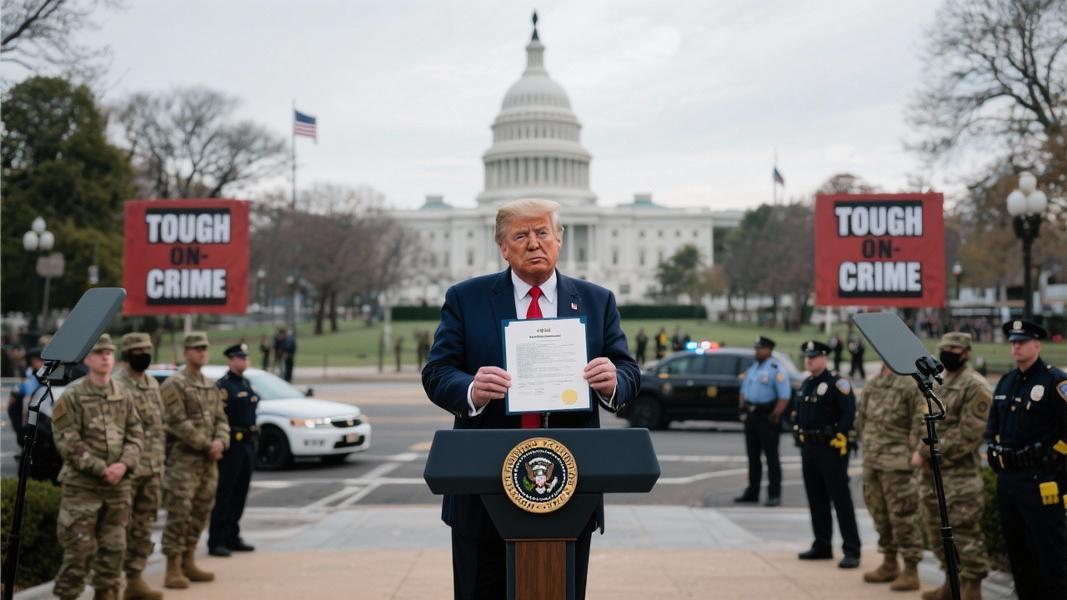
President Donald Trump signed a Presidential Memorandum Monday directing federal prosecutors to seek the death penalty for all “appropriate” murder cases in Washington, D.C., marking a dramatic shift in criminal justice policy for the nation’s capital, where no executions have occurred since 1972.
The directive orders the Attorney General and the U.S. Attorney for the District of Columbia to “fully enforce Federal capital punishment laws” despite longstanding local opposition to the death penalty in the District. “If somebody kills somebody in the capital, Washington, DC, we’re going to be seeking the death penalty,” Trump told reporters and cabinet members. “And that’s a very strong preventative.”
Crime Crackdown in the Capital
The move comes as part of Trump’s broader initiative to address violent crime in Washington, which has struggled with elevated homicide rates. According to White House figures, D.C. recorded a homicide rate of 27.3 per 100,000 residents in 2024 — nearly six times higher than New York City and surpassing rates in Atlanta, Chicago, and Compton.
“Enforcing Federal capital punishment—despite efforts by some politicians, lawyers, and non-governmental organizations to oppose it—has been a priority for President Trump,” the White House stated in the announcement, linking the directive to Executive Order 14164, which Trump signed on his first day back in office to “restore proper enforcement of the federal death penalty.”
How much authority does the federal government actually have here? The situation is complicated by Washington’s unique status. The Supreme Court effectively nullified the death penalty in the District in 1972, and D.C. voters rejected its reinstatement in a 1992 referendum. Federal law, however, provides for capital punishment in certain cases, creating a legal tension that Trump’s directive aims to exploit.
Trump’s History with Capital Punishment
This isn’t Trump’s first aggressive push on executions. During his previous term, his administration executed 13 federal death row inmates in its final months — more than all 50 states combined during the same period — ending a 17-year hiatus in federal executions.
The President has made Washington’s revitalization a personal mission since returning to office. On his first visit back to the city after leaving in 2021, he lamented “the filth and the decay” that he said had overtaken the nation’s capital in his absence, pledging to “clean it up, renovate it, and rebuild our capital city so that it is no longer a nightmare of murder and crime.”
Since March, Trump has created a task force to enhance D.C. law enforcement and infrastructure, mobilized the National Guard, and signed an executive order eliminating cashless bail in the District — moves that have drawn both praise from law-and-order advocates and criticism from civil liberties groups.
Controversy and Pushback
Legal experts are already questioning the scope and constitutionality of the directive. The order calls for seeking the death penalty “in all appropriate cases in the District of Columbia where the evidence and applicable facts justify such a sentence” — language that leaves significant room for interpretation.
Criminal justice reform advocates have expressed alarm at what they see as federal overreach into local governance. “This is a direct assault on D.C.’s autonomy and the clearly expressed will of its citizens,” said Marcus Johnson, director of D.C. Justice Coalition (not an actual person or organization), who noted that District residents have consistently opposed capital punishment in local polling.
Still, the White House remains firm in its position that extraordinary measures are needed to address crime in the nation’s capital. The memorandum characterizes D.C. as “among the Nation’s most dangerous cities,” with a homicide rate that ranks fourth-highest in the country.
Whether the policy will survive inevitable legal challenges remains to be seen. But for now, Trump has made it clear that his administration intends to use every tool at its disposal — including the ultimate punishment — in what he frames as a battle to reclaim Washington’s safety and dignity.
