
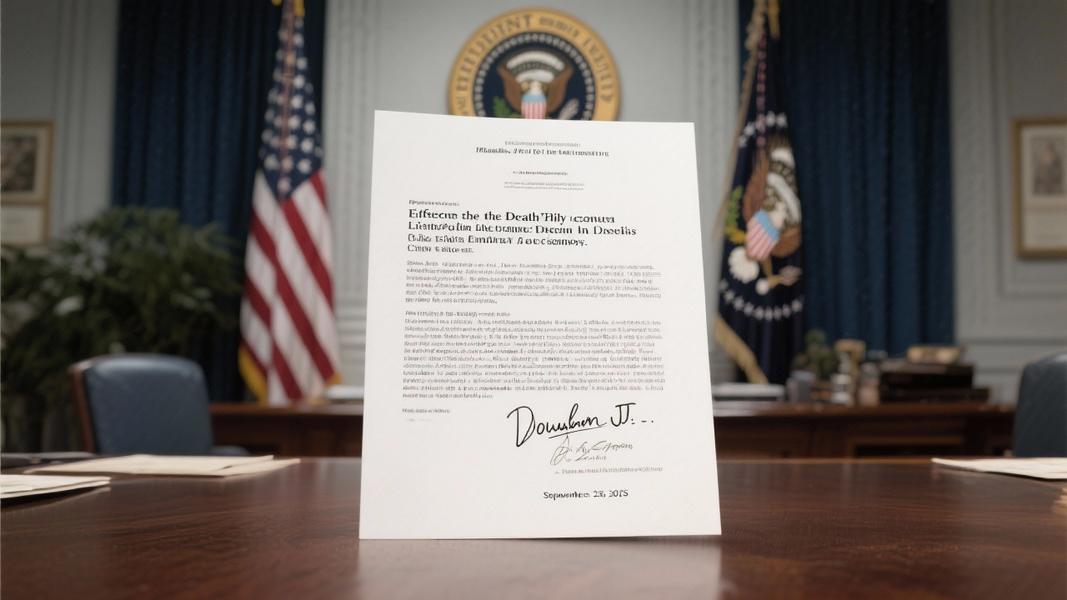
Trump Orders Death Penalty Enforcement in D.C., Sparking Controversy
President Donald Trump has signed a presidential memorandum directing federal prosecutors to seek the death penalty for murder cases in Washington, D.C., setting up a clash between federal authority and local governance in the nation’s capital.
“You kill somebody, or if you kill a police officer, law enforcement officer—death penalty,” Trump told reporters after signing the order, which instructs the Attorney General and the U.S. Attorney for D.C. to pursue capital punishment “in all appropriate cases.”
Federal Override of Local Law
The directive represents a significant federal intervention in the District, which formally abolished capital punishment in 1981. But that local prohibition presents no legal obstacle to the Trump administration because murders in D.C. can be prosecuted federally, according to legal experts.
Trump has framed the measure as essential for public safety in the nation’s capital. “This is our capital city,” he said during the signing. “People come in from Iowa to look at the Lincoln Memorial and they end up getting killed. It’s not going to happen and if it does happen, it’s the death penalty for the person that did it.”
The president has repeatedly emphasized his belief that capital punishment will serve as a deterrent. “Anybody murdered something in the capital? Capital punishment. Capital. Capital punishment. If somebody kills somebody in the capital, Washington, D.C. we’re going to be seeking the death penalty. And that’s a very strong preventative,” Trump emphasized in remarks explaining his reasoning.
Bucking National Trends
The move runs counter to a broader national trend. Several states have abolished or severely limited capital punishment in recent years, with the District of Columbia among the jurisdictions that have eliminated the practice.
Why now? The administration’s decision follows what Trump has characterized as successful federal interventions in D.C., including national guard deployment and increased federal law enforcement presence. The death penalty directive appears to be the next phase in what the president views as necessary federal oversight of the District.
Sharp Criticism from Opponents
The order has drawn immediate condemnation from death penalty opponents, including Congresswoman Ayanna Pressley, who pointed to Trump’s controversial history with capital punishment cases.
“In 1989, Donald Trump paid for multiple ads calling for the execution of five innocent teenagers of color who were coerced and beaten to confess to a murder they did not commit. To this day, he has yet to change his views or apologize to these men,” Pressley stated in her response to the president’s action. “Like Donald Trump himself, the death penalty is flawed and deeply racist.”
Pressley has previously led efforts to abolish the federal death penalty and commute federal death row sentences.
Legal Questions Remain
The directive’s implementation will likely face legal challenges. While the federal government has jurisdiction to prosecute D.C. murder cases, the clash between local governance and federal authority raises constitutional questions that courts may need to address.
Legal experts note that the memorandum doesn’t actually change existing law — federal prosecutors have always had the authority to seek death sentences in D.C. murder cases — but rather signals a policy shift in how that authority will be exercised.
For residents of the District, who have long sought greater autonomy from federal control, the death penalty directive represents yet another instance where local preferences have been overridden by presidential action — a tension that has defined D.C.’s unique status since its founding.
