
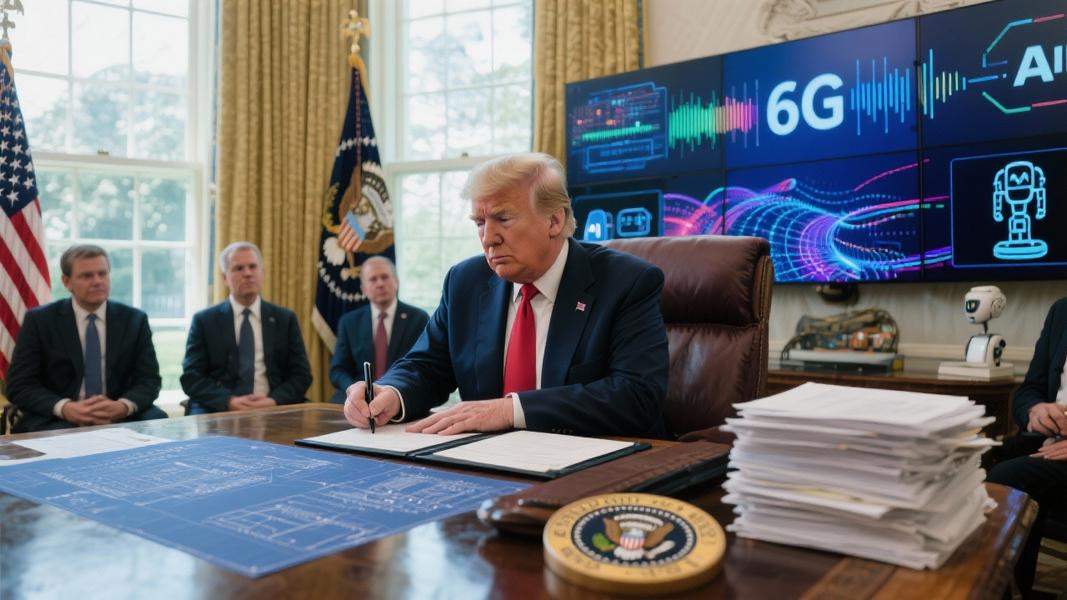
Trump Orders Federal Spectrum Shift to Accelerate U.S. 6G Development
President Donald Trump has signed a Presidential Memorandum directing federal agencies to vacate a key portion of the radio spectrum within 12 months to make way for commercial 6G development, marking his administration’s most aggressive move yet to position America at the forefront of next-generation wireless technology.
The December 19 directive orders federal systems to relocate from the 7.125-7.4 GHz band, a prime slice of spectrum that industry experts have identified as crucial for full-scale 6G deployment. It’s part of a broader push that Trump has framed as essential to maintaining America’s technological edge against competitors like China.
“It is the policy of the United States to lead the world in 6G development,” the memorandum states, positioning the advanced wireless technology as “foundational to national security, foreign policy, and economic prosperity.”
Why the urgency around 6G when many Americans are still transitioning to 5G networks? The administration envisions 6G as the backbone for transformative technologies including advanced artificial intelligence systems, robotics, and even implantable technologies that could revolutionize healthcare and human-computer interaction.
Spectrum Auctions Planned for 2027
FCC Chairman Brendan Carr has aligned the commission’s actions with the President’s aggressive timeline. “President Trump has been clear that America is going to lead the world in next-generation technologies,” Carr noted in a recent statement supporting plans for spectrum auctions by July 4, 2027.
The Presidential Memorandum doesn’t stop at the initial spectrum band. It also directs studies on two additional frequency ranges—2.69-2.9 GHz and 4.4-4.94 GHz—potentially opening up even more bandwidth for commercial 6G applications. The rapid timeline has raised eyebrows among some federal agencies that will need to relocate their communications systems.
Beyond domestic policy, the administration has been actively forging international partnerships to strengthen America’s technological position. A U.S.-U.K. Technology Prosperity Deal signed in September coordinates cooperation not just on 6G but also on artificial intelligence, nuclear technology, and quantum computing—suggesting the White House sees these technologies as interconnected pillars of future economic strength.
Olympic Showcase Planned
Looking ahead to a high-profile demonstration of American technological prowess, the National Telecommunications and Information Administration has launched “Mission LA 2028,” an initiative to showcase early 6G technologies at the 2028 Summer Olympics in Los Angeles. Companies interested in participating must submit Letters of Intent by January 30, 2026, according to program guidelines.
The Olympics target date gives a sense of the administration’s development timeline—ambitious but potentially achievable with the regulatory fast-tracking now underway.
Will everyday consumers see benefits from 6G anytime soon? That remains unclear. While 5G networks are still being built out across much of the country, the administration’s focus appears to be on ensuring America’s technological leadership rather than immediate consumer applications.
For now, the spectrum policy changes represent the opening move in what promises to be a years-long technological race with global implications for everything from autonomous vehicles to remote surgery. The administration’s bet is clear: whoever defines and deploys 6G first will shape the technological landscape—and economic opportunities—for decades to come.
