
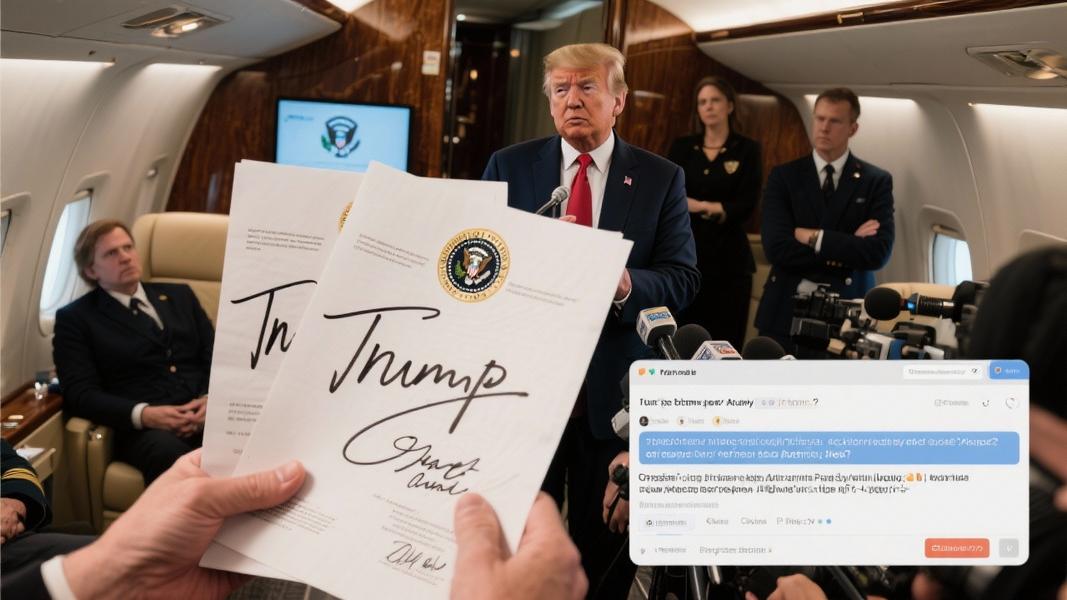
The Justice Department has quietly replaced multiple online pardons bearing identical copies of former President Donald Trump’s signature after experts flagged the unusual duplication, blaming the issue on a “technical error” and staffing shortages.
The identical signatures, which forensic document experts confirm would be virtually impossible to occur naturally, have sparked questions about the authenticity of the pardons and drawn comparisons to Trump’s previous criticism of President Biden’s use of an autopen for official documents.
Signature Scandal Erupts
“A basic axiom of handwriting identification science is that no two signatures are going to bear the exact same design features in every aspect,” said Tom Vastrick, a Florida-based handwriting expert who is president of the American Society of Questioned Document Examiners. The pardons in question included those for former baseball star Darryl Strawberry and disgraced Tennessee House Speaker Glen Casada, among others, all of which initially featured the same Trump signature.
The Justice Department was quick to offer an explanation. “The website was updated after a technical error where one of the signatures President Trump personally signed was mistakenly uploaded multiple times due to staffing issues caused by the Democrat shutdown,” said Justice Department spokesperson Chad Gilmartin. The department insisted that Trump had, in fact, personally signed each pardon.
White House spokesperson Abigail Jackson doubled down on this defense, dismissing the controversy entirely. “Trump signed each one of these pardons by hand as he does with all pardons. The media should spend their time investigating Joe Biden’s countless auto penned pardons, not covering a non-story,” Jackson wrote in a statement.
The Autopen Wars
The irony hasn’t been lost on political observers. Trump has made Biden’s use of the autopen — a mechanical device that reproduces signatures — a frequent target of ridicule, even going so far as to create a “Presidential Walk of Fame” that displays a picture of an autopen where a portrait of Biden might otherwise hang.
Republican allies have characterized Biden’s autopen use as one of the greatest scandals in American history. The House Oversight Committee, led by Republicans, has been particularly vocal, claiming that “Senior White House officials did not know who operated the autopen and its use was not sufficiently controlled or documented to prevent abuse.” The committee went further, declaring “void all executive actions signed by the autopen without proper, corresponding, contemporaneous, written approval traceable to the president’s own consent.”
Does this signature snafu actually invalidate the pardons? Legal experts say no.
“The key to pardon validity is whether the president intended to grant the pardon,” explained Frank Bowman, a legal historian and professor emeritus at the University of Missouri School of Law who is writing a book on pardons. “Any re-signing is an obvious, and rather silly, effort to avoid comparison to Biden,” he added.
Pardons Under Scrutiny
The pardons at the center of this controversy involve several high-profile figures. Casada, the former Republican speaker of the Tennessee House, was sentenced last September to three years in prison. Strawberry faced convictions in the 1990s for tax evasion and drug charges. Former New York City police sergeant Michael McMahon was convicted of acting as a foreign agent for China before receiving his pardon.
McMahon’s attorney appears unaware that the pardon documents had been replaced. “It is and has always been our understanding that President Trump granted Mr. McMahon his pardon,” his lawyer confirmed via email.
Meanwhile, Democrats have seized on the incident as an opportunity to raise questions about Trump’s competence. Rep. Dave Min has called for an investigation, saying, “We need to better understand who is actually in charge of the White House, because Trump seems to be slipping.”
The signature controversy highlights the intensely partisan nature of even seemingly mundane administrative processes in today’s Washington. What might once have been dismissed as a simple clerical error has become, in the current climate, fodder for political attacks and counterattacks about presidential capacity and administrative competence.
For the recipients of these pardons, the technical debate over signatures likely matters little compared to their legal freedom. But in a political environment where optics often outweigh substance, how a president signs his name has become yet another battlefield in America’s ongoing partisan divide.
