
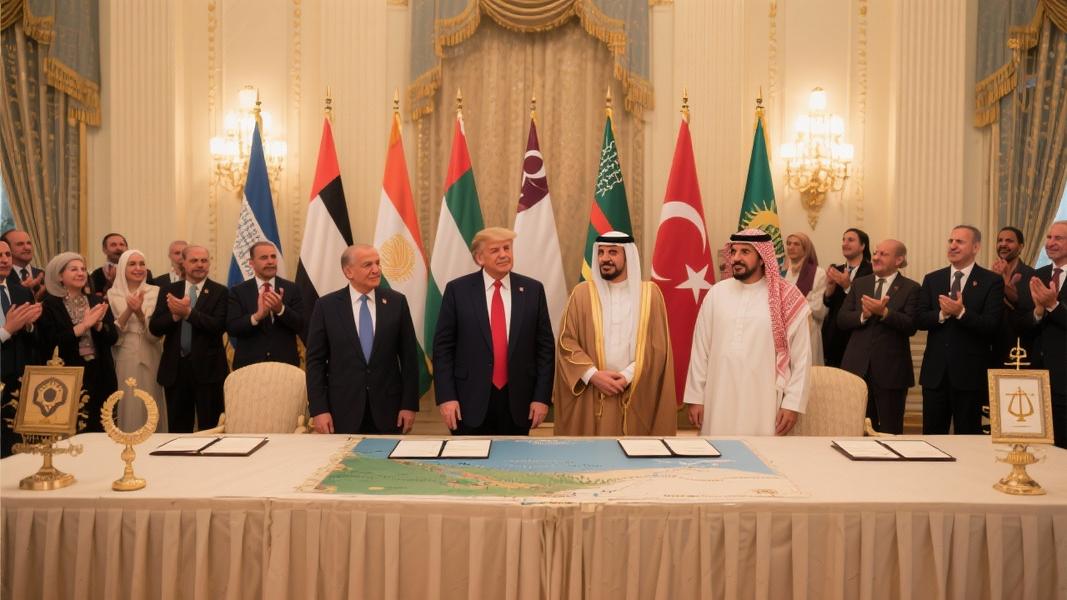
U.S. President Donald Trump unveiled what he’s calling the “Trump Peace Agreement,” a sweeping new ceasefire deal aimed at ending hostilities in Gaza while securing the release of all hostages held by Hamas.
The announcement came during a high-profile summit in Egypt’s Sharm el-Sheikh, where leaders from Qatar, Türkiye, and Egypt joined Trump to endorse what participants are describing as a potentially historic breakthrough for a region long plagued by cycles of violence.
Immediate Release of Hostages
In his address, Trump emphasized that the agreement’s first priority would be the return of captives. “If Hamas accepts the deal, all hostages, both living and deceased, would be released almost immediately,” he said, according to details outlined in the agreement framework.
The deal emerges after more than two years of devastating conflict that has claimed thousands of lives and left much of Gaza in ruins. Regional mediators have been working behind the scenes for months to broker terms acceptable to both sides.
What makes this attempt different? According to those present, it’s the unprecedented level of buy-in from key regional players who have often been at odds over previous peace initiatives.
Regional Consensus
The summit produced a formal declaration, signed by all participating nations, that states: “We, the undersigned, welcome the truly historic commitment and implementation by all parties to the Trump Peace Agreement, ending more than two years of profound suffering and loss — opening a new chapter for the region defined by hope, security, and a shared vision for peace and prosperity.”
Trump specifically praised the mediation efforts of leaders from Qatar, Türkiye, and Egypt, whose involvement has been crucial in bringing Hamas to consider the terms. The agreement reportedly contains provisions addressing security concerns, humanitarian aid delivery, and governance structures for Gaza.
Skeptics remain, though. Previous ceasefire attempts have collapsed within days or weeks, and deep mistrust exists between all parties involved in the conflict.
Beyond Ceasefire: A Vision for Lasting Peace
The so-called “Trump Declaration” goes beyond immediate hostilities, attempting to establish principles for long-term stability in the region. “We are united in our determination to dismantle extremism and radicalization in all its forms. No society can flourish when violence and racism is normalized, or when radical ideologies threaten the fabric of civil life,” the document proclaims.
This broader vision emphasizes mutual respect and cooperation between Israelis and Palestinians, a departure from the zero-sum approach that has characterized much of the conflict’s history.
“The principles outlined today aren’t just about stopping the fighting,” said one diplomat present who requested anonymity to speak freely. “They’re about building something sustainable that addresses the root causes that keep dragging us back to war.”
Still, implementation remains the greatest challenge. Previous agreements have faltered during the transition from paper to practice, with each side accusing the other of violations.
Path Forward
The agreement reportedly includes a phased approach, with initial steps focused on immediate humanitarian concerns and hostage releases, followed by more complex political arrangements.
For Gaza’s civilians, exhausted by war and deprivation, the prospect of peace carries both hope and wariness. Many have seen too many failed initiatives to embrace optimism without reservation.
Whether this agreement succeeds where others have failed may depend less on the words on paper than on the political will of leaders on all sides to weather the inevitable challenges of implementation — and the ability of regional powers to maintain pressure when complications arise.
As one seasoned Middle East observer noted after reviewing the declaration, “Peace isn’t an event, it’s a process. This might be a promising start, but the hardest work begins the day after everyone signs.”
