
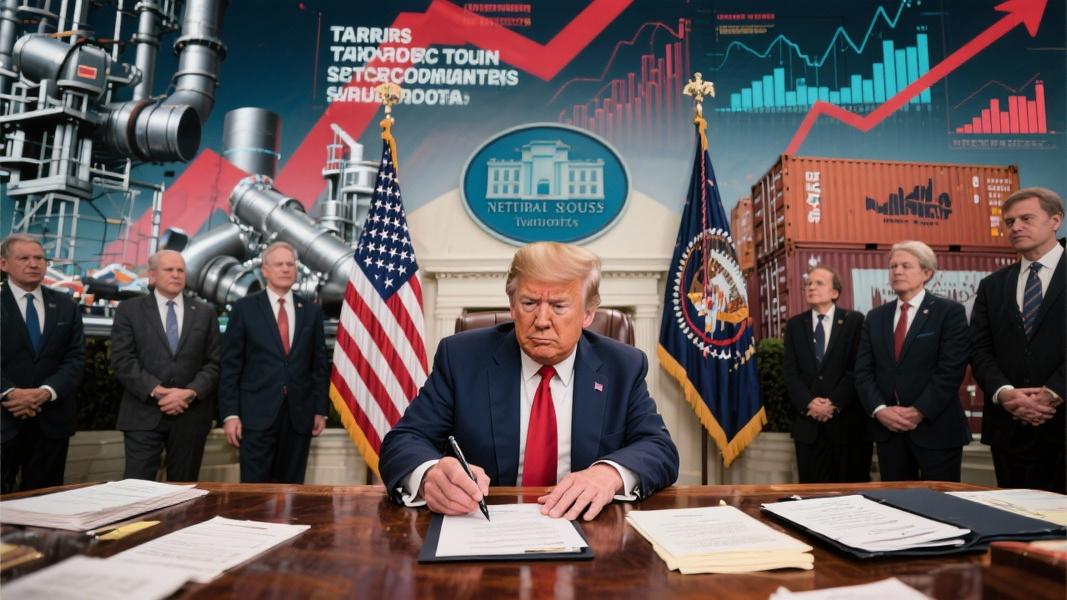
President Trump has dramatically reshuffled America’s global tariff policy, signing a sweeping Executive Order on September 5 that modifies his earlier trade actions while establishing a framework for new international deals. The move represents the latest chapter in what administration officials are calling an “America First” approach to fixing persistent trade deficits.
The Executive Order amends the reciprocal tariffs first announced on April 2, which the administration declared necessary to counter a “national emergency posed by our large and persistent trade deficit.” These deficits, according to White House statements, stem from “the absence of reciprocity in our trade relationships and other harmful policies perpetuated by other countries.”
What’s Changing?
The modifications create a complex reshuffling of which goods face tariffs. Bullion-related articles and certain critical minerals will no longer face reciprocal tariffs, nor will pharmaceutical products currently under pending Section 232 investigations. However, aluminum hydroxide, resin, and silicone products previously exempt will now be subject to the tariffs when the changes take effect on September 8, the White House confirmed.
Perhaps more significant is the establishment of what’s being called the “Potential Tariff Adjustments for Aligned Partners” (PTAAP) Annex — essentially a carrot-and-stick approach listing products that could receive more favorable Most-Favored-Nation tariff treatment if countries strike deals with the United States. These include aircraft and parts, certain generic pharmaceuticals, natural resources not readily available in the U.S., and agricultural products that America doesn’t produce in sufficient quantities.
“To earn a reduction of reciprocal tariffs for some or all of the products listed in the PTAAP Annex, a trading partner must conclude a deal with the United States that helps mitigate the national emergency relating to the trade deficit,” the administration explained. Implementation authority has been delegated to senior officials including the Secretary of Commerce and U.S. Trade Representative.
Country-Specific Tariffs
The Trump administration hasn’t limited its trade actions to general reciprocal tariffs. The White House has also imposed country-specific penalties: a 20% tariff on China targeting synthetic opioid supply chains, a 25% tariff on Mexico and 35% on Canada related to illicit drug flows across U.S. borders, a 40% tariff on Brazil, and a 25% tariff on India for purchasing Russian oil.
These come in addition to Section 232 tariffs on automotive products, copper, steel, and aluminum — all justified on national security grounds. Administration officials maintain these actions “protect national security, strengthen supply chains, and support American workers and industries.”
But the legal foundation for these tariffs faces serious challenges. The administration is currently engaged in a Supreme Court case regarding presidential authority to impose tariffs under the International Emergency Economic Powers Act. U.S. Solicitor General D. John Sauer has urged the justices to expedite review of a ruling by the U.S. Court of Appeals for the Federal Circuit, stating that “the stakes in this case could not be higher.”
Early Results and Trade Deals
The White House claims its aggressive tariff strategy is already paying dividends. Administration officials point to increased domestic investments and manufacturing reshoring as evidence the approach is working. Several major trade deals have either been finalized or are in progress.
The European Union has reportedly agreed to purchase $750 billion in U.S. energy and make new investments of $600 billion in the United States by 2028, while accepting a 15% tariff rate and charging American companies zero, according to White House statements. Similar negotiations are underway with Japan, the UK, Indonesia, the Philippines, South Korea, and Vietnam.
Critics, however, remain skeptical about both the legality and economic wisdom of the tariff-heavy approach. Many economists warn that tariffs function as taxes on American consumers and businesses, potentially raising prices during an already challenging economic period.
Still, the administration appears undeterred in its belief that these measures will ultimately benefit Americans. “By taking further action today, President Trump is ensuring America’s trade policies benefit the American people, strengthen national security, and promote economic fairness,” the White House asserted.
As implementation begins next week, the true test of this evolving tariff strategy — and the pending Supreme Court decision on its legal underpinnings — will determine whether Trump’s vision of reciprocal trade becomes America’s new economic reality or faces insurmountable legal and practical obstacles.
